
Will Google Audio shake up radio advertising?

Steve Rubel points to a ZDNet report on Google’s plan for a product “…that dynamically generates and changes a terrestrial radio commercial based on demographics and news/conditions in the local market. According to those who have seen the demo, if it’s really hot in one area, McDonalds can switch from their regular burger ad to one that touts their cool drinks and frozen treats. In addition, while most advertising campaigns require a $20,000 spend, the new Google solution would require a mere $200 minimum.”

I sure would like to see that demo.

And I’d love to know what Chris Anderson thinks of Google’s plans to sell radio advertising. In his book, The Long Tail, Anderson demonstrates a clear understanding of how advertising works:

“The traditional advertising market is a classic, hit-centric industry where high cost enforce a focus on the biggest sellers and buyers. The way it works is that an advertiser, say General Motors, has a marketing budget. GM commissions an advertising firm to create some ads and then a media buyer to place those ads in television, radio, and print and online.

Meanwhile on the other side, those ad-driven media have their own ad sales forces. they pitch the advertisers and their media buyers on the virtues of their advertising vehicles. If all goes well, millions of dollars change hands. All of it is labor-intensive and made even more costly by the expensive schmoozing that’s required in businesses where a lack of trusted performances metrics makes salesmanship and personal relationships key to winning business.

These days salespeople don’t just twist arms, they also serve as advertising consultants, informing advertisers about the most effective ways to use a given medium or brainstorming creative new approaches to getting the advertisers’ message out. That works well enough, but because it’s expensive, it imposes a subtle cost: a focus on just the largest and most lucrative of potential advertisers.”

Today, there are thousands of small Google advertisers who had never advertised anywhere before. Because of the self-service model, the measurable performance, the low cost of entry, and the ability to constantly tweak and improve the ads, advertisers are flocking to this new marketplace.”

It’s going to be interesting (Read: scary as hell) to see if Google can/will fundamentally change the way radio advertising is bought and sold.
YouTube and politics

“If any teenager can put up a video for or against a candidate, and persuade other people to watch that video, the center of gravity could shift to masses of people with camcorders and passable computer skills. And if people increasingly distrust the mainstream media, they might be more receptive to messages created by ordinary folks.” [Washington Post]

Dan Shelley headed for Big Apple

My old pal Dan Shelley is headed for New York to become the Executive Editor of Digital Media for WCBS-TV and WCBSTV.com. Yesterday was his last day at WTMJ in Milwaukee where he has been news director since 1995. Before that Dan was ND at KTTS in Springfield. I interviewed Dan in May, 2005, shortly after he was elected chairman of RTNDA, and he talked about journalism in a digital age. I’m trying to get a follow-up interview. Stay tuned.

Scott Adams: Flag burning

“It seems to me that the great thing about the flag is that it symbolizes something inherently indestructible: the concept of freedom. You can burn the flag as many times as you want and the concept of freedom is not only still there – it’s stronger. I like that about my flag. I would go so far as to say it’s my flag’s best feature.”

Heading for Destin

We saddle up and head for Destin tomorrow for a week in the sun with friends and family. (Thanks to Vince and Mike with the JCPD SWAT Team for sitting with the dogs.) Not sure what the wifi situation will be at Amberjack Landing but it won’t hurt me (much) to be off the grid for a few days. I plan to spend some of the time dancing the with Mac Book.

Mr. Smith Goes to Washington

Long-time readers might recall I’m fond of Frank Capra’s Mr. Smith Goes to Washington. It makes me nostalgic for a time and a government that probably never existed. Usually leaves me depressed because it reminds me how venal our real-life congressmen are. I’ve posted clips from the movie going back years and decided to put them all in one post. Just watch the movie.

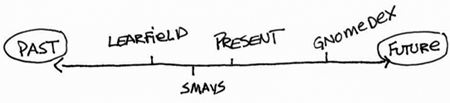
Five minutes ahead, five years behind

Every year I come back from Gnomedex with a sense of perspective. A better understanding of where I am on the technology continuum (for lack of a better term).

Future: That space way out on the edge of what we already know about and what the smart kids at Google and Amazon and eBay et al. are dreaming up.

Present: This is what I think of as “state of the art.” People and companies in this Present have a good grasp of all the current technologies and tools and are using them every day. Everybody fully in the Present has a clue and is standing on tiptoe, peering into the mists of the Future.

Past:
Where we’ve been. Valuable only in terms of how it helps us understand our place in the Present and the Future.

There were some very bright people at this year’s Gnomedex (and a few of us got in because we had $500) and as I listened to the discussions, I began seeing the image above in my head.

Learfield –the company I work for– is very successful. We are primarily a marketing and sales company with strong ties to what is frequently referrred to these days as “old media” (Radio and TV). Like all companies, we use the Internet extensively and we’re searching for ways to use it more effectively. But we’re not in the Present I described above. How far back up the road are we? I’m not sure. Perhaps we’re like those NASCAR drivers that get in behind the leaders and draft along until we see an opening.

And I’m only about five minutes ahead because this is all I think and read about. And even that small gap is narrowing.

Attending Gnomedex is like cresting a hill and –for just a few minutes– I can see some of the smart kids way off on the horizon, running toward the future. I won’t catch them, but it’s nice to get a glimpse every now and then.

The Long Tail (Book)

If you loved Chris Anderson’s Wired article (Octoboer, 2004), The Long Tail… you will love his book (same name). I’m just a couple of chapters in but finding “hmmm” nuggets on every page.

Most of the top fifty best-selling albums of all time were recorded in the seventies and eighties (the Eagles, Michael Jackson), and none of them were made in the past five years.

Anderson provides a deeper understanding of why Amazon and Netflix, et al. are so popular. This might be a two-highlighter book.

Mac on the road

I can’t remember who made the first “portable” computer I owned but the bastard must have weighed 15 pounds. Connecting to the web wasn’t an issue in those days because it didn’t exist (in any way that mattered to me). I can’t even remember what I did with the laptop on the road.

This is my first outing with a Mac and I couldn’t be happier. The hotel charged me $10 a day for cable access but I just plugged it in and was up and running. Wifi was very slow at the conference but the Mac found the signal with no fiddling or port futzing.

I’m posting this from the Seattle airport where $8 buys 24 hours of really fast net access. Nobody needs 24 hours but what a great way to pass the time (or do bidness). And, again, so easy. This is the way mobile computing was meant to be.

Gnomedex: Day Two

Heading out for Day Two of the annual geek-fest. Roger is on his way back to JC. Wish you could have been with us last night when he got his first explanation of Second Life (“They’re not talking about real islands, are they?”). If you’re remotely interested in following Gnomedex, there is no shortage of blog posts and this guy has a nice flickr set. And here’s a good piece on John Edwards’ keynote, which was mostly Q&A. I was skeptical about having a pol speaking but I kind of enjoyed the session.