
William Gibson Interview

Excerpts from interview with William Gibson in the Paris Review

INTERVIEWER: Do you take notes?
GIBSON: I take the position that if I can forget it, it couldn’t have been very good.

“Naps are essential to my process. Not dreams, but that state adjacent to sleep, the mind on waking.”

“It’s harder to imagine the past that went away than it is to imagine the future. What we were prior to our latest batch of technology is, in a way, unknowable. It would be harder to accurately imagine what New York City was like the day before the advent of broadcast television than to imagine what it will be like after life-size broadcast holography comes online. But actually the New York without the television is more mysterious, because we’ve already been there and nobody paid any attention. That world is gone.”

“My great-grandfather was born into a world where there was no recorded music. It’s very, very difficult to conceive of a world in which there is no possibility of audio recording at all. Some people were extremely upset by the first Edison recordings. It nauseated them, terrified them. It sounded like the devil, they said, this evil unnatural technology that offered the potential of hearing the dead speak. We don’t think about that when we’re driving somewhere and turn on the radio. We take it for granted.”

“We know that something happened then. We know that broadcast television did something—did everything—to us, and that now we aren’t the same, though broadcast television, in that sense, is already almost over. I can remember seeing the emergence of broadcast television, but I can’t tell what it did to us because I became that which watched broadcast television.

“In Neuromancer, the whole range of social possibility when they meet is, Shall we have sex, or shall I kill you? Or you know, Let’s go rob a Chinese corporation—cool!”

“If you’re visiting the future, you really want to have a few of the “shit, could they do that?” moments.”

“In Neuromancer, the war starts, they lose a few cities, then it stops when multinational corporations essentially take the United States apart so that can never happen again. There’s deliberately no textual evidence that the United States exists as a political entity in Neuromancer. On the evidence of the text America seems to be a sort of federation of city-states connected to a military-industrial complex that may not have any government controlling it.”

“The Bridge is a fable about counterculture, the kind of counterculture that may no longer be possible. There are no backwaters where things can breed—our connectivity is so high and so global that there are no more Seattles and no more Haight-Ashburys. We’ve arrived at a level of commodification that may have negated the concept of counterculture.”

“Social change is driven primarily by emergent technologies, and probably always has been. No one legislates techno­logies into emergence—it actually seems to be quite a random thing.”

“It looks to me as though that prosthetic-memory project is going to be what we are about, as a species, because our prosthetic memory now actually stands a pretty good chance of surviving humanity. We could conceivably go extinct and our creations would live on. One day, in the sort of science-fiction novel I’m unlikely ever to write, intelligent aliens might encounter something descended from our creations. That something would introduce itself by saying, Hey, we wish our human ancestors could have been around to meet you guys because they were totally fascinated by this moment, but at least we’ve got this PowerPoint we’d like to show you about them. They don’t look anything like us, but that is where we came from, and they were actually made out of meat, as weird as that seems.”
Kevin Kelly: Found Quotes

My thanks to Kevin Kelly for finding and sharing the following quotes:

“The core function of memory is to imagine the future. Memory is not designed to perfectly replay past events; it is to flexibly construct future scenarios. “– Tali Sharot, The Optimism Bias, Time, June 6, 2011

“It is said that we are all three different people: the person we think we are (the one we have invented), the person other people think we are (the impression we make) and the person we think other people think we are (the one we fret about).” — Stephen Bayley, The Gentle Art of Selling Yourself, March 4, 2007

“In attempting to construct such machines we should not be irreverently usurping His power of creating souls, any more than we are in the procreation of children. Rather we are, in either case, instruments of His will providing mansions for the souls that He creates.” — Alan Turing, Computing Machinery and Intelligence, 1950, p. 444.

“Is it a fact – or have I dreamt it – that, by means of electricity, the world of matter has become a great nerve, vibrating thousands of miles in a breathless point of time? Rather, the round globe is a vast head, a brain, instinct with intelligence!” – Nathanial Hawthorne, The House of the Seven Gables. Chapter 17.

What did we do before computers?

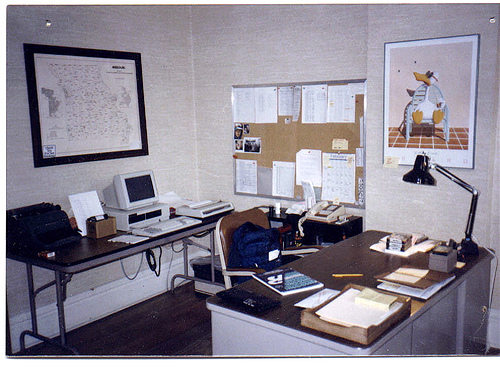
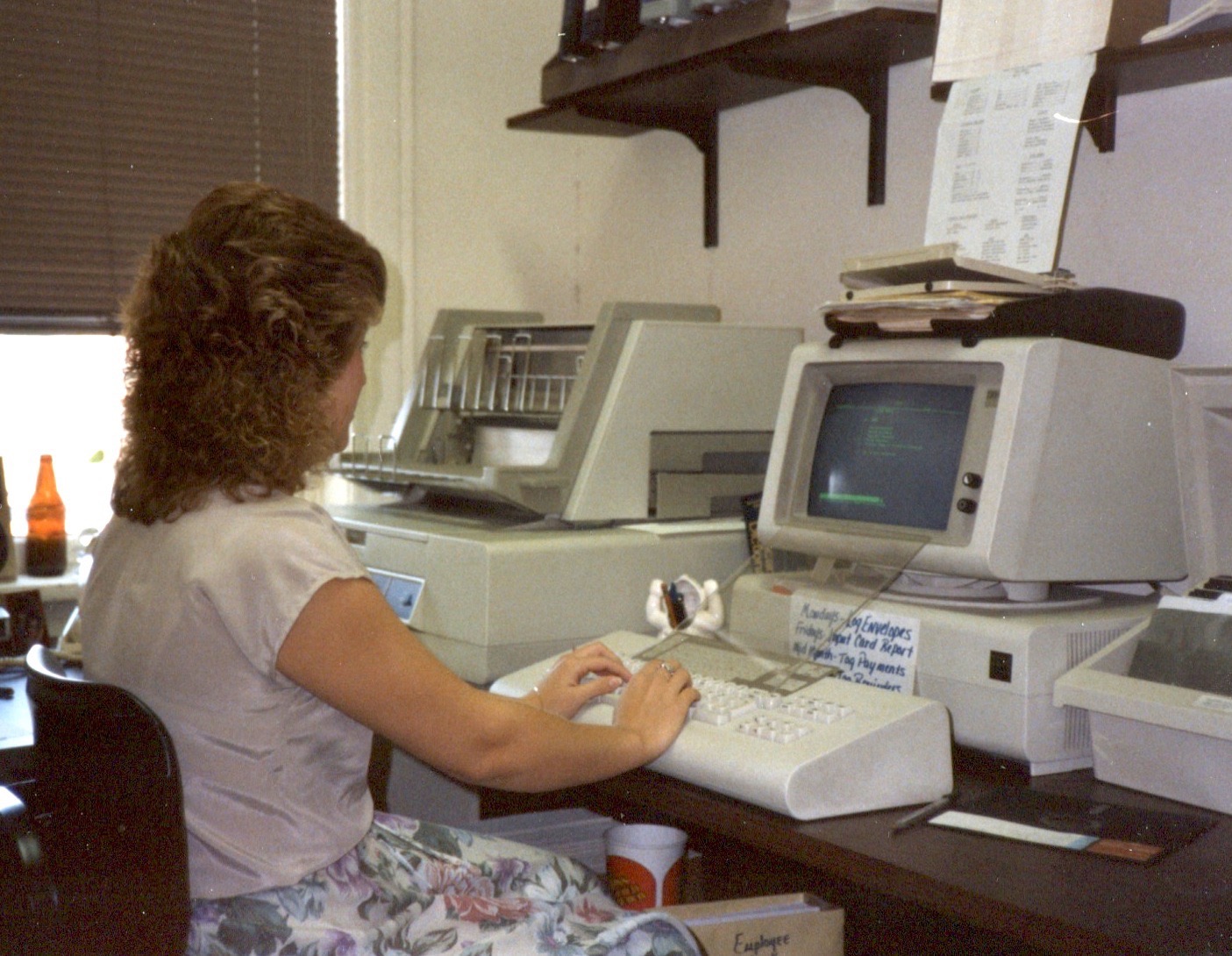
It’s a question I silently ask myself from time to time, so I thought I’d try to reconstruct how I (and others) did my job when I first came to Learfield in 1984. (This photo was taken in 1985 and I’m including it with this post as a memory aid. Annotated version.)

It might be easier to to start with what we didn’t have. I’m going to say no computers even though there was a Lisa II (?) running VisiCalc. No fax machine. No mobile phones.

The bulk of my job was dealing with affiliate radio stations and there was only three ways to do that:

1. Call them on the phone
2. Send them a letter in the mail
3. Get in the car and go see them in person

Each week we would send stations a “log” showing which commercials would be airing in each of the news or farm programs we sent them via satellite. One of the secretaries had drawn a table (6 columns for M-Sa and 13 rows for the number of shows) using a ruler. This was copied (we had a copier) each week and the blank table was rolled into an IMB Selectric typewriter and the names of the sponsors typed in.

This had to be completed by Wednesday of each week in order to get them mailed and to the stations in time for their “traffic” person to insert those commercials into THEIR log for the coming week. And delay and the system fell apart.

The photo above reminds me I used a manual typewriter often enough to keep it close. The computer in the photos is a Zenith and I was the only person in the company with his own personal computer.

We also had a big IBM Displaywriter that allowed us to do mail-merge documents. Amazing tech for the time.

Next to my phone is a Rolodex with all of my contacts, each typed on the big Royal but continuously updated with scratch-throughs and margin notes. If you got fired, you wanted to have a copy of your Rolodex.

If –god forbid– we needed to get information to every network affiliate “fast,” someone had to call each station, one at at time.

One of the tools I relied upon most was my big map. You can’t see them but there is a pin showing the location of each radio station on the network. It was a thrill to add a new pin and agony to remove one.

Long before Google Docs, there was the bulletin board for all the important lists. (this was not portable)

Years later we got our first fax machines, even though most of our stations didn’t have them. We knew they would. Someone stood at the machine and keyed in the name and phone number of every radio station (or advertiser). When you wanted to blast a fax out to a “list,” you fed the document in and it called each number, transmitted the facsimile; printed a “receipt” and then called the next number on the list. It was wonderful. We didn’t have to wait 3 or 4 days for the USPS.

And it got better. As we got more computers and modems, programs like WinFax could do the job of a fax machine but with far less effort and with much greater speed. We could keep a station’s fax machine humming all day and all night, burning up expensive rolls of thermal paper. The term “spam” was years in the future.

Now we post information to our websites and stations download at their leisure. We communicate with them on Facebook and Twitter and all the rest. Email is instantaneous.

Will it get faster/better/easier still? Hard to imagine how but I assume it will

Apple taking over mobile?

The first iOS gadget shipped in 2007 and just a whole bunch of folks scoffed at the notion anyone would pay $400 for a mobile phone. What’s happened since then?

  • Nokia’s smartphone handstet market share dropped from 24% to 16% in one year.
  • 97% of all tablet traffic in the United States comes from iPads. The number is 100% in Japan and 99% in the UK. (The global average is 89%.)
  • last year Google earned about $102 million from apps sales, while Apple raked in $1.7 billion.
  • Apple has ordered two manufacturers to build enough iPhone 5 handsets to sell 15 million in the first month of sales (August or September).
  • 40% of all smartphone buyers in Europe say they intend to buy an iPhone next time they buy a phone.
  • There are 910 million mobile phone subscribers in China (where the iPhone is very popular)
  • Apple has sold 25 million iPads to date and one analyst believes Apple will sell a billion of them.