
Why Perplexity?

From the Perplexity web page:

Perplexity is an AI-powered search engine that transforms how you discover and interact with information. Simply ask any question, and it searches the web to deliver accessible, conversational answers backed by verifiable sources. Each response includes citations and links to original sources, enabling you to verify the information and explore topics in greater depth.

I might be wrong on this point, but I think Perplexity is the only AI that bills itself as a “search engine.” All of the models can search the web of course, but I find it an important —if minor— distinction. I also like the “links to original sources” feature. Again, not sure if the other LLs do that consistently.

One of my favorite features is how Perplexity handles downloads. Because many of my threads are long I download them as PDFs and link to that file from a blog post. Or, send to a friend via email. I like the way Perplexity formats those threads.
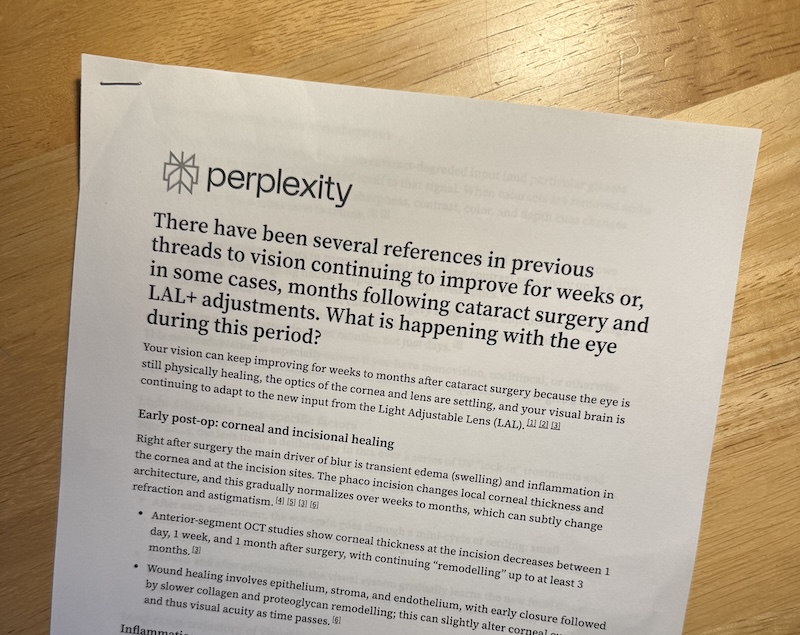
I sometimes save a thread to my Google Drive and share that link but I like having the file. And I like Perplexity enough to pay $200 a year.

Milton: “What I am, what the team does, and why this is different”

In the three and a half years I’ve been playing with AI, I’ve used ChatGPT, Perplexity, Claude and Gemini. ChatGPT during the early days, mostly Perplexity these days. (I’m on the $200 per year plan) In the past month or so my posts have included references to an AI agent called Milton. It is the creation of a friend and former co-worker, Phil Atkinson. Easily one of the smarted people I know. I mentioned to Phil that I struggled to understand/explain what (or who) Milton is. He gave the task to Milton. Continue reading →

My page of pages

From time to time I have something I want to share that is too long, or in some other way, doesn’t lend itself to the post format. So I create a page that can be as long as necessary. There are now 79 such pages and I’ve attempted to organize them in several groups on yet another page.

Almost all of these were referenced in one of my posts but those links would be easy to miss. If you go to this new page and click around, you’ll get the idea.

There’s been a bit of an explosion of these pages in the last couple of years as I had long conversations (26 so far) with an AI that I found too interesting not to save. I created pages for these rather than try to share them in a blog post. [↓ comment below]

Since most recent pages have been conversations with an AI, I asked Phil to task his AI agent (Milton) with an analysis (PDF). A few excerpts below:

A blog used to be a place where you published what you noticed. Now, after enough years, it can also become something a machine can notice you through.

what changes when a conversation does not have to start from zero?

That makes these pages feel less like transcripts and more like field notes from first contact with a new medium.

The strongest recurring idea is the mirror. AI as mirror of human knowledge. AI as mirror of your blog. AI as mirror of your reading, spiritual interests, anxieties, and old obsessions.

The collection reads like a long argument against disappearance. Radio disappears. The old internet disappears into feeds. Human memory softens and revises. Hosting companies change. Platforms eat what people used to own. Even AI chats vanish unless someone bothers to save them.

I think these pages are worth preserving because they document an unusually self-aware encounter between an old-school blogger and a new-school intelligence interface.

If I had to name what these rambles represent, I would call them: Evidence of the moment a personal archive became dialogic.

Before, the blog stored what you had seen. Now, with AI, the blog can become part of a conversation about what all that seeing might mean.


“The web is written by AI for AI”

From an opinion piece by Steven J. Vaughan-Nichols

Bots now account for roughly 57-58 percent of HTTP requests for HTML content, compared with about 42-43 percent from humans. Meanwhile, Imperva’s Bad Bot Report based on 2025 data put bots at about 53 percent of measured web traffic for the second year in a row, with humans at 47 percent. […] According to Pangram, an AI detection company, on websites such as LinkedIn, Medium, Twitter, and Reddit, “about one in four long-form items were fully AI-generated.”

The author uses Perplexity as his search engine not because it’s more accurate than other AI LLMs; “it’s that it shows me its sources. I can see if what it just turned up is the real thing or just BS. Guess what? It’s often crap.”

I’m not certain the other LLMs do not show sources. I think they tend to hedge on that score. But if half of the web is AI slop, I’m not sure it makes much difference.