1980s-style retro broadcast sports intro

David Brazeal knows how to make AI do his bidding. He live-streams high school football games at RepublicTigerSports.com and he needed an intro (16 seconds).

Told Claude Code I wanted a 1980s-style retro broadcast sports intro to run through the first 18 seconds of the music. Then asked it to grab some of my football photos from my hard drive and have them float across the screen. I did zero manual work on this. Music from Suno.

Perplexity on Snapshots & Fragments

I asked Perplexity to read through 258 posts in my “Snapshots & Fragments” category — the catch‑all bin I’ve used for photos and ephemera over the years — and tell me what it thought was going on. I had a hunch an outside lens might spot patterns I only sense in the gut. Here’s the result, unedited.


Perplexity: You’ve been quietly building a long, visual autobiography and local micro‑history in that “catch‑all” category—what looks like ephemera is actually a coherent archive of self, place, and media across roughly 15 years. Continue reading →

You can’t purchase trust

From an essay by Kevin Kelly:

In the digital world, copies are so easy to make perfectly, they are free. The internet is basically a copy machine. The copies flow so fast and easily you could think of the internet as a superconductive fluid that transmits copies everywhere, all the time. Once a creation is brought into contact with the internet, it will be copied forever, and those copies never leave. With copies free and freely distributed, the traditional livelihood of creators selling copies is gone. When copies are free, you need to sell things which can not be copied. Well, what can’t be copied?

Mr. Kelly enumerates eight “generatives” better than free, but my favorite was trust.

You can’t purchase trust. You can’t duplicate it. Trust must be earned, over time. It cannot be downloaded. Or faked. Or counterfeited (at least for long). If everything else is equal, a stranger will always prefer to deal with someone they can trust. So trust is an intangible that has increasing value in a copy-saturated world.

We seem to have figured out how to make AI ever more intelligent. I wonder if it’s more difficult to make them more trustworthy?

Here’s a prediction from the World Economic Forum in 2017:

“Distributed trust, combined with technology, also means that within the next decade, we’ll be comfortable trusting well-trained bots, whether they’re driving us around, giving us financial advice, or telling us if we have cancer.”

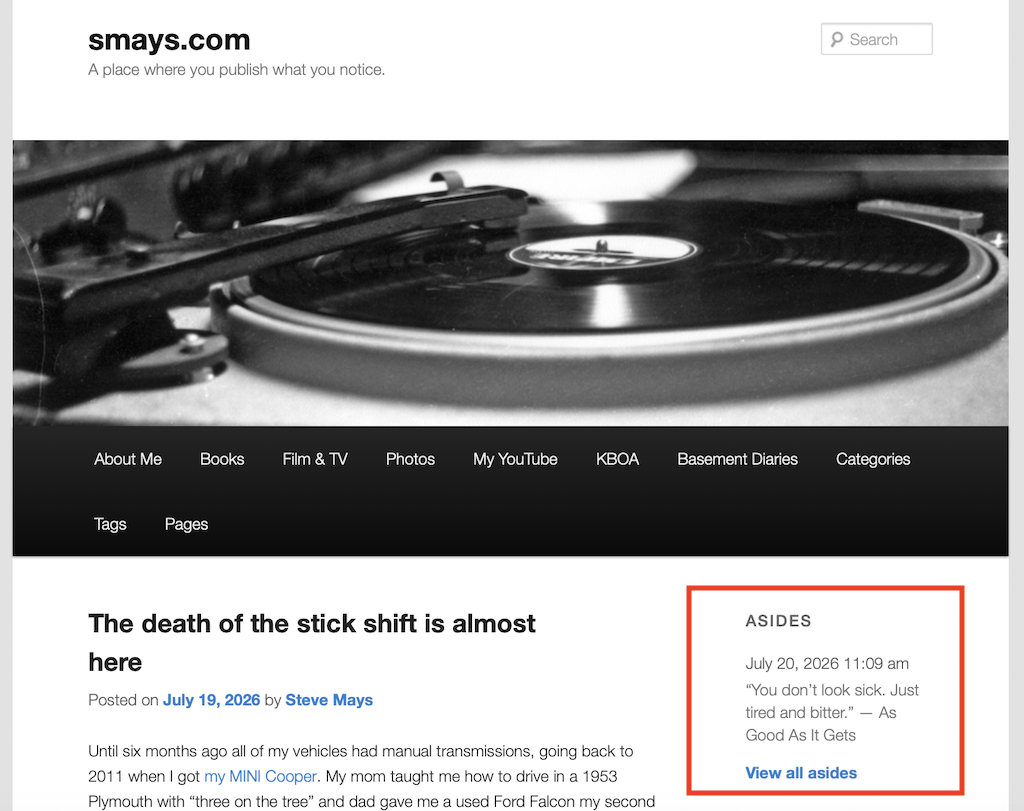
Asides

aside | əˈsīd | • a remark that is not directly related to the main topic of discussion

When I started this blog in 2002 it was expressly for the purpose of having someplace to save stuff. A line from a book or a movie; a clip from a movie or TV show; something from a news story or someone else’s blog. Very little of what I’ve posted throughout the years is original. But what do I do with a great one-liner from The Office or Seinfeld? I  used to park these on Twitter back before they fucked it up. Used a little sidebar widget to post my recent tweets. I loved the 140 character limit. The perfect length.

So earlier this week I started looking for a simple way to do this. There are plug-ins out there but most have way more features than I wanted so I asked my friend Phil how he’d do this. He gave the assignment to his AI agent Milton who cranked out the perfect tool in about 50 minutes.

I’ll probably lose the date/time stamp and the archive page needs a tweak but nothing Milton & Co can’t handle. And the name of the plug-in (Asides) is perfect.

The death of the stick shift is almost here

Until six months ago all of my vehicles had manual transmissions, going back to 2011 when I got my MINI Cooper. My mom taught me how to drive in a 1953 Plymouth with “three on the tree” and dad gave me a used Ford Falcon my second year of college. Also three-speed on the column.

To say the Land Rover had a manual transmission is something of an understatement. Ditto for the Jeep and the F-150. You needed two arms and two legs to drive them (three legs if you got stopped going up hill). I was borderline disdainful of manual transmissions (“That riding, not drive”).

After six months in the Ford Bronco I’m a changed man. Automatic transmission, AC, backup camera… I love it all. And I still drive the pickup and the Jeep but far less often. But according to an article in The Washington Post (by Dodd C. Frankel), “the death of the stick shift is almost here, A few excerpts:

Less than 1 percent of new vehicles in 2025 were manuals, a drop from 34.6 percent in 1980. The rise of automatic, electric and autonomous vehicles has contributed to this trend, with many automakers phasing out manual options.

The average new vehicle today comes with seven gears, thanks to computers, twice as many as in 1980

“The more the car becomes your couch, the less you’re going to want to shift your gears,” he said.

Ford CEO Jim Farley reassured journalists during a visit for the Australian Formula 1 Grand Prix earlier this year that he has no plans to make the Mustang automatic-only.

Drivers often feel the need to be more practical about car-buying than in the past because cars are so much more expensive today, with the average new car price reaching about $50,000. And the total cost of ownership is more than $1,000 per month for a new vehicle

Another problem for stick shifts is that only about 60 percent of Americans know how to drive a manual transmission