
Non-American health care

Good old American health care is all I’ve ever known. I remember when the family doctor made house calls. I think I even remember when the insurance company existed to help us (but that could have just been a dream).

We can’t really call what’s happening a national “debate” on health care — more of a national shriek– but there are those who think we have the best health care in the world. Since I haven’t been a lot of places in the world, I decided to get the opinion of some of my over-seas pen pals.

Keith Povall lives in or near Birmingham, UK and has recently had more of their national health care than he would have liked. You can read his full assessment in the comments, but here’s an excerpt:

“In modern times, much criticism has been leveled at the NHS because there is a lot of truth in the opinion that it is a monster grown out of control. It is the largest employer in Europe for example and many say / believe that there are too many chiefs and not enough Indians (to coin a phrase). Over the years, governments have thrown billions at it and the monster gobbles up the cash. It is believed governments would like to introduce a private service to replace it, but in the main “the people” love the NHS, something that is there as a safety net for when they need it and whilst you will hear complaints about income tax and stealth taxes, no one complains about their NI contributions.”

Peter is a psychiatric nurse in the Netherlands and –as a health care provider– might be less than objective on this subject. On the other hand, he has first-hand knowledge of his country’s system.

“The insurance companies want to control everything; they even want to control what professionals like me should do or not. The basis of their policy is not what the clients want (those who put money in the big jar) but what the shareholders want. Their goal is not good health care for their members, but profit and big bonus for a couple of hotshots. A very bad development which surely will be changed the moment the issue is hot again and elections are due. As you see we are quite a normal country in this.”

Again, I hope you’ll read Peter’s full email in the comments.

I’m still waiting to hear from a friend in Belgium and will add her thoughts if and when we get them. My thanks to Keith and Peter for taking time to respond to a serious inquiry from me. Something they are rarely called upon to do.
Neal Stephenson on “the people of America”

I love the novels of Neal Stephenson and find that I can read them again and again, always discovering something new and fresh. The excerpt below is from Snow Crash, written in 1976. published in 1984.

“The people of America, who live in the world’s most surprising and terrible country, take comfort in that motto. Follow the loglo outward, to where the growth is enfolded into the valleys and canyons, and you find the land of the refugees. They have fled from the true America, the America of atomic bombs, scalpings, hip-hop, chaos theory, cement overshoes, snake handlers, spree killers, space walks, buffalo jumps, drive-bys, cruise missiles, Sherman’s March, gridlock, motorcycle gangs and bungee jumping. They have parallel-parked their bimbo boxes in identical computer-designed Burbclave street patterns and secreted themselves in symmetrical sheetrock shitholes with vinyl floors and ill-fitting woodwork and no sidewalks, vast house farms out in the loglo wilderness, a culture medium for a medium culture.”

It means nothing out of context, I suppose, but this is where I put things I want to find again. I don’t think I’ve ever seen Neal Stephenson do an interview but perhaps I just missed them.

A video from the CEO

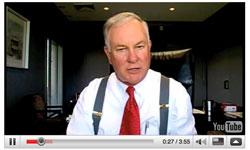
Learfield CEO Clyde Lear started blogging in March of 2006. And he’s been very consistent since then, writing or rewriting every post. This morning he asked me to come to his office to help him add a video to a post he was working on.

clyde-videoHe shot the video by setting his Casio Exilim on the window sill (to get the best light) and ad libbing his post in one take. By the time I got there, he had the file on the desktop of his iMac and just wanted to know best way to trim the front and back. I showed him how to do that in iMovie and then gave him the login to my YouTube account.

You can watch the video on his blog if you’re interested. I think the quality is pretty darned good.

Equally impressive –to me– is Clyde’s use of his blog and –in this instance– video to communicate something to the entire company. This is the next best thing to him walking into every employee’s office and talking to them, one on one. The entire process took maybe 30-40 minutes.

So there are two things at work here. First, our CEO wants to let us know why he does the things he does. He cares that we get it from him “directly.” Second, mastering the tools and skills needed to do this.

Am I making too much of this? Maybe. But had he had someone write (and rewrite) a script that he “delivered” to a crew who gave it to some editors who ran it past some lawyers and PR types… the message would have been a different one.

Cell phone etiquette (interview)

July is Cell Phone Courtesy Month. As with all such months, there’s a list of cell phone no-no’s. There are a lot of lists. As I scanned them I saw that I was guilty of a couple of the more venial sins. I still catch myself talking too loudly and I answer the phone in the middle of a conversation. I’ve chalked these up to still being something of a newbie to the cell phone experience and plan to break these bad habits.

Nathan Waddell is the director of sales for U. S. Cellular in Missouri and a nice PR lady named Susan arranged for me to talk with Nathan about this important topic.

AUDIO: 15 min interview (MP3)

Radio stops with the listener

What do you do when someone sends you a good video, a photo, or a link to an interesting news item? You share it. Maybe with a link on Facebook or Twitter; a blog if that’s your thing; or you simply email it to everyone in your address book. And some of them will do the same. It seems quite natural after 15 years of life on the net.

Now, what do you do when you hear something interesting, amusing or important on the radio? Assuming you’re not recording, your options are limited. You could call a friend, but by the time you reach them the song/interview/comedy bit is likely to be over.

All the good stuff you hear on the radio (or TV) pretty much stops when it reaches the listener. That never bothered me before because… well, where else _could_ it go after reaching me? There WAS no practical way to share it.

The web changed all that. Even the dumbest cat photo goes on and on and on.

Before hitting the record button or opening the mic, we should ask ourselves, “Can anyone link to what I am about to create?”