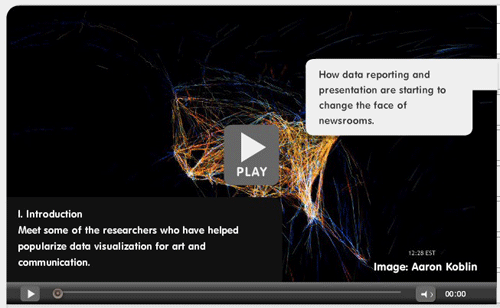
Journalism in the Age of Data

I keep reading how data visualization is the future of journalism but it didn’t sink in very far. This documentary (?) turned on the light bulb in several ways.

I remember (sort of) the first time I inserted some audio into a story that aired on the radio station I worked at. Zowie! How cool is that? Well, better than no sound at all (maybe).

As I watched this, I realized how little understanding is communicated by the sound bite or some TV Ken/Barbie sticking a mic in someone’s face. Real depth, real insight and understanding will happen online (although we’ll soon stop making that distinction if we haven’t already).

I was also struck by the really smart men and women featured. They are not pretty faces. You don’t get on TV unless you look good. I sure hope J-Schools are paying attention to this.

The news organizations (if in fact it turns out to BE news organizations) the bring these skills to the party will win and we’ll all be better informed.

[via Cool Infographics]

Pandora Radio

Top 40 radio was just what it sounds like. The 40 most popular songs played over and over and over. The idea –as I understand it– was people would rather hear the popular songs more frequently than have a bunch of new stuff mixed in.

The little station I worked at had a longer play list. Maybe 100 to 150 songs? It was pretty loose. Nobody got too upset if you mixed in something not in “the box.” But it was pretty easy to get burned out on the most popular songs if you played them every…single…day.

By the time I left in the mid-80s, I’d heard about all the music I needed for a while. And the only easy way to listen to music at the time was… on radio stations with very “tight” playlists. Somebody else was picking my tunes.

It was nearly 15 years before the iPod rekindled my interest in music. I ripped the few CD’s I had and started buying music on iTunes. It was nice.

The idea of “streaming” music didn’t immediately appeal to me. I wanted to “have” the songs. But when Pandora came along a couple of years ago, I gave it a try and was immediately hooked.

Now I start each day at the Coffee Zone (6:30) by popping in the ear buds and firing up one of my “stations” on Pandora. More on those in a moment.

When I hear a song I like, I give it a thumbs up. If I don’t care for the song, thumbs down immediately rejects it. I think you can reject up to 5 songs an hour. If I want to give my station more variety, I can add and artist or a song and Pandora will start mixing in similar music. It isn’t perfect but over time, Pandora gets better and better at playing songs I like.

And I can have as many stations as I want. If I’m feeling funky, for example, I jump over to my Al Greene station.

Pandora keeps a record of every song I vote up or down, including the date and time I did so. You can check this out if your interested. I can also bookmark songs and/or artists and post a link to Twitter or Facebook.

I was surprised by some of my choices. And by the percentage of new music by artists I’d never heard of. And songs I don’t think I’d hear on our local radio stations. And certainly not commercial-free. You can listen to 40 hours of Pandora a month for free. I opted for the paid version (Pandora One) which cost $36/year. Best money I spend.

Apps for the iPhone and iPad, of course.

If this page had ads, you’d ignore them

Robin Wauters takes a look at the results of a new Adweek Media/Harris Interactive survey of about 2,100 U.S. adults. Topic: ads
“over six in ten respondents say they tend to ignore or disregard Internet ads. Among those who ignore online ads, two in five say they ignore banner ads (43 percent) the most, and one in five say they ignore search engine ads (20 percent) the most.”
Ms. Wauters notes Internet ad revenues in the U.S. are at an all-time high. What about other media?
“people who said they ignore ads on other media: television ads (14 percent), radio ads (7 percent) and newspaper ads (6 percent).”
If only 7% ignore radio ads, I’ll put that in the win column. Younger folks are more likely to ignore radio ads, compared to older people.
11% in the 18-34 demo say they ignore radio ads, compared to 6% 55+.
Ms. Wauters concludes her post by concluding all ads have to be better. Much better

Scott Adams: Online voting

“Our current system, which features massive traditional advertising aimed primarily at older voters, would become obsolete. With online voting, the average age of voters would shift dramatically lower. The young are less susceptible to advertising because they use technology such as DVRs and ad-blocking software to avoid ads. And they avoid traditional print media altogether.  When big advertising budgets become less effective, special interests become less powerful because their money can’t help politicians get elected.”

“I started this post by claiming online voting would solve almost every problem in the world. My observation is that our planet doesn’t suffer from a lack of resources, just a lack of competence in managing those resources. Online voting could replace a broken government with one that allocates resources efficiently. And that one change, in time, could stimulate and release the economy to solve almost every problem in the world.”