
This begs the question, “Does my local radio station have programs so compelling I want to record them and listen later?” Let’s hope so. If you have –or plan to– tried DAR, let me know what you think. (via Roger Gardner)
Author Archives: Steve Mays
Future of video conferencing?
Skype, more bandwidth and easier-to-use software is making video conferencing ever more practical. We’re doing it at Learfield, Barb’s firm is using, it’s happening. But we ain’t seen nothin’ yet.
Some students from the MIT Media Lab show off a few features of what’s around the corner.
My favorite is the little timer in the speech bubble that shows how long each person has been talking.
What you see is NOT what you get
A lot of my recent reading has dealt with consciousness and –by extensions– reality. It has completely changed the way I see my world. Literally.
“Your senses are your windows on the world, and you probably think they do a fair job at capturing an accurate depiction of reality. Don’t kid yourself. Sensory perception – especially vision – is a figment of your imagination. “What you’re experiencing is largely the product of what’s inside your head,” says psychologist Ron Rensink at the University of British Columbia in Vancouver, Canada. “It’s informed by what comes in through your eyes, but it’s not directly reflecting it.”
“In conjuring up this “now”, the visual system has to do something even more remarkable: predict the future. Information striking the fovea cannot be relayed instantaneously to conscious perception: first it has to travel down the optic nerve and be processed by the brain. This takes several hundred milliseconds, by which time the world has moved on. And so the brain makes a prediction about what the world will look like about 200 milliseconds into the future, and that is what you see. Without this future projection you would be unable to catch a ball, dodge moving objects or walk around without crashing into things.”
“The problem with attention is that it is a limited resource. For reasons that remain unknown, most people are unable to keep track of more than four or five moving objects at once. That can lead your visual system to be oblivious to things that are staring you in the face.”

My favorite line from this piece: “Essentially we experience the brain’s best guess about what is happening now.”
Is Gen Y changing the workplace?
Generation Y (GenY) is made up of those born between 1981-1999. I hear a few knocks on today’s young people but mostly from older folks with a very different view of… everything. I found the following in a story on a Canadian website and have applied for membership in Gen Y.
Clay Collins, author of The Alternative Productivity Manifesto and Quitting Things and Flakiness: The #1 Productivity Anti-Hack, argues that Gen Y is different than previous generation workers in the following ways:
- Gen Y uses modern tools and technologies, including software that’s easily accessible and free from the Internet;
- Gen Y easily maintains their to-do lists, and priorities by synching with the PDAs and iPODs;
- Gen Y are not workaholics, and understand the relationship between a balanced life and productivity;
- Gen Y are more likely to love their jobs, because they change jobs more frequently, and stay in jobs that match their passions and talents;
- Gen Y has a continuing thirst for learning and personal growth;
- Gen Y wants to have new experiences, try new things, and be creative;
- Gen Y doesn’t stay in jobs they don’t like just to be comfortable and secure.
Understanding Generation Y is important not just for employers. Older workers–that is, anyone over 30–need to know how to adapt to the values and demands of their newest colleagues. Before too long, they’ll be the bosses. via Is Gen Y changing the workplace? Entrepreneur Financial Post.
TwitVid
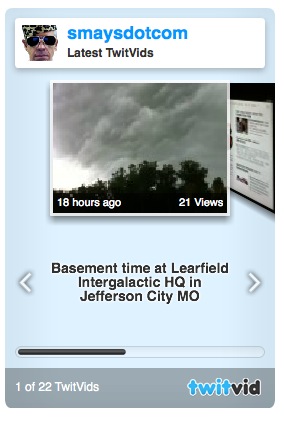 TwitVid is one of the countless apps that spring up around Twitter. I’d used it a time or two and started seeing it show up in tweets immediately after (during?) the tornado that hammered Joplin, MO. People were shooting amazing video with their phones and post directly to Twitter and Facebook via TwitVid.
So I’ve started using it again, mostly for short, update videos. Just a quick “check this out” clip. A bunch of our employees were posting photos and videos to our internal network during a tornado warning.
I’ve added a widget to the sidebar where you can browse my twitvids.