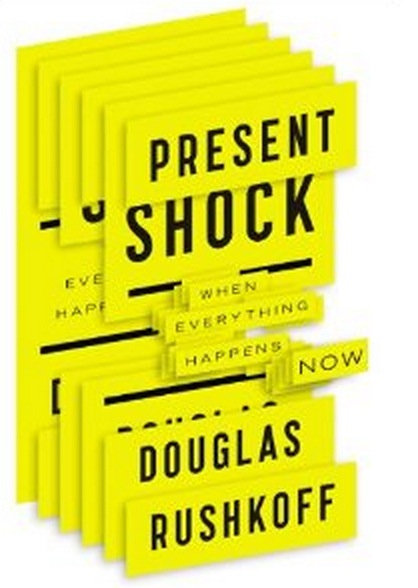
 “We tend to exist in a distracted present, where forces on the periphery are magnified and those immediately before us are ignored.”
“The minute the ‘now’ is apprehended it has already passed. […] The more forcefully we attempt to stop the passage of time the less available we are to the very moment we seek to preserve.”
“Which ‘now’ is important: the now I just lived or the now I’m in right now?”
“Digiphrenia – the way our media and technologies encourage us to be in more than one place at the same time.”
“Not only have our devices outpaced us, they don’t even reflect a here and now that may constitute any legitimate sort of present tense. They are reports from the periphery, of things that happened moments ago. […] By dividing our attention between our digital extensions, we sacrifice our connection to the truer present in which we are living.”
“Humans once lived without any concept of time at all. In this early, hunter-gatherer existence, information was exchanged physically, either orally or with gestures, in person. People lived in an eternal present, without any notion of before or after, much less history or progress. Things just were. […] While they had to worry about where their next meal was coming from, they felt no pressure to succeed or to progress, to achieve or to improve. They had nowhere to go, since the very notion of a future hadn’t yet been invented. This stasis lasted several thousand years.”
“Like a digital file, a spelled word is the same everywhere it goes and does not decay.”
“Where calendars led people to think in terms of history, clocks led people to think in terms of productivity. Only after the proliferation of the clock did the word ‘speed’ (spelled spede) enter the English vocabulary.”
“Digital technology is more like a still-life picture. A sample. It is frozen in time. Sound, on the other hand, is audible only over time. We hear sound as it decays. […] The digital universe is a visual one: people staring silently at screens, where the only sounds in the room are the keys and mouse clicks.”
“While there is tremendous value in group thinking, shared platforms, and networked collaboration, there is also value in a single mind contemplating a problem.”
“We must retrain ourselves to see the reward in the amount of time we get to spend in the reverie of solo contemplation or live engagement with another human being. Whatever is vibrating on the iPhone just isn’t as valuable as the eye contact you are making right now.”
“In the space of one childhood, we can learn what it took humanity many centuries to figure out.”
“Catching up with Twitter is like staying up all night to catch up on live streaming stock quotes from yesterday. The value was in the now — which at this point is really just a then.”
“When everything is rendered instantly accessible via Google and iTunes, the entirety of culture becomes a single layer deep. The journey disappears, and all knowledge is brought into the present tense.”
“Our recorded past competes with our experienced present for dominance over the moment. […] What isn’t coming at us from the past is crashing in at us from the future.”
“Big data companies collect seemingly innocuous data on everyone, such as the frequency of our text messages, the books we’ve bought, the number of rings it takes us co pick up the phone, the number of doors on our cars, the terms we use in our Web searches, in order to create a giant profile. They then compare this profile against those of everyone else. For reasons no one understands, the data may show that people who have two-door cars, answer the phone in three or more rings, and own cats are extremely likely to respond favorably to ads for soup. So these people will Ье shown lots of soup advertisements. The market researchers don’t care about the data points themselves or the logic connecting one behavior to another. They only care care about predicting what a person is statistically likely to do.”
“For the first time, people engaged with products completely divorced from the people who actually made them. Technologies masked not just the labor, but also the time that went into an item’s production. […] This new way of interacting with things defined a new human identity for the very first time — that of the consumer.”
“Consumption makes up about half of all economic activity in America.”
“In a digitally enhanced consumer reality, we not only work to keep up with the latest products and service options, we purchase products and services that serve no purpose other than to help us better keep up. Our iPads and Adroids are nothing like the productivity-computing tools on which they may once have been based but are instead purchasing platforms designed to increase the ease and speed with which we consume.”
“We are so good at making stuff and providing services that we no longer require all of us to do it.”
“It is now usually cheaper to just try something than to sit around and try to figure out whether to try something.” — Joichi Ito
“The individual is flow, and the community is storage. Only the individual can take actions. Only the community can absorb their impact over time.”
“Fractalnoia – Relating one thing to another, even when the relationship is forced or imagined.”
“Ideas don’t generally emerge from individuals, but from groups (liquid networks).” – Social critic Steven Johnson
“In a networked ideascape, the ownership of an idea becomes as quaint and indefensible a notion as copyright or patents. Since ideas are built on the logic of others, there is no way to trace their independent origins. It’s all just access to shared consciousness. Everything is everything.”
“Consumers don’t want to speak with companies through social media; we want to speak with one another. We don’t even think of ourselves as consumers anymore, but as people.”
“As long as people didn’t engage with one another and were instead kept happily competing with one another, their actions, votes, and emotions remained fairly predictable.”
“The human body is a space suit for something that could be stored quite differently.”
“I find myself unable to let go of the sense that human beings are somehow special, and that moment-to-moment human experience contains a certain unquantifiable essence. I still suspect there is something to quirky, too paradoxical, or too interpersonal to be imitated or re-created by machine life.”
Amazon