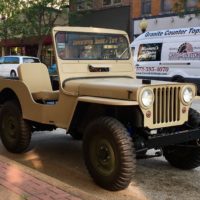
What is the essence of a Jeep?

Perhaps the better question is, do vehicles have an essence.

“the intrinsic nature or indispensable quality of something, especially something abstract, that determines its character.”

I put this question to a handful of people I know who might have given some thought to such a question.

I’ve been watching lots of videos about the history of the Jeep as well restoration projects. Seems there’s as much mystique and passion surrounding the Jeep as Land Rover.

The historical videos started with the initial development during WWII; then the transition to Jeeps made for the agricultural market; and on to the more mainstream civilian models.
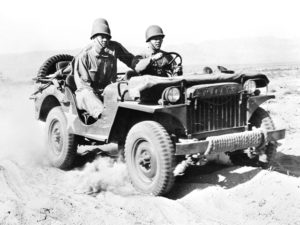
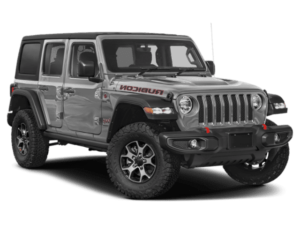
The Jeeps I see on the road (and there seems to be a LOT) bear little resemblance to those early Jeeps. Looks like the name and the grill (maybe) is all that’s left. Which got me wondering… when did these models cease to be a “true Jeep?” If Mitsubishi purchased the brand and putting the Jeep name on one of their models, nobody would consider it a Jeep.

We saw this mindset at work with the Land Rover “Santana.” The forums were full of guys who insisted that is not a “real” Land Rover. I suspect no two Jeep owners could agree on this question. And I don’t particularly care, except from a philosophical standpoint.

If I get any takers on this question, I’ll share them in comments below.
Jeep promotional videos

YouTube: Willys, the “World’s Largest Manufacturer of Utility Vehicles,” presents the “Jeep Family of 4-Wheel Drive Vehicles and Special Equipment,” a circa 1954 black-and-white film promoting Jeeps produced for civilian use. (“One man with a Jeep can do the work of 100 men with shovels”)

Because this video runs a tad over 20 minutes, I’m guessing it ran in theaters before feature films. I recall seeing newsreels like this as a child in the 1950s. Jeeps like mine (CJ2A) were aimed at the agriculture market and this video show one handy attachment after another.

The narrator pronounces Willys: WILL us … rather than WILL eez so I’m confident that is the correct way to say it.

YouTube titles the video below: Autobiography of a Jeep and the narrator is the “voice” of a Jeep during its development and the early years of WWII. The delivery is that Pete Smith Specialty style from the 40s and early 50s (you had to be there). A little corny but some excellent Jeep footage.

YouTube description: “A small company in Pennsylvania, Bantam, invented the Jeep, but the military needed more than Bantam could produce. So they turned to Willys and Ford and had these auto titans build Jeeps. Edsel Ford joins other Ford Motor Company officials as they demonstrate their vehicles for the military.” (this video has no sound)

Okay, one more. 1940 Ford Pilot Model GP-No. 1 Pygmy

Jeeps in the wild

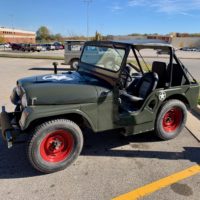
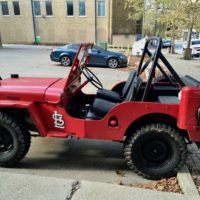
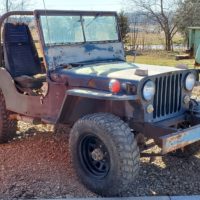
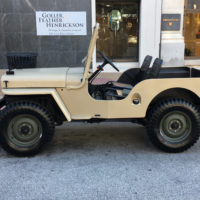
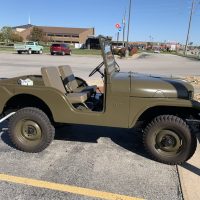
I’ve been collecting these for a while. The last two (sand color) are the same Jeep. The first Jeep on the bottom row was on Paul Bandelier’s lot. Will ask him what happened it and update here.

1940’s Jeeps in Junkyards


“A look at vintage Willys Jeeps hidden away from the world in junkyards and barns across the United States. It’s amazing how much vintage iron out there needs rescuing. The Jeeps in this video range from pre-mass production WWII Jeep such as the 1941 Ford GP, to the standardized Willys MB, and of course post-war Jeeps such as the CJ2A, CJ5, and even a Korean-War era M38. They range from the 1940’s to the 1960’s.”

My friend John Middleton pointed me to a terrific YouTube channel called Turn N Burn. This young man has been restoring Jeeps since he was 17 and I’m finding his videos fascinating. The video below features a 1940’s Willys Jeep that as in a home garage when the place went up in flames and the Jeep burnt to the ground.”

After reviving the fire-surviving CJ2A, they take it to an off-road park for a proper break-in. I’ve yet to drive my new toy but watching these videos makes me think I might be a little more adventurous with the Jeep than I’ve been with the Land Rover.