Sharp-shinned Hawk

Living on 10 wooded acres, we have lots of birds flocking to the four or five feeders we have hanging over our deck. Sometime after I retired, I took over the chore of keeping the feeders filled and have come to love watching the birds.

Yesterday, for the first time, this guy showed up. A Sharp-shinned Hawk (Accipiter striatus). Identification rests on several anatomical markers that distinguish it from its near-twin, the Cooper’s Hawk:

  • Head Shape: It has a “pin-headed” appearance with a rounded crown. It lacks the prominent supraorbital ridge (the “brow bone”) that gives Cooper’s Hawks a stern, angry expression.
  • Tail Structure: The tail is relatively square-tipped with a thin white terminal band. In a Cooper’s Hawk, the tail is typically rounded with a thicker white band.
  • Eye Placement: Centered on the side of the head, contributing to the “bug-eyed” look typical of the species.
  • Legs: Noticeably spindly, “pencil-thin” yellow legs.

Given the barred rufous chest and dark slate-gray back, this is an adult. These are specialized ambush predators, so if you have bird feeders nearby, its presence is purely tactical.

“Why humans cling to stories”

I prompted Perplexity to look for themes or trends in the 70+ posts (going back to 2004) in the Religion category.


1. Religion as human-made stories and systems

You treat religion less as revelation and more as a **human** technology: something people invent, edit, and use to organize behavior, power, and meaning. You’re drawn to writers like Harari, Adams, Hines, Watts, Harris, and Ehrman who frame gods, money, nations, and ideologies as “shared fictions” or “maps” that work pragmatically rather than metaphysically. Your own comments echo that: religion is one example of a larger human habit of myth‑making to hold fragile social orders together.

2. Skepticism of certainty, affection for “I don’t know”

Many posts poke at people who are utterly sure they’ve found the “one true faith” out of thousands of incompatible options. You highlight quotes and essays that argue the only honest stance is some version of “I don’t know, and neither do you,” and you clearly resonate with that. The tone is rarely angry; it’s closer to amused disbelief at how confident people can be in claims they can’t possibly verify.

3. Religion, ego, and performance

You repeatedly connect religiosity to **ego**: chosen peoples, special relationships with God, and the need to feel correct or favored. Posts about appearing religious (Machiavelli, “appearing to be religious”), evangelical branding, and “religion and ego” all treat belief as something performed for social and psychological payoff as much as for doctrine. You’re especially interested in the gap between what people say they believe and how they actually behave or legislate.

4. Power, politics, and “weaponized” faith

Another through‑line is religion as a power tool: surveillance, social control, justification for violence, or political branding (evangelicals and the GOP, Christian Right decline, cults, “The Family”). You focus less on abstract theology and more on who gets to define “God’s will” and what that does in the real world. Organized religion, in your posts, is often less about God than about those who act in his name.

5. Spirituality without dogma

Alongside the critique, there’s a consistent interest in non‑dogmatic spirituality: Zen, Buddhism, meditation, Sam Harris’s “spirituality without religion,” Alan Watts on stillness and consciousness. You repeatedly highlight ideas about awareness, present‑moment experience, the illusory self, and consciousness as primary, often contrasting that with inherited belief systems and scriptures “cobbled together during the Iron Age.” You seem much more attracted to practices that clarify experience than to creeds that explain it.

6. Religion, technology, and future “gods”

In more recent posts you connect religion to AI, Silicon Valley, and new ideologies: AI‑written scriptures, Silicon Valley as a birthplace of future religions, money and the economy as a kind of religion, liberalism/communism/nationalism as modern creeds. A recurring question is what happens to “religions of text” when the texts start talking, or when algorithms and biotech become the new sources of superhuman authority.

7. Your overall stance

Putting it all together, your “religion posts” read less like attacks on believers and more like a long, curious investigation into why humans cling to stories and what those stories do to us. You tend to trust awareness over belief, experience over doctrine, and are wary whenever any story—religious or secular—claims unquestionable authority.


Goodbye old friend

The local electric co-op crew insisted on cutting the few remaining live limbs on our old Walnut tree and it wasn’t going to survive. So today we said goodbye. 

Based on several metrics, the tree was between 80 and 100 years old.

The equipment in the video is a knuckleboom loader (specifically a forestry/trash crane) mounted on a grapple truck. This specific configuration is commonly used by tree service companies (like “Korte Tree Care” seen on the door) to load heavy logs and brush into the truck for transport without requiring a separate loader or manual lifting. A complete grapple truck like the one in the video typically costs between $150,000 and $350,000 when purchased new.

Tag cloud graphic

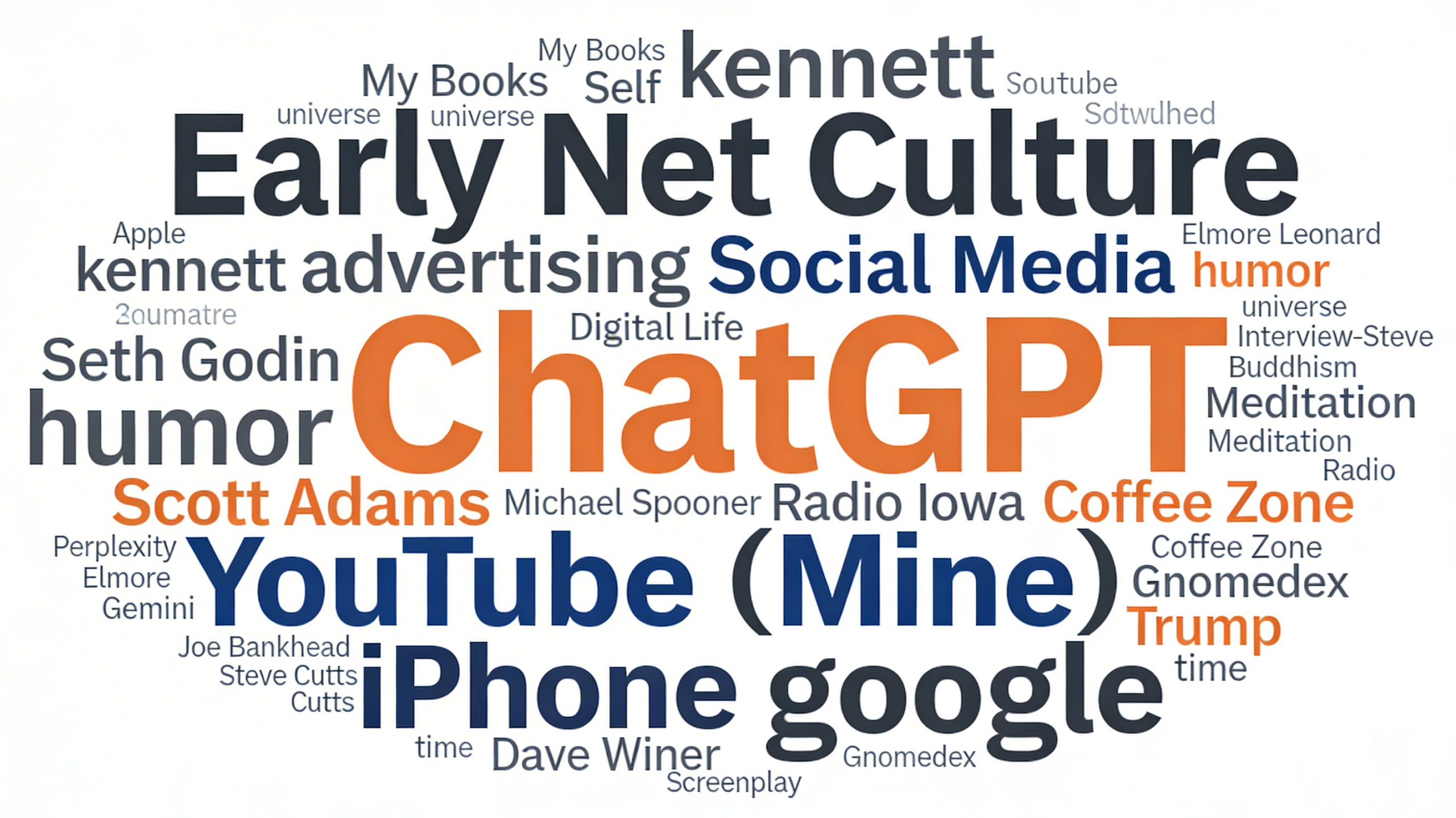
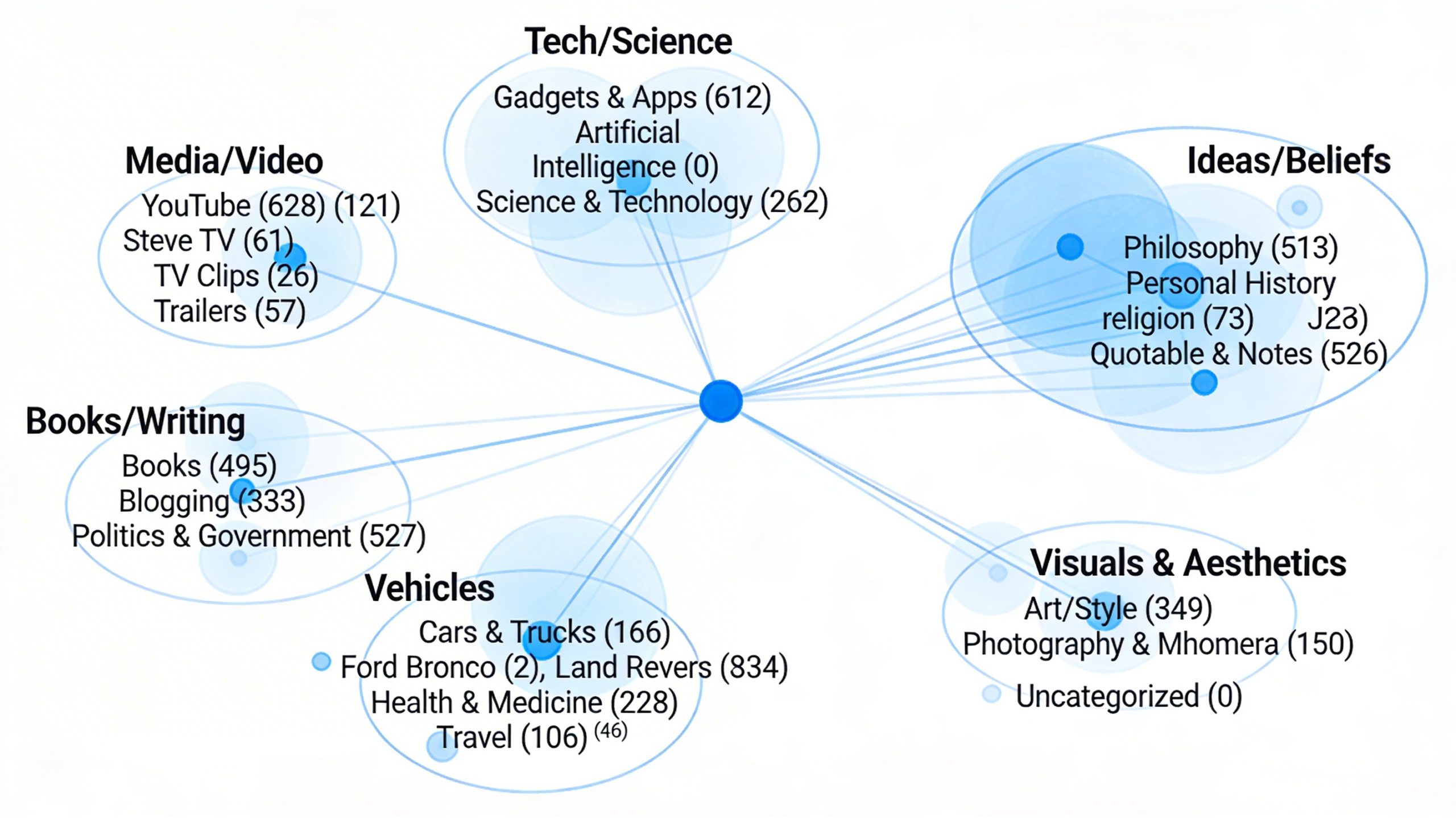
An earlier post featured two graphical representations (from Perplexity) of the categories I’m currently using on smays.com. As a follow-up, I uploaded the current list of tags.

At first glance one would think this blog is just about ChatGPT and it did capture a lot of my attention over the past couple of years. That will change now that I have deleted my ChatGPT account.

During recent blog maintenance, I moved ChatGPT from category to tag (along with Perplexity and Gemini). Artificial Intelligence is the top-level category for those topics (link below).

Along with all of the blog posts on this topic, I saved a lot of those conversations to my local Documents folder. This morning I prompted Gemini to analyze that “AI Bots” folder. Continue reading

Crime Fiction Philosphy

The #1 reason I started this blog was to have a place I could save (and later find) stuff. Lines from movies, favorite quotes from books, a photo, etc. Additionally, I save stuff in a folder in the cloud. AI tools like Gemini offer interesting and creative ways to look at these archives. Below are ten quotes of a philosophical nature from Crime Fiction novels I’ve read.


  1. “The memory is like twin orbiting stars, one visible, one dark, the trajectory of what’s evident forever affected by the gravity of what’s concealed.” — “O” Is for Outlaw, Sue Grafton
  2. “Integrity is not a conditional word. It doesn’t blow in the wind or change with the weather. It is your inner image of yourself, and if you look in there and see a man who won’t cheat, then you know he never will.” — A Deadly Shade of Gold, John D. MacDonald
  3. “Civilization seems to be something we choose when it fits our purpose.” — A Drink Before the War, Dennis Lehane
  4. “Hypocrisy is the tribute that vice pays to virtue, dear man.” — A Murder of Quality, John le Carré
  5. “Sometimes it’s a dog-eat-dog world and the rest of the time it’s the other way around.” — A Dance at the Slaughterhouse, Lawrence Block
  6. “The whole legal system—if you think it’s just a big set of rules, you’re dead wrong. It’s really a bunch of people sitting around and talking to each other, deciding what they want to do with you.” — A Cold Day in Paradise, Steve Hamilton
  7. “Real power around the world does not reside with governments any longer, but with private interests. Real power is secret power.” — A Firing Offense, David Ignatius
  8. “I believe in God, but not as a he or she or an it, but as something that defines my ability to conceptualize within the rather paltry frames of reference I have on hand.” — A Drink Before the War, Dennis Lehane
  9. “Education is something which should be apart from the necessities of earning a living… the measured and guided study of the history of man’s reiteration of the most agonizing question of all: Why?” — A Deadly Shade of Gold, John D. MacDonald
  10. “Even our most arbitrary actions are the result of the trips we take down our mental highways.” — A Little Yellow Dog, Walter Mosley

Pretty sure my list would have been different but I see that as a feature, not a bug.

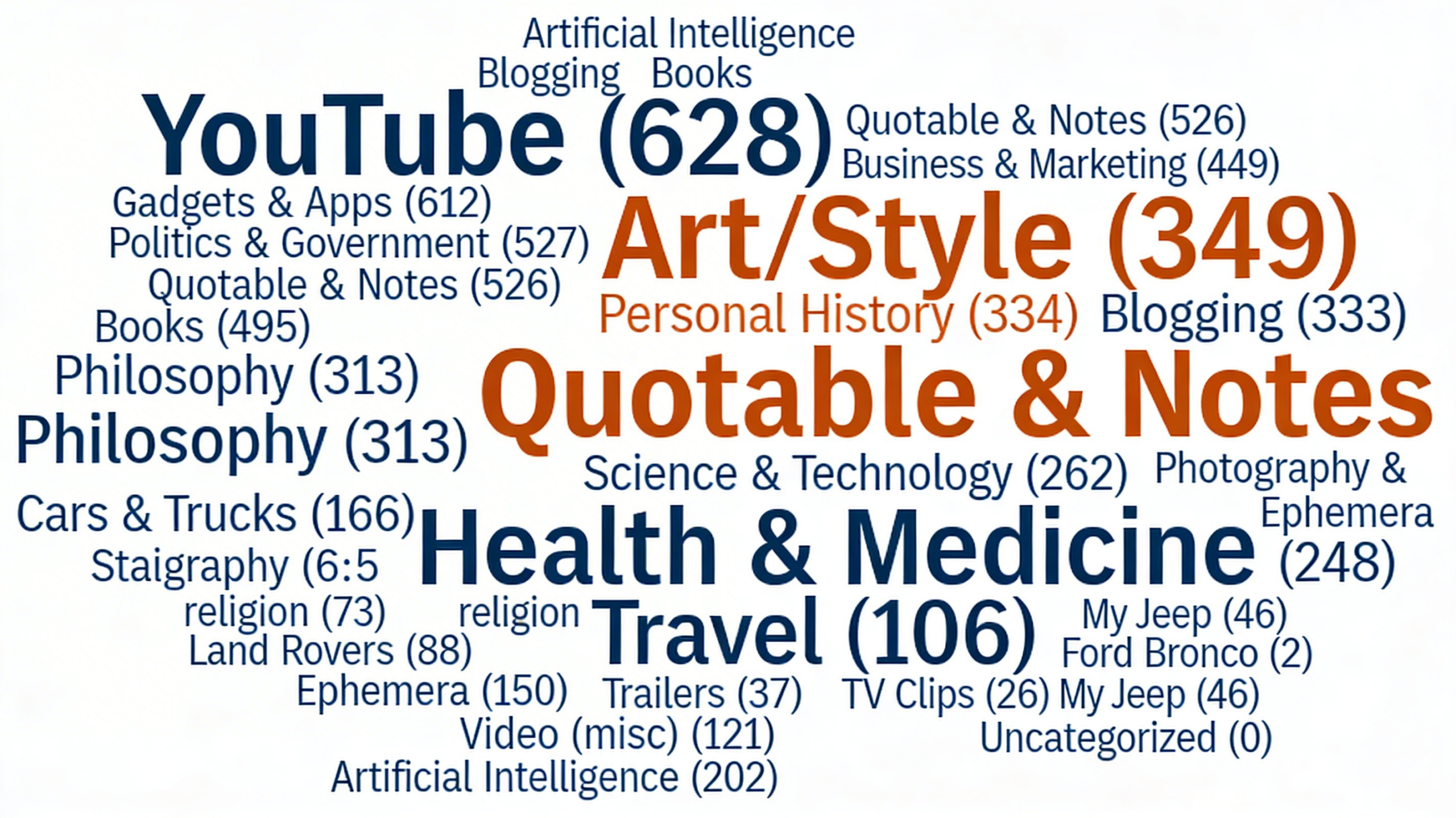
Category “tag cloud”

AI tools like Perplexity and Gemini have proven to be invaluable at giving me a new perspective and understanding of my 24 years of blog posts. I’ve written about this frequently. This morning I provided a list of my categories showing the number of posts in each and prompted Perplexity to create a visual representation of the data. Took a little tweaking but I find the results interesting.

For what it’s worth, Gemini was unable to perform this task but did offer several explanations of what it was my fault and not the AI.