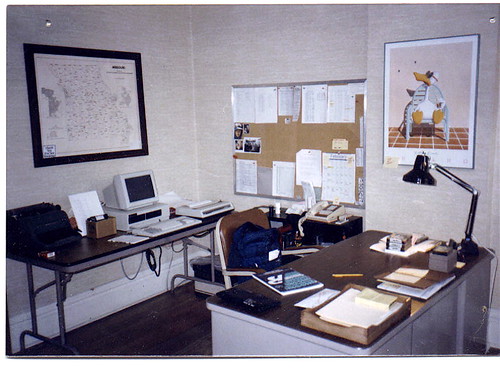
While browsing images last night, I came across this photo of my little corner of the office I shared with Jim Lipsey when Learfield HQ was on McCarty Street in downtown Jefferson City. The photo –probably taken around ’86– reminded me of how much things have changed. Check out the “Notes” on flickr image.
eBay is ready to begin auctioning advertising airtime on 2,300 participating U.S. radio stations. The venture –which puts eBay into competition with Google– includes both conventional terrestrial radio and Internet radio advertising. Stations in all of the 300 top-ranked radio markets are covered. Advertising inventory includes primetime spots with 90 percent in morning drive, midday or evening commute hours from Monday through Friday.
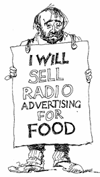
How (if at all) will this impact companies like ours that barter our services for radio station commercials? When you finish the quiz, close your Blue Book and raise your hand.
Internet’s ad share surpasses radio for the first time. Radio’s share of advertising revenues held flat in the first quarter — taking 6.6% of spending. But for the first time the Internet has a bigger share. It took 7.7%. TNS Media says radio is now fifth — behind TV, magazines, newspapers and the Web. [Inside Radio]
Fifty years ago, Jerrell Shepherd mastered a form of broadcasting alchemy that turned small town radio lead into gold. It wasn’t much of a secret, however, since he readily shared it with countless radio station owners and managers who made the pilgrimage to Moberly, Missouri, in hopes of bringing some of Shepherd’s sales and programming magic back to their stations.
While most small market broadcasters were content to get “their fair share” of local advertising budgets (the bulk went to the local newspaper), Shepherd’s sales reps were trained to ask for it all and believed in their hearts they deserved it.
Mr. Shepherd’s approach to programming his stations was deceptively simple: report anything and everything that happened in each of the communities covered by his stations’ signals. The KWIX and KRES “Red Rovers” showed up just about every high school football game, junior high choral concert and chamber of commerce ribbon-cutting. And the Shepherd stations put it all on the air. Always with local sponsors. Lots of local sponsors.
Dave Shepherd grew up in the radio business and built on his father’s success, growing The Shepherd Group to 16 stations before selling them to a Florida-based company called GoodRadio.TV, for $30 million earlier this year.
I got Dave on the phone for a little chat and he talked about where small market radio has been… and where it’s going. He shared some thoughts on the Internet, iPods, HD, satellite and Google Radio.
He says he decided to sell because it just wasn’t as much fun as it used to be. And, in the next breath, he wondered if some of his father’s small town magic might work in The Big City.
My first official day at Learfield Communications was June 4, 1984. I’ve posted on enough anniversaries that I don’t have anything fresh to add, but didn’t want the day to slip by without note.
A surprising number of people who were there on my first day are still with the company: Clyde, Roger, Charlie, Bob Priddy, Derry (no longer technically part of Learfield but always in my head and my heart), Greg, Clarice, Joyce… who am I missing?
The company has grown so rapidly in recent years, it bears little resemblance to the company I started with. But that is as it should be. Like that old Saturday Night Live bit… “Learfield has been berry, berry good to me.”
Patrick Knight is scheduled to be executed later this month for the fatal shooting of his neighbors, Walter and Mary Werner, almost 16 years ago outside Amarillo. To come up with his final statement, Knight is accepting jokes mailed to him on Texas’ death row or emailed to a friend who has a Web site for him. The friend then mails him the jokes. Knight said the joke he finds the funniest will be his final statement the evening of June 26.
Knight said he got the idea for a joke as his last statement after a friend, Vincent Gutierrez, was executed earlier this year and laughed from the death chamber gurney: “Where’s a stunt double when you need one?”
I think I knew that Robert Scoble once worked with/for Dave Winer at Userland Software, but completely forgot writing this “thank you” to Chris Pirillo, waaaay back in 2002:
“We’re always quick to talk about poor service or support, so I’d like to be equally quick to report a wonderful experience. Based on your recommendation, I purchased a copy of Radio from Userland Software. Total impulse buy. I’d been playing with Blogger and when I saw that you liked Radio, I bought it.
Fact is, I really didn’t need the program and had a little problem getting going and wound up emailing the company for some help. Which I quickly got. In my first email to the company I mentioned that mine was a poorly thought out impulse buy and it would be great if I could “back up” on the purchase, never expecting the company to go along.
Today I got a very nice email from Robert Scoble, refunding my purchase. I immediately sent along my thanks and –in his reply– got an invite to Gnomedex 02! Just a nice way to end the day. You can’t go wrong dealing with the Lockergnome community.”
Seth Godin on the “organic success” path to a high Google rank:
“If you want to be on the front page of matches for “White Plains Lawyer”, then the best choice is to build a series of pages (on your site, on social sites, etc.) that give people really useful information. Once you’ve done everything you can… once you’ve built a web of information and once you’ve given the ability to do this to your best clients and your partners and colleagues, then by all means apply the best SEO (search engine optimization) thinking in the world to your efforts.”
David Weinberger’s latest book —Everything Is Miscellaneous— is a philosophical look at “the power of the new digital disorder.” A few nuggets:
“Individuals thinking out loud now have weight, and authority and expertise are losing some of their gravity. It’s not whom you report to and who reports to you or how you filter someone else’s experience. It’s how messily you are connected and how thick with meaning are the links.
It’s not what you know, and it’s not even who you know. It’s how much knowledge you give away. Hoarding knowledge diminishes your power because it diminishes your presence. (p.230)
“A playlist is an important means of self-expression. The motivation is to say, ‘This is who I am, and you can find out who i am by knowing what I love.'” Attributed to Rebecca Tushnet, a professor at Georgetown University Law Center. (p.159)
“Physical limitations on how we have organized information have not only limited our vision, they have also given the people who control the organization of information more power than than those who create the information. Editors are more powerful than reporters, and communication syndicates are more powerful than editors because they get to decide what to bring to the surface and what to ignore.(p.89)
“Facts are that about which we no longer argue.” (p.214)
“A span of expertise is about as long as a shelf in a library.” (p.205)
“For many fans, hearing Sgt. Pepper’s Lonely Hearts Club Band for the first time was a life-changing experience. Prior to its release in June of 1967, most of music being produced was for Top 40, AM radio play and for dance parties. Kids bought 45s and never thought of a collection of songs as a “concept album” or work of art. Sgt. Pepper’s was unlike anything anyone had heard before.”
You had to be there to appreciate “Sgt. Pepper’s” but this piece on today’s All Things Considered takes a good stab at explaining why it was a big deal. I was just finishing my first year of college when the album was released. Perfect timing.

 Fifty years ago, Jerrell Shepherd mastered a form of broadcasting alchemy that turned small town radio lead into gold. It wasn’t much of a secret, however, since he readily shared it with countless radio station owners and managers who made the pilgrimage to Moberly, Missouri, in hopes of bringing some of Shepherd’s sales and programming magic back to their stations.
 A surprising number of people who were there on my first day are still with the company: Clyde, Roger, Charlie, Bob Priddy, Derry (no longer technically part of Learfield but always in my head and my heart), Greg, Clarice, Joyce… who am I missing?