Gen Z is over Facebook

Facebook, once the go-to social media platform for many, has plummeted in popularity among younger users, according to a Pew Research Center survey.

In a 2015 overview, Pew found that 71% of teens ages 13 to 17 used Facebook. It easily beat out platforms such as Instagram, Snapchat and Twitter among that demographic.[…] By 2022 the share of 13- to 17-year-olds who said they use Facebook dropped from 71% in the 2015 study to 32% today.

Is Facebook’s monopoly imploding?

That’s the premise of an article by Edward Ongwesso Jr.

What seemed impossible just a year or two ago—that Facebook will become just another tech company, more or less—now seems like a very real possibility. […] In a Q1 earnings call, Facebook warned that Apple’s 2021 privacy changes to its iOS operating system—which makes it harder for third parties like Facebook to harvest data to target users—would be “a pretty significant headwind for our business” to the tune of $10 billion in advertiser revenue this year. […] over the past four quarters, Facebook’s ad revenue has faltered: $33.67 billion (Q4 ‘21), $26.998 billion (Q1 ‘22), $28.152 billion (Q2 ‘22), and $27.2 billion (Q3 ‘22), with first-ever year-over-year declines reported these last two quarters.

Facebook is still a gigantic force that has spread an endless amount of disinformation and misinformation worldwide, a hugely important platform, and a monopolistic company; this cannot be waved away simply because the company is grossly incompetent. […] There is a possible near future, if we’re not already there, where Meta is just another company rather than a world-shaping monolith, having been outfoxed and outclassed by more competent monopolies and wrecked by the hubris of its chief executive.

Facebook to remove false vaccine claims

Facebook said on Monday that it plans to remove posts with erroneous claims about vaccines from across its platform, including taking down assertions that vaccines cause autism or that it is safer for people to contract Covid-19 than to receive the vaccinations. […] Monday’s move goes further by targeting unpaid posts to the site and particularly Facebook pages and groups. Instead of targeting only misinformation around Covid vaccines, the update encompasses false claims around all vaccines. Facebook said it consulted with the World Health Organization and other leading health institutes to determine a list of false or misleading claims around Covid and vaccines in general.”

I’ll believe it when I see it. Of course, I won’t see it but you know what I mean.

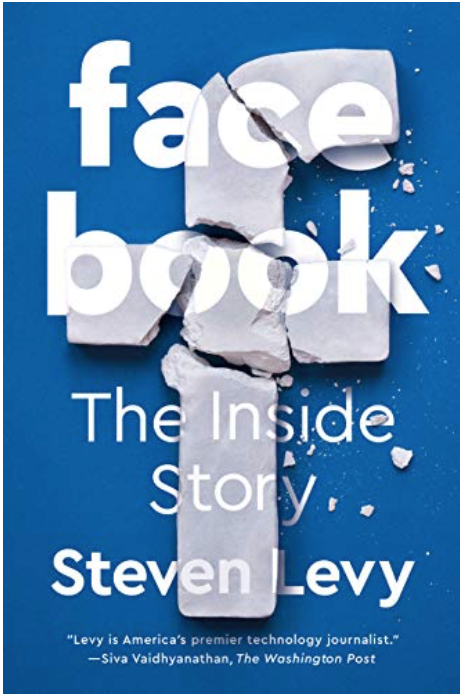
Facebook: The Inside Story

I’m at a loss for what to say about Steven Levy’s book, Facebook: The Inside Story. At 500 pages it’s a deep dive into the history of Facebook (the startup and all that’s happened since). The excerpts below are just a few of the things that caught my eye. It would be a mistake to judge the book (or Mark Zuckerberg) based on the passages I underlined.

Soley by analyzing Likes, they successfully determined whether someone was straight or gay 88 percent of the time. In nineteen out of twenty cases, they could figure out whether one was white or African American. And they were 85 percent correct in guessing one’s political party. Even by clicking innocuous subjects, people were stripping themselves naked. […] In subsequent months,Kosinski and Stillwell would improve their prediction methods and publish a paper that claimed that using Likes alone, a researcher could know someone better than the people who worked with, grew up with, or even married that person. “Computer models need 10, 70, 150, and 300 Likes, respectively, to outperform an average work colleague, cohabitant or friend, family member, and spouse.”

A 2012 study found that Facebook was mentioned in a third of divorces.

It was a natural evolution to put (content moderators) in factories. They became the equivalent of digital janitors, cleaning up the News Feed like the shadow workforce that comes at night and sweeps the floors when the truly valued employees are home sleeping. Not a nice picture. And this kind of cleaning could be harrowing, with daily exposure to rapes, illegal surgery, and endless images of genitals.

Between January and March 2019, (Facebook) blocked 2 billion attempts to open fake accounts — almost as many as actual users on the system. […] The company concedes that around 5 percent of active accounts are fake. That’s well over 100 million.

It’s left to the 15,000 or so content moderators to actually determine what stuff crosses the line, forty seconds at a time. In Phoenix (site of one of the moderator “factories”) I asked the moderators I was interviewing whether they felt that artificial intelligence could ever do their jobs. The room burst out in laughter.

A computer-science teacher at one of the big AI schools told me that Facebook used to be the top employment choice. Now he guesses that about 30 percent of his students won’t consider it, for moral reasons.

“We’ve actually built an AI that’s more powerful than the human mind and we hid it from all of society by calling it something else,” Harris says. “By calling it the Facebook News Feed, no one noticed that we’d actually built an AI that’s completely run loose and out of control.” Harris says that using the News Feed is like fighting an unbeatable computer chess player—it knows your weaknesses and beats you every time.” — Tristan Harris (former Google interface engineer)

A few take-aways:

  • Facebook might be the most powerful (influential) organization in the world. And therefore — potentially — the most dangerous.
  • Everyone on the planet is affected by what Facebook does (or doesn’t do). Even those of us without accounts.
  • Mark Zuckerberg is brilliant and has surrounded himself with other brilliant people. He seems to believe he is always the smartest person in the room.
  • Zuckerberg is on a mission to save/change the world. Combined with the above, this makes him very dangerous.
  • People who use Facebook (and those of us who do not) have no idea the extent to which we are influenced by the people running the platform.
  • Users will never —voluntarily — stop using Facebook.

The book has left me a bit shaken. I always considered religion — some religion — the greatest danger to humanity. Facebook seems a greater threat.

“An existential threat to humanity”

The following quote is from Steven Levy’s new book, Facebook: The Inside Story.

“We’ve actually built an AI that’s more powerful than the human mind and we hid it from all of society by calling it something else,” Harris says. “By calling it the Facebook News Feed, no one noticed that we’d actually built an AI that’s completely run loose and out of control.” Harris says that using the News Feed is like fighting an unbeatable computer chess player—it knows your weaknesses and beats you every time.”

Tristan Harris (former Google interface engineer)

More apps caught sending personal info to Facebook

Sam Schechner, reporting for The Wall Street Journal (Subscription required. Here’s John Gruber’s post):

“In the Journal’s testing, Instant Heart Rate: HR Monitor, the most popular heart-rate app on Apple’s iOS, made by California-based Azumio Inc., sent a user’s heart rate to Facebook immediately after it was recorded.

Flo Health Inc.’s Flo Period & Ovulation Tracker, which claims 25 million active users, told Facebook when a user was having her period or informed the app of an intention to get pregnant, the tests showed.

Real-estate app Realtor.com, owned by Move Inc., a subsidiary of Wall Street Journal parent News Corp , sent the social network the location and price of listings that a user viewed, noting which ones were marked as favorites, the tests showed.

None of those apps provided users any apparent way to stop that information from being sent to Facebook.”

So I’m thinking about apps that I use: TextGrabber, Scanner Pro et al. Are they sending my shit to Facebook (even though I don’t have an account?). Apple needs to stop this shit or at the ver least tell us which apps are doing this so we can delete them.

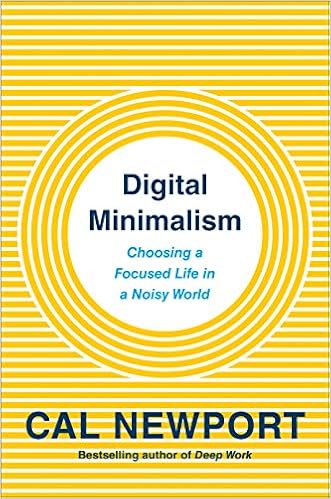
Digital Minimalism: Choosing a Focused Life in a Noisy World by Cal Newport

“Minimalism is the art of knowing how much is just enough. Digital minimalism applies this idea to our personal technology. It’s the key to living a focused life in an increasingly noisy world.” (Amazon)

I’ve been creeping in this direction for a while. Never on FB; deleted my Twitter account back in 2016; and said goodbye to Google+ last year. But my world is still noisier than I’d like and I got some good ideas from this book. Here’s a few excerpts:

“Philip Morris just wanted your lungs. The App Store wants your soul.”
“Checking your “likes” is the new smoking.” — Bill Maher

“(Smart phones are) slot machines in our pockets.”

“What’s the single biggest factor shaping our lives today?” (Our screens)

“We didn’t sign up for the digital lives we now lead. They were instead, to a large extent, crafted in boardrooms to serve the interests of a select group of technology investors.”

“The iPod provided for the first time the ability to be continuously distracted from your own mind.”

“You cannot expect an app dreamed up in a dorm room, or among the Ping-Pong tables of a Silicon Valley incubator, to successfully replace the types of rich interactions to which we’ve painstakingly adapted over millennia. Our sociality is simply too complex to be outsourced to a social network or reduced to instant messages and emojis.”

“A life well lived requires activities that serve no other purpose than the satisfaction that the activity itself generates.”

“Assuming that you use Facebook, list the most important things it provides you—the particular activities that you would really miss if you were forced to stop using the service altogether. Now imagine that Facebook started charging you by the minute. How much time would you really need to spend in the typical week to keep up with your list of important Facebook activities?”

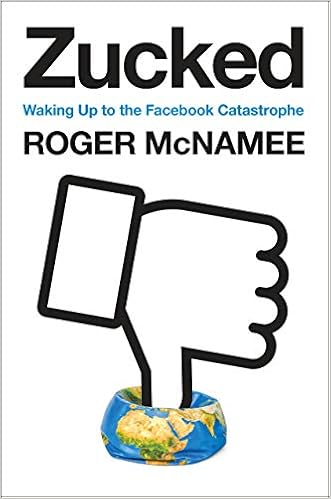
Zucked: Waking Up to the Facebook Catastrophe

Excerpts from Zucked: Waking Up to the Facebook Catastrophe by Roger McNamee.
Imagine a stew of unregulated capitalism, addictive technology, and authoritarian values, combined with Silicon Valley’s relentlessness and hubris, unleashed on billions of unsuspecting users.

The most likely case is that the technology and business model of Facebook and others will continue to undermine democracy, public health, privacy, and innovation until a countervailing power, in the form of government intervention or user protest, forces change.

Surveillance, the sharing of user data, and behavioral modification are the foundation of Facebook’s success.

When users are riled up, they consume and share more content. Dispassionate users have relatively little value to Facebook.

Facebook is the fourth most valuable company in America, despite being only fifteen years old, and its value stems from its mastery of surveillance and behavioral modification.

It turns out that connecting 2.2 billion people on a single network does not naturally produce happiness for all. It puts pressure on users, first to present a desirable image, then to command attention in the form of Likes or shares from others. In such an environment, the loudest voices dominate, which can be intimidating. As a result, we follow the human instinct to organize ourselves into clusters or tribes.

The competition for attention across the media and technology spectrum rewards the worst social behavior. Extreme views attract more attention, so platforms recommend them.

Research suggests that people who accept one conspiracy theory have a high likelihood of accepting a second one.

Belonging is stronger than facts.

The Russians might have invented a new kind of warfare, one perfectly suited to a fading economic power looking to regain superpower status.

Technology tends to reflect the values of the people who create them.

When a company grows from nothing to 2.2 billion active users and forty billion dollars in revenues in only fourteen years, you can be sure of three things: First, the original idea was brilliant. Second, execution of the business plan had to be nearly flawless. And third, at some point along the way, the people who manage the company will lose perspective. If everything your company touches turns into gold for years on end, your executives will start to believe the good things people say about them. They will view their mission as exalted. They will reject criticism. They will ask, “If the critics are so smart, why aren’t they so successful and rich as we are?”

On Facebook, information and disinformation look the same; the only difference is that disinformation generates more revenue, so it gets much better treatment.

Huge amounts of data are available. Campaigns can buy a list of two hundred million voting-age Americans with fifteen hundred data points per person from a legitimate data broker for seventy-five thousand dollars.

Where Orwell worried about the burning of books, Huxley argued that the greater risk would be citizen no longer wanting to read.

Facebook is a threat to democracy.

Facebook: Where friendships go to never quite die

“(Facebook) has created an entirely new category of relationship — the vestigial friendship. It’s the one you’ve evolved out of, the one that would normally have faded out of your life, but which, thanks to Facebook, is instead still hanging around.”

“Having many Facebook friends, then, is kind of like having a big old encyclopedia. Most of the time it’s just gathering dust on a shelf but you keep it around anyway, because one day you might need it.”

The Atlantic

Blogging coming back in style?

David Heinemeier Hansson (creator of Ruby on Rails, Founder & CTO at Basecamp) is leaving Medium for… a WordPress blog.

“Writing for us is not a business, in any direct sense of the word. We write because we have something to say, not to make money off page views, advertisements, or subscriptions.”

“Beyond that, though, we’ve grown ever more aware of the problems with centralizing the internet. Traditional blogs might have swung out of favor, as we all discovered the benefits of social media and aggregating platforms, but we think they’re about to swing back in style, as we all discover the real costs and problems brought by such centralization.”

“With the new take, we’re also trying to bring more of a classic SvN style back to the site. Not just big, marque pieces, but lots of smaller observations, quotes, links, and other posts as well. In fact, the intention is to lessen our dependency on Twitter too, and simply turn Signal v Noise into the independent home for all our thoughts and ideas – big or small.”

I’ve been seeing articles (posts?) on Medium for six or seven years but never paid much attention. Here’s the Wikipedia page.