
Forgetting

Most of us has had the experience of committing something to memory. The multiplication tables; important dates in American history, etc. But how does one go about intentionally forgetting something? The following is from a novel (crime fiction) by Lawrence Block, one of my favorite authors. The protagonist is a contract killer and the excerpt describes how he avoids thinking about the people he kills.

“Years ago he’d learned how to clear his mind after a job. Very deliberately he let himself picture the master bedroom on Caruth Boulevard as he had last seen it. Portia Walmsley lay on her back, stabbed through the heart. Beside her was her unnamed lover, comatose with drink, his fingers clenched around the hilt of the murder weapon. It was the sort of image you’d want to blink away, especially if you’d had something to do with it, but Keller fixed it in his mind and brought it into focus, saw it in full color and sharp relief.”

“And then, as he’d learned to do, he willed the image to grow smaller and less distinct. He shrank it, as if viewing it through the wrong end of a telescope, and he washed out the bright colors, dimming the image to black and white, then fading it to gray. The details blurred, the faces became unrecognizable, and as the image disappeared, the incident itself its emotional charge. It had happened, there was no getting around it, but it was as if it had happened years and years ago, and to somebody else.”

I don’t know if this works. Like everyone, I’ve had moments in my life I’d rather not recall but I’ve never made this kind of conscious effort to forget.
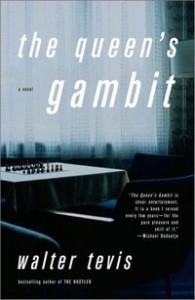
The Queen’s Gambit

The-Queens-GambitThis is a thriller about tournament chess. The tournaments aren’t just background for a more exciting plot, the chess games are the action. Piece-by-piece. Don’t play chess? (I don’t) Doesn’t matter, I was on the edge of my seat. (Wikipedia)
As with the only other novel I’ve ready by Walter Tevis (Mockingbird), I felt a sense of impending doom on every page of this story. I was exhausted by the end. I didn’t read closely enough to learn if Tevis was a chess player. Hard to image writing this story if he wasn’t.

If there was a false note, for me it was the main character’s struggle with alcohol and pills. According to Wikipedia, the author had the same struggle. This element just seemed “tacked on” to me.

[I was reminded of the drinking binges (and hang-overs) of Matthew Scudder, the alcoholic detective created by Lawrence Block. It was hard to read those without a cold cloth on the back of your neck.]

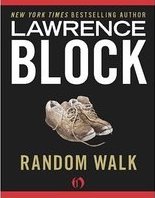
Random Walk

randomwalkAuthor Lawrence Block on Random Walk: “Every now and then someone comes up to me at a speech or signing and says one of two things. ‘I’ve liked all your books,’ I’ll be told, ‘but there was one I couldn’t make heads or tails out of.’ Or just the opposite: ‘I’ve read most of your books, but there was one that really knocked me for a loop, and I’ve read it seventeen times now, and it’s completely changed my life.’ “It’s always the same book. Random Walk.”

I wrote the book in the spring of 1987, and never was a book more eager to be written. Paradoxically, never was a book less eager to be read–the advance sale was light, the reviews were venomous, and most readers never even knew the book existed. Now it’s getting a new lease on life, and I’m delighted. I don’t know that it’s time has come–it’s just as possible it’s time has come and gone. But I do know Random Walk has enormous impact on some of the people who read it, and I hope that now they’ll have a chance to find it.”

A few of my favorite passages: Continue reading

Reading

Go-Go Girls of the Apocalypse by Victor Gischler

Mortimer Tate was an insurance salesman on the verge of a nasty divorce when he holed up in a mountain cave in Tennessee and rode out the end of the world. Go-Go Girls of the Apocalypse begins nine years later, when he emerges into a bizarre landscape filled with hollow reminders of an America that no longer exists.

Hit and Run by Lawrence Block

Keller’s a hit man. For years now he’s had places to go and people to kill. But enough is enough. He’s got money in the bank and just one last job standing between him and retirement. In Des Moines, Keller stalks his designated target and waits for the client to give him the go-ahead. And one fine morning he’s picking out stamps for his collection at a shop in Urbandale when somebody guns down the charismatic governor of Ohio.

I’m not familiar with Gischler but he’s got a knack for titles. I’m a long-time fan of Lawrence Block. If you’ve never been on one of Keller’s hit jobs, you’re in for a treat.

Reading List: 2005

The Fool’s Run – John Sandford (September)
What the Dormouse Said: How the 60s Counterculture Shaped the Personal Computer – John Markoff (September)
The Hot Kid – Elmore Leonard (August)
Harry Potter and the Half-Blood Prince – J. K. Rowling (August)
The Historian – Elizabeth Kostova (July)
The System of the World – Neal Stephenson (June)
The Twelfth Card – Jeffery Deaver (May)
All the Flowers Are Dying – Lawrence Block (February)
The Broker – John Grisham (February)
State of Fear – Michael Crichton (February)

Reading List: 2004

Stab in the Dark, Lawrence Block (December)
Distraction, Bruce Sterling (October)
Florence of Arabia: A Novel, Christopher Buckley (October)
The Rule of Four, Ian Caldwell and Dustin Thomason (September)
Rain Fall, Barry Eisler (September)
We the Media, Dan Gillmor (August)
R is for Ricochet, Sue Grafton (August)
Skinny Dip, Carl Hiaasen (August)
The Stone Monkey, Jeffery Deaver (July)
Live Bait, P. J. Tracy (July)
Hidden Prey, John Sandford (June)

Note: This post has been predated so that it would appear in 2004. 8/16/05

Turn the page

I’m a long-time fan of the novels of Lawrence Block and have read most of them. From time to time I come across one that had been out of print. Spotted two Matthew Scudder novels yesterday (A Stab In The Dark, and Time To Murder And Create) and snapped them up. Matt Scudder is a New York private investigator (no license) with a serious drinking problem. He’ll go on a bender and then suffer nasty hang-overs. In later novels, Matt joins AA and, finally, gets his act together.

Time To Murder And Create was written in 1976 and Matt is still boozing. When I first read these stories, it was almost painful and certainly depressing to “watch.” Having read all of the later Scudder novels, I know that everything works out for Matt. He gets sober. Meets the perfect woman (for him). And finds some peace.

It’s nice to think that someone is re-reading our stories and knows what happens to us down the road. Our Cosmic Author simply has no way to tell us everything is going to be all right. Or that it isn’t. Or, maybe we aren’t listening. I choose to believe my author prefers happy endings.

Death

One of my first posts was a quote from Lawrence Block’s Everybody Dies:

“When you die, it is said you see your whole life. But you don’t see it minute by minute, like a speeded-up film. It’s like everything you ever did in all your days was a brushstroke, and now you see the whole painting all at once.”

Poet Billy Collins has a different view:

I wonder how it all got started, this business
about seeing your life flash before your eyes
while you drown, as if panic, or the act of submergence,
could startle time into such compression, crushing
decades in the vice of your desperate, final seconds.
From The Art of Drowning