
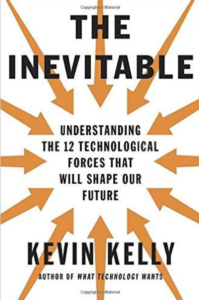
The Inevitable

inevitable“Thousands of years from now, when historians review the past, our ancient time here at the beginning of the third millennium will be seen as an amazing moment. This is the time when inhabitants of this planet first linked themselves together into one very large thing. Later the very large thing would become even larger, but you and I are alive at the moment when it first awoke. Future people will envy us, wishing they could have witnessed the birth we saw.”

“This very large thing (the net) provides a new way of thinking (perfect search, total recall, planetary scope) and a new mind for an old species. It is the Beginning. […] At its core 7 billion humans, soon to be 9 billion, are quickly cloaking themselves with an always-on layer of connectivity that comes close to directly linking their brains to each other. […] By the year 2025 every person alive — that is, 100 percent of the planet’s inhabitants — will have access to this platform via some almost-free device. Everyone will be on it. Or in it. Or, simply, everyone will be it.”

While reading Kevin Kelly’s The Inevitable, I underlined passages so I could post them here for future reference. I do this with each book I read. I’m not going to do that for this book because my highlights filled 11 pages The Inevitable (Kevin Kelly) (PDF)

The Underpopulation Bomb

Kevin Kelly on what we should be worried about:

The picture for the latter half of this century will look like this: Increasing technology, cool stuff that extends human life; more older people who live longer, millions of robots, but few young people. Another way to look at the human population in 100 years from now is that we’ll have the same number of over-60-year olds, but several billion fewer youth.

Here is the challenge: this is a world where every year there is a smaller audience than the year before, a smaller market for your goods or services, fewer workers to choose from, and a ballooning elder population that must be cared for. We’ve never seen this in modern times; our progress has always paralleled rising populations, bigger audiences, larger markets and bigger pools of workers. It is hard to see how a declining yet aging population functions as an engine for increasing the standard of living every year. To do so would require a completely different economic system, one that we are not prepared for at all right now.

Floating in Extraordinariness

Kevin Kelly thinks we’ve reached a point where “rather than be surrounded by ordinariness we’ll float in extraordinariness.”

“The internet is like a lens which focuses the extraordinary into a beam, and that beam has become our illumination. It compresses the unlikely into a small viewable band of everyday-ness. As long as we are online – which is almost all day many days — we are illuminated by this compressed extraordinariness. It is the new normal.”

“That light of super-ness changes us. We no longer want mere presentations, we want the best, greatest, the most extraordinary presenters alive, as in TED. We don’t want to watch people playing games, we want to watch the highlights of the highlights, the most amazing moves, catches, runs, shots, and kicks, each one more remarkable and improbable than the other.”