
God for a Day

For most of us (well, actually, for all of us) God is a mystery. Whatever God is, I’m confident she has a fine sense of humor and might be doing something like this.

Once she knocked out the Heaven and Earth stuff and had a few people running around it occurred to her to put them in charge of the Universe. But she knew a committee was the wrong way to go. They’d come up with those soon enough.
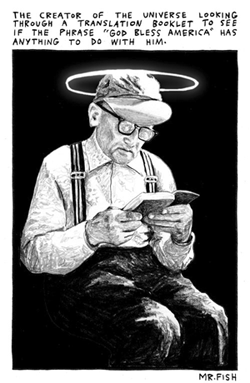
So she decided to rotate the job. Every day, someone new becomes God, with full powers. They can create sunsets or erupting volcanoes or whatever pops into their temporarily divine heads.

And to keep things interesting, there would be no rhyme or reason to selection. Totally random.

Even if the world’s great religions figured this out, they kept it to themselves. You can’t build a functioning religion when there’s a new deity every day. Just keeping up with the artwork would be a nightmare.

Each new god could tell his friends the exciting news if they chose but, being omniscient they could see that could turn out badly. Some couldn’t resist, however.

You’d think after all this time (and all those god’s) the world would be in pretty good shape. But each new god could –and often did– fuck up the good work of previous gods.

So. If today is your day, what will you do?
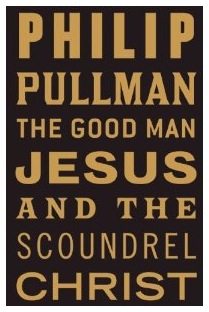
The Good Man Jesus and the Scoundrel Christ

Last week I read The Good Man Jesus and the Scoundrel Christ by Philip Pullman. I’ve been sorting out my thoughts about the book but I’m not there yet. I think it’s going to take a while. But I want to get something down here while the story (and my impressions) are still fresh in my mind. So, this will be one of those stream-of-consciousness posts (not a real review of the book).

GMJ&TSC is fiction. It is the story (a story) about the life and death of Jesus and his twin brother Christ (hardly a spoiler since it’s the title).

I found the style of the book very different from Pullman’s His Dark Materials trilogy. The book read very quickly. The chapters are very short with little or no character development.

To me it felt as though Pullman was trying to condense the stories most Christians grew up with to the bare “facts” (The Childhood of Jesus, Jesus Scandalises the Scribes, The Death of John, etc). Now that I think about it, each chapter read like a Cliffs Note.

Here’s how Pullman describes the book on the back of the dust cover:

“The story I tell comes out of the tension within the dual nature of Jesus Christ, but what I do with it is my responsibility alone. Parts of it read like a novel, parts like a history, and parts like a fairy tale; I wanted it to be like that because it is, among other things, a story about how stories become stories.”

TRUTH and HISTORY –and the relationship between the two– is a common theme throughout GMJ&TSC:

“If the way to the Kingdom of God is to be opened, we who know must be prepared to make history the handmaid of posterity and not its governor. What should have been is a better servant of the Kingdom than what was.” (pg 99)

Deeply “religious” people are often offended when someone takes liberties with their story. (Jesus Christ Superstar, the Dutch cartoonist’s depiction of Mohammed, etc) And if you happen to believe that every word of the King James Bible is literally true and an exact account of the life and death of Jesus, you probably won’t find this book a good read.

If on the other hand, you aren’t ready to stop thinking about such things, you might. I know that I did. Here are some questions it raised for me:

  • If you wanted to start a religion that would last thousands of years, how would you go about it?
  • How would Jesus feel about the religion that is based on his life and death?
  • Could Christianity have taken hold if Jesus had lived at any other time or place?
  • If the story of Jesus’ life/death –as we have known it for 2,000 years– was shown to be inaccurate, would it be better to know the truth, or to allow Christianity to continue to be based on events that never happened?

Continue reading

The One True Faith. Mine.

I’ve always wondered how deeply religious people could be so certain their “faith” was the real deal and everyone else’s was bogus. Brian Hines wonders, too:

“People will reject unsubstantiated claims in holy books… except the book they believe in. People will reject miracle stories… except miracles related by their own faith. People will reject the divinity of living prophets or messengers of God… except the person they accept as a genuine spiritual teacher.

Every religious believer, aside from the few who are genuinely open-minded, considers that he or she has found the One True Faith among the 4,199 or so false faiths. Yet how is this possible, logically or realistically?

It’s like Garrison Keillor’s Lake Woebegon, where all the children are above average.

There are good reasons for belonging to a religious, spiritual, or mystical group. But having a lock on cosmic truth isn’t one of them. Nobody knows what lies at the heart of reality, or even if there is such a thing: a heart, a core, a central truth.

So the only honest attitude is “I don’t know.” Along with, “You don’t know either.” This leaves us all on the same unknowing level.”

Religion and ego

Brian Hines finds it strange “that religiosity is so often associated with humility, selflessness, and lack of ego. Actually, the religious impulse is highly egotistical.”

How would religious belief be affected if it was known that our sensations of being connected with, of under the care of, a higher power were entirely contained within our own personal mind/brain?

The mystical and spiritual experiences would feel the same. But no longer would we believe that we were contacting a transcendent divinity. We couldn’t claim a special relationship with some supernatural being, because that “higher power” would be us.

An expanded us, to be sure. An us that encompassed normally untapped areas of the mind/brain. An us that wasn’t as split, searching, anxious, uncertain, and self-doubting as we are now.

This would eliminate a lot of unnecessary religious egotism. No one would be a member of a chosen people, or a special beloved of God. We’d all just be human beings, having human experiences, making the best use possible of our human psyches.

I’m grateful we live in a country where it’s still okay wonder and write about such things. And yet, any candidate fo higher office who dared make such a connection between religion and ego would be toast.

The God Theory

My interest in quantum theory, time and the relationship between consciousness and reality lead me to a book by Bernard Haisch titled The God Theory. (I’ve included a chunk of Dr. Haisch’s bio below). I include this post for my own reference.

“If you look up at the faint smudge in the night sky that is really the distant, huge Andromeda galaxy, you might see light that, from your point of  view, took two million years to traverse hat vast intergalactic distance before it was absorbed in your retina and registered as an image. For a beam of light itself, however, things look different. Instead of radiating from some star in the Andromeda galaxy and racing through space for two million years, every single photon sees itself, metaphorically speaking, as born and instantaneously absorbed in your eye. It is one simple jump that takes no time at all, according to the theory of special relativity. That’s because, in the reference frame of a particle traveling at the speed of light, all distances shrink to zero and all time collapses to nothing. From its own perspective, the photon of light leaps instantaneously from there to here because distance has no place in its existence. We can almost say that the photon was created because it had someplace to land and, in an instant, it jumped from there to here, even across two million light years of space from our perspective.”

“Bernard Haisch, Ph.D., is an astrophysicist and author of over 130 scientific publications. He served as a scientific editor of the Astrophysical Journal for ten years, and was Principal Investigator on several NASA research projects. After earning his Ph.D. from the University of Wisconsin in Madison, Haisch did postdoctoral research at the Joint Institute for Laboratory Astrophysics, University of Colorado at Boulder and the University of Utrecht, the Netherlands. His professional positions include Staff Scientist at the Lockheed Martin Solar and Astrophysics Laboratory; Deputy Director of the Center for Extreme Ultraviolet Astrophysics at the University of California, Berkeley; and Visiting Scientist at the Max-Planck-Institut fuer Extraterrestrische Physik in Garching, Germany. He was also Editor-in-Chief of the Journal of Scientific Exploration.”

Scott Adams: The building blocks of God

“Humanity is developing a sort of global eyesight as millions of video cameras on satellites, desktops, and street corners are connected to the Internet. In your lifetime, it will be possible to see almost anything on the planet from any computer. And society’s intelligence is merging over the Internet, creating, in effect, a global mind that can do vastly more than any individual mind. Eventually everything that is known by one person will be available to all. A decision can be made by the collective mind of humanity and instantly communicated to the body of society.

A billion years from now, if a visitor from another dimension observed humanity, he might perceive it to be one large entity with a consciousness and purpose, and not a collection of relatively uninteresting individuals.”

“Are you saying we’re evolving into God?”

“I’m saying we’re the building blocks of  God, in the early stages of reassembling.”

— From God’s Debris: A Thought Experiment, by Scott Adams

Scott Adams: Holy Land

“Well, usually it’s because some important religious event took place there.”

“What does it mean to say that something took place in a particular location when we know that the earth is constantly in motion, rotating on its axis and orbiting the sun? And we’re in a moving galaxy that is part of an expanding universe. Even it you had a spaceship and could fly anywhere, you can never return to the location of a past event. There would be no equivalent of the past location because location depends on your distance from other objects, and all objects in the universe would have moved considerably by then.”

“I see your point, but on Earth the holy places keep their relationship to other things on Earth, and those things don’t move much,” I said.

“Let’s say you dug up all the dirt and rocks and vegetation of a holy place and moved it someplace else, leaving nothing but a hole that is one mile deep in the original location. Would the holy land now be the new location where you put the dirt and rocks and vegetation, or the old location with the hole?”

“I think both would be considered holy,” I said, hedging my bets.

“Suppose you took only the very top layer of soil and and vegetation from holy place, the newer stuff that blew in or grew after the religious event occurred thousands of years ago. Would the place you dumped the topsoil and vegetation be holy?”

“That’s a little trickier,” I said. “I’ll say the new location isn’t holy because the topsoil that you moved there isn’t itself holy, it was only in contact with holy land. If holy land could turn anything that touched it into more holy land, then the whole planet would be holy.”

The old man smiled. “The concept of location is a useful delusion when applied to real estate ownership, or when giving someone directions to the store. But when it is viewed through the eyes of an omnipotent God, the concept of location is absurd.

“While we speak, nations are arming themselves to fight for control of lands they consider holy. They are trapped in the delusion that locations are real things, not just fictions of the mind. Many will die.”

— From Scott Adams’ God’s Debris: A Thought Experiment

Scott Adams: Different Religions

I just finished listening to the audio version of Scott Adams’ first non-Dilbert, non-humor book (2004): God’s Debris: A Thought Experiment. In the introduction, Mr. Adams identifies the target audience as “people who enjoy having their brains spun around inside their skulls.

I’ve read this small book (132 pages) twice before checking out the audio version. And I know I will read this book many more times, trying to wrap my mind around ideas the human brain probably will never grasp. Like religion.

“Imagine that a group of curious bees lands on the outside of a church window. Each bee gazes upon he interior through a different stained glass pane. To one bee, the church interior is all red. To one bee, it is all yellow, and so on. The bees cannot experience the inside of the church directly; they can only see it. They can never touch the interior or smell it or interact with it in any way. If bees could talk they might argue over the color of the interior. Each bee would stick to his version, not capable of understanding that the other bees were looking through different pieces of stained glass. Nor would they understand the purpose of the church or how it got there or anything about it. The brain of a bee is not capable of such things.

“But these are curious bees. When they don’t understand something, they become unsettled and unhappy. In the long run the bees would have to choose between permanent curiosity—an uncomfortable mental state—and delusion. The bees don’t like those choices. They would prefer to know the true color of the church’s interior and its purpose, but bee brains are not designed for that level of understanding. They must choose from what is possible, either discomfort or self-deception. The bees that choose discomfort will be unpleasant to be around and they will be ostracized. The bees that choose self-deception will band together to reinforce their vision of a red-based interior or yellow-based interior and so on.”

“So you’re saying we’re like dumb bees?” I asked, trying to lighten the mood.

“Worse. We are curious.”

Scott Adams: God’s Debris

I love the writing of Scott Adams. The Dilbert Principle played no small part in my escape from Management. His blog is one of the most thought-provoking I read. I just finished God’s Debris. Not a book for those who already have things figured out.

“Humanity is developing a sort of global eyesight as millions of video cameras on satellites, desktops, and street corners are connected to the Internet. In your lifetime it will be possible to see almost anything on the planet from any computer. And society’s intelligence is merging over the Internet, creating, in effect, a global mind that can do vastly more than any individual mind. Eventually everything that is known by one person will be available to all. A decision can be made by the collective mind of humanity and instantly communicated to the body of society.” pg 53

It is beyond the human brain to understand the world and its environment, so the brain compensates by creating simplified illusions that act as a replacement for understanding. When the illusions work well and the human who subscribes to the illusion survives, those illusions are passed to new generations. pg 34

The odd collection of molecules that make a human being will stay in that arrangement for less time than it takes the universe to blink. pg 35

What could possibly be interesting or important to a God that knows everything, can create anything, can destroy anything. The concept of ‘importance’ is a human one born out of a need to make choices for survival. pg 36

I love the writing of Scott Adams. The Dilbert Principle played no small part in my escape from Management. His blog is one of the most thought-provoking I read. I just finished God’s Debris and will post a few of my favorite bits here. Let’s start with this one:

We’re the building blocks of God, in the early stages of reassembling.

Time is a human concept of how things change compared to other things. pg 57

Morality and willpower are illusions. For any human being, the highest urge always wins and willpower never enters into it. Willpower is a delusion. pg 94

Your short-term payoff for contributing to God’s consciousness is fewer problems in your daily life, less stress, and more happiness. pg 101

Over time, everything that is possible happens. pg 102

“A replica of your mind and body will exist in the distant future, by chance. And the things you do now can either make life more pleasant or more difficult for your replica. pg 102

You can change only what people know, not what they do. pg 107

Awareness does not come from receiving new information. It comes from rejecting old information. pg 125

Obama’s spirituality

In 2004, Chicago Sun-Times religion writer Cathleen Falsani interviewed freshman state legislator Barack Obama about his spiritual beliefs. Earlier this year, she republished the entire interview on her blog. Here are a few paragraphs from that interview [pulled selectively]:

"I’m rooted in the Christian tradition. I believe that there are many paths to the same place, and that is a belief that there is a higher power, a belief that we are connected as a people. That there are values that transcend race or culture, that move us forward, and there’s an obligation for all of us individually as well as collectively to take responsibility to make those values lived."

"I’m not somebody who is always comfortable with language that implies I’ve got a monopoly on the truth, or that my faith is automatically transferable to others."

"I’m a big believer in tolerance. I think that religion at it’s best comes with a big dose of doubt. I’m suspicious of too much certainty in the pursuit of understanding just because I think people are limited in their understanding."

"The most powerful political moments for me come when I feel like my actions are aligned with a certain truth. I can feel it. When I’m talking to a group and I’m saying something truthful, I can feel a power that comes out of those statements that is different than when I’m just being glib or clever.
I think there is an enormous danger on the part of public figures to rationalize or justify their actions by claiming God’s mandate."

"I think there is this tendency that I don’t think is healthy for public figures to wear religion on their sleeve as a means to insulate themselves from criticism, or dialogue with people who disagree with them."

"What I believe in is that if I live my life as well as I can, that I will be rewarded. I don’t presume to have knowledge of what happens after I die. But I feel very strongly that whether the reward is in the here and now or in the hereafter, the aligning myself to my faith and my values is a good thing."

For all the sturm and drang –and endless showing of a couple of video clips– surrounding the Reverend Wright… I don’t even know what to call it… issue? We learned precious little about Senator Obama’s faith and spirituality. This blog post offers a useful insight.