
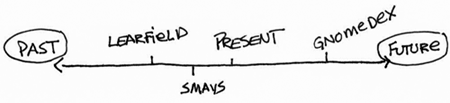
Five minutes ahead, five years behind

Every year I come back from Gnomedex with a sense of perspective. A better understanding of where I am on the technology continuum (for lack of a better term).

Future: That space way out on the edge of what we already know about and what the smart kids at Google and Amazon and eBay et al. are dreaming up.

Present: This is what I think of as “state of the art.” People and companies in this Present have a good grasp of all the current technologies and tools and are using them every day. Everybody fully in the Present has a clue and is standing on tiptoe, peering into the mists of the Future.

Past:
Where we’ve been. Valuable only in terms of how it helps us understand our place in the Present and the Future.

There were some very bright people at this year’s Gnomedex (and a few of us got in because we had $500) and as I listened to the discussions, I began seeing the image above in my head.

Learfield –the company I work for– is very successful. We are primarily a marketing and sales company with strong ties to what is frequently referrred to these days as “old media” (Radio and TV). Like all companies, we use the Internet extensively and we’re searching for ways to use it more effectively. But we’re not in the Present I described above. How far back up the road are we? I’m not sure. Perhaps we’re like those NASCAR drivers that get in behind the leaders and draft along until we see an opening.

And I’m only about five minutes ahead because this is all I think and read about. And even that small gap is narrowing.

Attending Gnomedex is like cresting a hill and –for just a few minutes– I can see some of the smart kids way off on the horizon, running toward the future. I won’t catch them, but it’s nice to get a glimpse every now and then.

Your online presence

A thoughtful and well-linked post by Jim Mathies, wondering how a potential employer might reflect on his (Jim’s) online persona. I’ve posted on this topic a few times and thought about it again last week following an interview with a young man who was interested in a job with our company.

The job in question is web-related so I asked if he had anything online that I could look at. “Not really,” he responded. He read a little surprise on my face and added, “I have a My Space page.”

When I pressed him for a look, he reluctantly pulled up his page, which launched to the sound of music that could best be described as “urban.” And there was a nice photo of the young man striking a bit of a “gangsta” pose. (Like I’d know)

He seemed a little uncomfortable so I attempted to reassure him that I’d rather see his My Space page than some dry, lifeless resume.

But, as Jim’s post (and the NYT article that prompted it) reminds us, a lot of who we are it “out there,” just a Google or Technorati search away. I have no doubt I have written something that would keep a prospective employer from hiring me. But I wouldn’t want to work for a company that would not hire me based on something they read here. Younger bloggers might not have that luxury.

So, do you let the world know who you really are by letting it all hang out on your blog? Or, do you craft a sanitized, lifeless, carefully worded resume? Most pros would argue for the resume and they’d probably be right. Unless I was doing the interview.

Keeping customer data secure

Some dumb-ass working for the government takes a laptop full of veterans’ records home and it gets stolen. Naw, that doesn’t surprise me. Big accounting firm like Ernst & Young pulls a similar stunt and loses 230,000 records belonging to one of their big clients. Okay, that’s a little hard to imagine… but it happened. Could it happen at a company like Amazon? Not if we can belive Werner Vogels, the company’s chief technology officer:

“…to get to Amazon customer credit cards you will need a small army of Marines. Although recently we have been discussing (how) to place physical and electronic booby-traps such that the servers will self-destruct when compromised, to deal with such full physically attack …”

Now that’s what I call contingency planning. I always to try buy from/through Amazon. Mr. Vogels is one of the discussion leaders at Gnomedex.

73% of U. S. now online

Latest Pew Internet Survey (PDF): 73% of respondents (about 147 million adults) are internet users, up from 66% (about 133 million adults) in January 2005 survey. And the share of Americans who have broadband connections at home has now reached 42% (about 84 million), up from 29% (about 59 million) in January 2005.

Percentages vary by education and income, but no more than you might expect. No idea how accurate the survey results but I continue to be amazed at how many people refuse to believe this is happening. Or, perhaps, don’t want it to be happening. No idea why.
 

Web surfers see only what they want

Certainly no surprise to anyone that designs or (in my case) maintains websites. A few specifics from recent study by Jakob Nielsen’s Nielsen Norman Group:

  • Individuals read Web pages in an “F” pattern. They’re more inclined to read longer sentences at the top of a page and less and less as they scroll down. That makes the first two words of a sentence very important.
  • Surfers connect well with images of people looking directly at them. It helps if the person in the photo is attractive, but not too good-looking. Photos of people who are clearly professional models are a turnoff.
  • People respond to pictures that provide useful information, not just decoration.

And my favorite: When there is less on a page, users read more.