Why two Google Shared Stuff pages?

I’m a regular user of the Shared Stuff feature in Google Reader. That’s the little widget in the sidebar, which feeds to a larger page. I love it.

I recently discovered another Google tool that also seems to be called Google Shared Stuff. This one works from a little icon in your menu bar. As you surf around the web you can add links and notes to a “shared stuff” page. But not the same shared page. It has to be a DIFFERENT shared page.

Why can’t the shared pages be shared? One page for stuff from my Google Reader and the “shared” button. If any of you kids in the Accelerated Class can help me out with this, I’ll be grateful.

I’ll be i20 on January 1st

I have not felt my age for years. I’ve always felt (and acted?) much younger. Or so it seems to me. You might recall that I turned 60 back in March and I sure as hell don’t feel 60.

And on January 1st, 2009, I will no longer BE “sixty.” My new –more accurate age– will be i20 (“I” for Internet). My new “doi” (date of Internet) is 1/1/89:

“CompuServe was the first online service to offer Internet connectivity, albeit limited access, as early as 1989 when it connected its proprietary e-mail service to allow incoming and outgoing messages to other Internet e-mail addresses.”Wikipedia

No presents, please.

Media 101

My recent visit to Central Methodist University included a tour of the campus which wound up in the studios of what was –I believe– the student radio station. I’m not sure when or why the station went off the air but the plan is to bring it back as an internet station.

During the few minutes I chatted with a couple of instructors and students about the project, I got the impression the approach will be… traditional, for lack of a better term. By that I mean, they’ll have a control room and studios with the usual assortment of recording and mixing hardware. Instead of pumping it all out to a transmitter and tower… they’ll stream it.
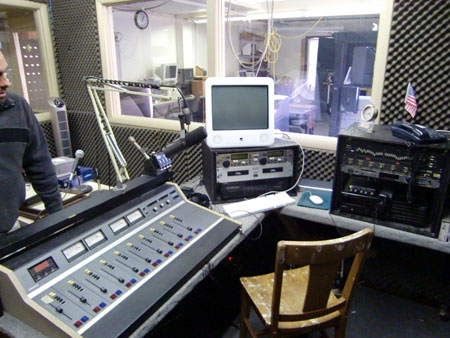
As for programming, they plan to do what we used to call “block programming.” An interview program followed by a news program followed by… Music licensing issues prevent them from programming music.

The way college radio stations have always been programmed. I don’t doubt the students can learn some useful skills and gain some valuable experience doing this but I’m not sure it will prepare them for the future that is already here.

So what would I do if they put me in charge of the program for a semester?

I’d start by dropping the term “radio” and go with “media.” Not “new media,” just media.

I’d assemble production teams made up of a producer and host (and co-host?). These teams would be responsible for one 25 minute program a week. Can be any topic (more on that in a moment)

A Senior Producer and Managing Editor would coordinate these teams (using Basescamp or some similar online collaboration tool) and insure quality standards and deadlines were being met.

All or most of these programs would be produced as live feeds and podcasts. Instead of a “college radio station” (Internet or otherwise), you’d have a portal site (I hate that term) that featured each of the individual programs with a link to that programs blog (where the hosts and producer interact with listener/viewers). Show notes, comments, etc.

The central feature of the portal page would be a video section. It could be a live stream of one of the shows being recorded or some live event on campus. Or just a live webcam from the student center.

Equipment. Each team would have a laptop, a digital camera (video capable) and a small webcam. All shows would be produced on location. No reason to schlep back to a studio jammed with expensive equipment.

I wouldn’t limit this project to just students. I’d open it up to the community as well, but with students producing.

Once these podcasts are up, it’s an easy matter to track which ones produce a following. If nobody downloads, you fix the podcast or replace it. But you aren’t limited to the 24 hours of a real-time station. You can have as many programs as you have people to produce and watch/listen.

So what are the students learning here?

  • How to write, edit and tell a story
  • How to shoot and edit video and share it with the world
  • How to build an online community or tribe
  • How to produce a live webcast
  • How to take and edit photos
  • How about a course in Smart Phone Reporting?

…and so on and so forth. I’m not an educator so there could be lots of things wrong with this approach. I’m pretty sure it would cost a lot less than a more traditional approach while involving many more students (in and out of the communications program). If you have suggestions on this mythical program, please include them in the comments. Or, if you see flaws, post those as well.

PS: I think this might be a powerful recruitment tool, as well.

UPDATE/12.08.08: On a recent edition of NPR’s Morning Edition, Steve Inskeep interviewed journalist Sreenath Sreenivasan who, within an hour of the attacks in Mubai, began hosting a web radio call-in show with other Indian journalists, relaying what they knew. Sreenivasan used a service called Blog TalkRadio:

“BlogTalkRadio is the social radio network that allows users to connect quickly and directly with their audience. Using an ordinary telephone and computer hosts can create free, live, call-in talk shows with unlimited participants that are automatically archived and made available as podcasts. No software download is required. Listeners can subscribe to shows via RSS into iTunes and other feed readers.”

Website make-over

We relaunched our corporate website today. Same content, just a fresh coat of digital paint provided by Caffeinated Studio in Dallas. Much thanks to Trent, Brad and Rob for the design and to Joel, Phil and Andy for all the under the hood stuff.

We’ll be fixing broken links and such for days but it’s it good to have finally thrown the switch. We ripped off the previous design from GE back when a company website wasn’t all that big a deal (“Yeah, sure, go ahead. As long as it doesn’t cost much.”)

Today our company has lots of web pages “out there.” Internet, intranet, extranet, blogs, etc etc. Thousands of pages. This “Internet thing” has caught on and I no longer have to sell the idea of the web et al. Even blogs and podcasts have become part of our company culture.

I used to say I was an EMT frantically giving CPR to the Internet patient in the back of the ambulance as it meandered toward the hospital. Today, our online patient is feeling much better. Drinking apple juice and watching Oprah. I’m so glad to see him feeling better.

“10 Survival Tools for the Digital Age”

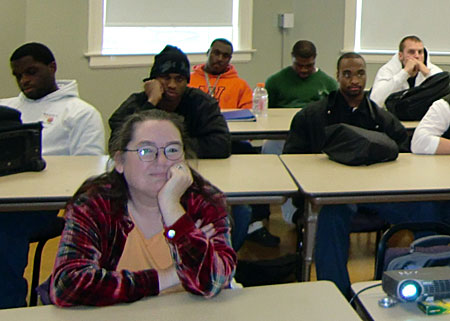
Professor Kristin Cherry teaches a beginning Radio course at Central Methodist University in Fayette, MO, and was kind enough to invite me come talk about… radio. I didn’t know what to say about “radio” so I made a list (“10 Survival Tools for the Digital Age”) of things I was pretty sure they already knew about. They didn’t. [Just click a slide to see the next one] The photo below was taken just as my presentation peaked.

I don’t have the opportunity to spend a lot of time around young people but I’ve come to believe they are no more web savvy than the population at large. They’re great at texting and know the ends and outs of Facebook… but very few are creating media or exploring.

In my group of about 25 students, only one had uploaded a video to YouTube and that was for a class assignment. Twitter, UStream, flickr? Never heard of them.

I tried to convey the idea that these –and similar tools– will be useful no matter what they do after college. What I forgot (it was a very long time ago) was that they had very little interest in next semester, let alone The Rest of Their Lives.

The instructors (and the administration!) were incredibly gracious hosts and the campus is really pretty. As always, I got much more out of this experience than the students. More on that in a future post. [Wikipedia entry for “film strip”]

When every game is webcast

A few months ago I got a call from Brian Slawin. Someone told him I fooled around with streaming live video and he wanted some ideas on how to stream his daughter’s softball games so family members could watch her play. He gave Qik and Kyte a try but wasn’t happy with the results but he kept at it. This past weekend he packed up his laptop, webcam and Sprint cellular card and headed for the ball field.

“Initially, I was concerned that a wireless cellular card wouldn’t allow enough upload bandwidth to actually stream the signal, but it turned out that even at 100kbps upstream, the signal was rock solid and remarkably clear. My gear includes an HP Pavilion PC, the Sprint card, a Logitech QuickCam Vision Pro, a power strip with 1400 joules filtering and some other cables, etc…

“Turns out I got lucky…my Sprint signal was 5×5 and there was power right at the backstop plus an angled desk/bench that made for the perfect setup.  I used the Justin.tv streaming system and it was tons of fun to have about a dozen parents/friends watch each game and join in the chat with Justin’s embedded chat feature. I made like a play-by-play narrator typing out what was going on…and every now and then playing “Joe Buck” for fun.”

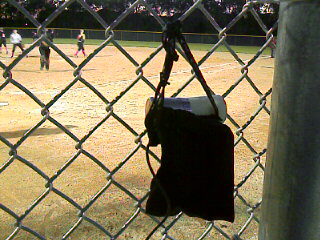
Webcam“I’ll need a better setup than just hanging the web cam from a couple of lanyards and a bag…when it got windy, or when there was a foul ball, the camera shook and I had to reposition it numerous times.  Likely a tripod or perhaps a platform that is more securely attached to the fence and would allow for a higher angle is what I’m going to experiment with next.”
Brian’s company has some big plans.

“I can see a time where we’d actually hire broadcast teams (students in broadcasting programs in local high schools or colleges) to broadcast the games. We’ve already begun working with a softball tournament company on the East coast and are going to try and bring this forward for next summer’s tournaments in the New York, Pennsylvania and New Jersey area.”

“But for now, I’ll continue to enjoy traipsing after my daughter this fall and into next summer as we travel to Junior Olympic softball tournaments throughout the Midwest.  Be sure to visit Warcats18Gold.com for more information about the team and if you’re nearby, be sure to come by and say hello at the Eleventh Annual St. Louis Softball Showcase in Chesterfield, MO Oct 31 – Nov 2.”

During my early radio days (’70s) there was tremendous pressure on the radio station to broadcast high school football and basketball games. We did some high school baseball but I don’t know that we ever found air time for girls softball. There just wasn’t enough time, staff or advertising support. And if one of the local radio stations didn’t broadcast the game… you had to be in the stands.

No more.

No satellite or cable TV? No problem.

Our DirecTV works great until a heavy rain rolls in and blocks the signal. It’s called “rain fade” and you lose your signal a couple of minutes before the rain actually reaches earth.

That happened last night while we were watching the Democratic National Convention. It wa getting close to time for Obama to speak and, since we didn’t know how long it would last, I grabbed the MacBook and started streaming CNN’s live feed.

It was a little small and I didn’t bother to go full-screen because we were on the floor in the bedroom and could see it fine.

This has become so easy and mundane, it’s hardly worth mentioning. But that’s my point. Distribution is becoming –has become– a non-issue. In four years I have no doubt I would just swipe the iPhone and watch the speeh there.

Perhaps I’m still awestruck by this because I remember a time before color TV, cable, VCR, DVD, computers, web, etc.

Wi-Fi on some American flights

American Airlines passengers will now have Wi-Fi access on some flights. The airline said Wednesday that it has finally launched its in-flight Internet access service via Wi-Fi on 15 of its 767-200 airplanes. The service, called Gogo, will be offered on nonstop flights between New York and San Francisco, New York and Los Angeles, and New York and Miami. The cost is $12.95 per flight. Passengers will be able to sign up when they boot up their browsers.– [More at C|Net

Now that would make the flight from STL to Seattle whiz by. Would happily pay $13. Have to believe all flights will have it eventually.

Public Access TV in a YouTube world

If you watch any TV or cable news, you hear references to this or that video on YouTube. It reminds me of the days when the big three networks referred something on CNN. YouTube is starting to feel like another network. NBC doesn’t want to cover my speech? No problem. I’ll just post it to YouTube.

My next thought was the similarity to public access TV. Let the record show I know almost nothing about public access TV. I think it works something like this:

The local cable company (or someone) sets aside a channel for the public to produce programming. I assume there is a local board or committee that manages the channel and decides what programming to air and when.

Putting Tivo aside for a moment, the public access channel is limited to 24 hours of programming each days. And to keep the math simple, let’s say every program is an hour long and airs once a week. That’s 168 programs a week. And many of those would “air” in the middle of the night.

I think it would be difficult to fill that much time. And what if I had something that was only 5 or 10 minutes long?

Here’s my question: Why won’t YouTube (and similar services) make public access television obsolete? [This is where I show my ignorance of PATV] If local relevance is the raison d’etra of PATV, why not just invite the people of your community (or people who visit your community) to post their videos to YouTube and tag them with the name of the city/town?

But wait, what about our live coverage of the weekly city council meeting? It runs 2 hours or longer and YouTube limits videos to 10 minutes.

Hmm. I guess I’d stream it on Ustream and then pull “highlights” and post those on YouTube.

I expect the Big Question would be, “What about all the people who don’t have computers and access to the Internet?” For the answer, see: “What About People Who Don’t Have TV Sets?”

Don’t misunderstand. I’m not suggesting for a moment that public access TV isn’t a good or necessary thing. There must be people who watch it or it wouldn’t exist. It just feels like one of those things –like classified adds– that would work better and cheaper online.

My friend Jeff knows a LOT about public access TV and I encourage him to comment and help me understand how technology is evolving in this area.

Live from the Zone: May 3, 9:30 a.m.

Georgetv
If you’re up and online this Saturday at 9:30 a.m. Central, try to catch a few minutes of our live webcast from Yanis Coffee Zone here in Jefferson City. It’s one of those "we’re doing it just because we can" events. Taisir (Owner and Proprieter) is gonna set up a table in a corner and George Kopp and I will plug in the video camera and shoot the breeze.

If you want to chat, you need to a) create an account at UStream.tv or b) IM me at smaysdotcom. We’ll probably go for 30 min or so, unless we start having a lot of fun. If you don’t see any live video it means we screwed the pooch and will have to post some lame-ass excuse. We’ll have the video player front and center here at smays.com.

On a typical day, we get about 300 visitors here. I’d like to see how many folks we can have watching at any one time.