Tweeting the execution

My Small History of Learfield and the Internet (1995-2005) is complete. Every drawer I open has some interesting new tidbit. Missourinet News Director Bob Priddy (now retired) share’s this gruesome bit of history:

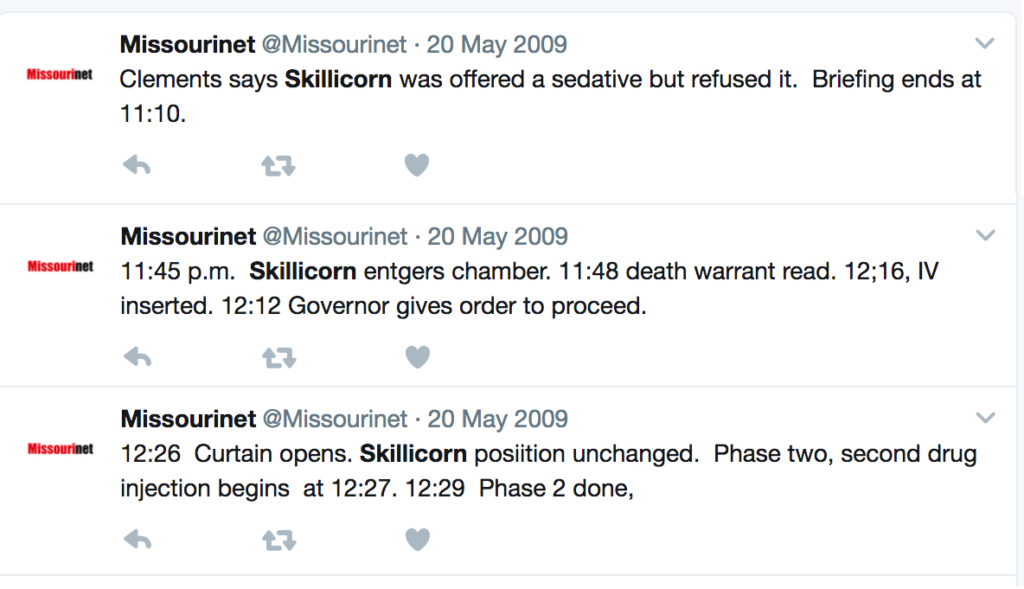
“One of the highlights of our coverage of executions was when I became ( I think) the first reporter in the world who tweeted an execution. Dennis Skillicorn was executed in May, 2009. I could not take anything into the witness room except my notebook and a pen, and the book I had been reading in the waiting room, but I kept a careful chronology and as soon as we came out, I posted tweets on a minute-by-minute basis describing the events.

I stopped using Twitter in November of 2016 because it had become toxic with politics.
Missouri Death Row Audio

In the late ’90s I created a website called MissouriDeathRow.com. A Missourinet reporter had served as a witness (while covering) of every execution going back to 1989. There was no death row website because a) the web was still pretty new at the time and b) the Missouri Department of Corrections went to some lengths to avoid the term “death row,” even though prisoners sentenced to — and awaiting — execution were housed together.

At each execution, a packet of information was handed out to reporters and a stack of those were gathering dust in the Missourinet newsroom. News Director Bob Priddy and I began putting that information online and it quickly became the de facto site for information about capital punishment in Missouri. I maintained the site until I retired in 2012.

The site included a page with some of the history of capital punishment, including audio recorded by Missourinet reporters. As of this writing, much of that audio is no longer available on the site. The site was moved a few times, different servers, different platforms… files get misplaced or lost. My buddy Phil Atkinson did his best to find some of those and I’ve archived them here.

Missouri hasn’t executed anyone in a couple of years but they had quite run at one point. The audio includes post-execution news conferences, interviews with victims’ families, opponents and proponents, and the condemned.

Updating MissouriDeathRow.com

MissouriDeathRow.com was one of the first websites I did. And it looks like it. This was before flickr and Typepad and such. So I’m doing a little make-over. Hope to have it complete by the end of the year.

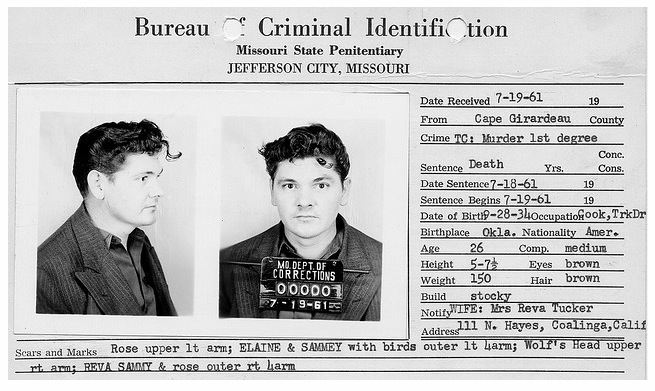
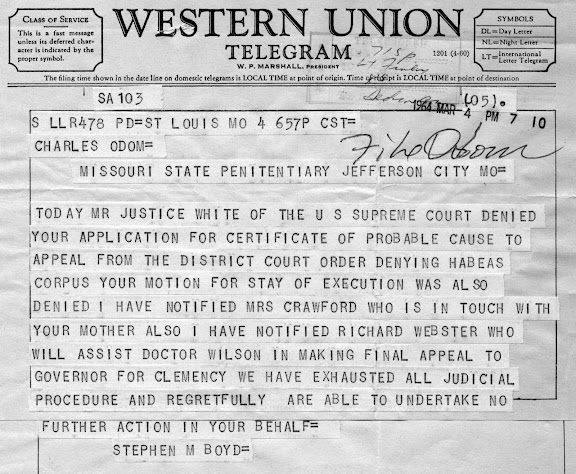
I’m starting with images and documents related to those executed in Missouri’s gas chamber. First time out, I just posted photos of the condemned. This time I’m posting the… not sure what to call it… the record or card for each inmate [flickr slideshow].

I scanned these from the state archives. For some reason, I find them fascinating.

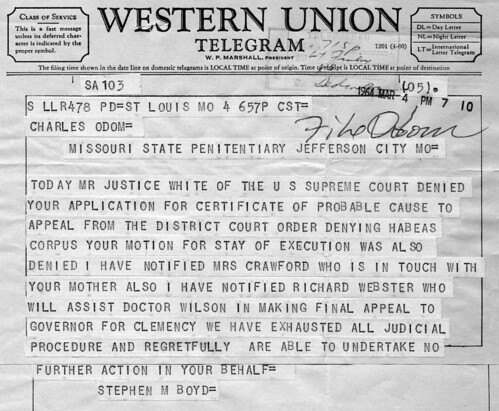
The state archive has a file on each of the inmates executed in the gas chamber. I spent a week going through these, scanning as much as time allowed. Letters, notes, telegrams…

On June 24, 1962, Odom and another Death Row inmate attempted an escape. Odom’s file contained a report by the guard on duty at the time. I’ve also included  (from his appeal to the Missouri Supreme Court) a description of the crime for which Odom was executed.

Lethal injection: Fatal if not painful

Timothy Johnston was executed this morning at the state prison in Bonne Terre, Missouri. It had been delayed by appeals based on the argument that Missouri’s method of execution (lethal injection) is cruel and unusual punishment. Johnston seemed intent to prove his defense was true as he writhed on the gurney for what seemed like a minute. But some witnesses thought he was moving before the first drug was administered.

If his death was painful, it couldn’t have been much worse than being beaten and kicked to death which is how Tim dispatched his wife back in 1989.

But let’s assume he did fake the pain, as it were. You’re just seconds from crossing over to The Other Side, hoping you know what awaits but no way to know for sure… and you pretend to be in agonizing pain to…what? Make some kind of political statement?! That takes some real focus.

And having one of the corrections officers lean over and whisper, “Dude, we didn’t give you the shot yet” …would take me out of character.

Execution journal: Donald Jones

In his capacity as news director for The Missourinet, Bob Priddy has witnessed 15 executions. The most recent was the April 27th execution of Donald Jones, for which Bob produced an “audio journal” that begins as he leaves his motel in Bonne Terre to go to the prison and ends as he prepares to leave the prison about two and a half hours later. Bob telescoped the audio down to about half an hour and some segments have been shifted for context purposes (the reading of the final statement of Donald Jones, for example).

Bob was not allowed to take his recorder to the execution witness area, so he summarizes the events that took place in that approximately 90-minute span. The main voices you will hear are those of Missourinet News Director Bob Priddy, Corrections Department spokesman John Fougere, and Corrections Director Larry Crawford. Voices of various other officers will be heard as part of the process.

James Henry Hampton

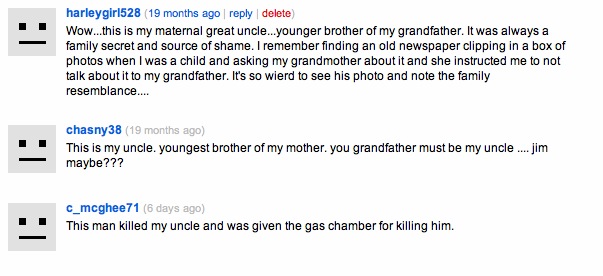
On March 25, 2002, I posted some thoughts on the movie Monster’s Ball, including a reference to the execution of James Henry Hampton two years previously (I was a media witness). On Thursday I received an email from someone (no name was provided, just initials) identifying herself as Hampton’s granddaughter.

I have just recently learned that I am the granddaughter of James Henry Hampton, a man you saw executed on March 22, 2000, ironically the night of my junior prom. I’ve been searching for information on him for a while, because my family refuses to tell me even his last name or anything about him. I was only told of his first name and my mother informed me the night of my celebration that my real grandfather was being executed. The only leads I have are the online articles I’ve come across. My friend came across your web log and suggested I e-mail you. So I guess I’ll get to the point. Can you please tell me all that you can remember about my grandfather’s execution? Was he hateful or spiteful? Was he scared and lonely? Regretful? I realize that this man was an atrocity to society but this same man’s blood courses through my veins. I’m the only one in my family who apparently has his color features and love for root beer (only thing mom and grandma ever let slip when I ordered it at a restaurant). So please sir, tell me what you can, to help me in my search for my family’s truths. Thank you for your time.

I replied with a description of the execution and a link to a website with more information about her grandfather. I can only wonder at the woman’s curiosity that she would be moved to ask a stranger to “…tell me all that you can remember about my grandfather’s execution.” As we (the official witnesses) waited for Hampton’s execution, I had many thoughts. That this man might have a granddaughter attending her junior prom was not one of them. Another example of Dr. Weinberger’s Small Pieces Loosely Joined.

First and only woman executed in Missouri

Half a century ago, radios throughout the country were broadcasting the news that a woman had died in Missouri’s gas chamber… the first– and so far, the only –woman ever executed in a state prison. Bonnie Brown Heady of St. Joseph and her lover Carl Hall had been convicted less than a month earlier of the kidnapping and murder of a little Kansas City boy, Bobby Greenlease. Former prison caseworker Gail Hughes remembers the Heady execution in an interview with Bob Priddy.

18 Years

Yesterday the Missouri Supreme Court overturned the death sentence and conviction of Joseph Amrine, 46, of Kansas City. He’s faced execution since 1986 for the stabbing of a fellow inmate. Over the years, the three former inmates who testified against him recanted. He was in for robbery, burglary and forgery and would have been out 1992 had he not been convicted of murder. If he walks free, he will become only the third Missouri death row inmate in modern times to be freed of his capital conviction. One of our reporters, John Davis, interviewed Amrine today. It runs about 15 minutes. You can also listen to the oral argument before the Missouri Supreme Court on February 4th. This strikes me as a good example of how the web –more specifically, streaming audio– enables a news organization like ours to go way beyond a 4-minute newscast with a couple of sound bites.