Talent more important than size

That is one of the lessons of Web 2.0, according to AdWeek’s Bob Greenberg:

“Long before they became global behemoths, the great (advertising) agencies of the past were small businesses built around people of uncanny creative ability. What’s amazing is that our competition in the future will come from exactly where we started: small teams of creative geniuses with ideas galore on how to capture the hearts and minds of consumers. Only now they probably don’t work in agencies. At the same time, they have a fully democratized means of content distribution that doesn’t rely on captive audiences. Lesson No. 2: Talent is more important than size.”

Good look at the Google Ad Creation Marketplace

Can Google Audio Ads be as easy and effesctive as Google AdWords? That was the question Donna Bogatin (Digital Markets) put to André Bergeron, owner/operator of Babble-On Recording Studios. She wanted “a radio production talent insider take” on how the Google Ad Creation Marketplace will impact the radio advertising industry. Bergeron seems to know what he’s talking about.

“Dollar-A-Holler Radio ads have been around forever. The local Hi-Fi Store owner could always go into the local station and bark off a series of sale prices in shrill tones that would annoy anyone within earshot. This would be no different, really. There is so much more to effective messaging, to branding, to understanding how people listen to the radio than simply writing down “for all your underwear needs” and handing it off to Johnny promo voice to record.

Part of why people can’t stand listening to the radio is the quality of the ads, they’re, by most estimations, shouted, boring, and insultingly simplistic, and, if there are a lot of them, it just magnifies the mind-numbing nature of them.”

I think that sentence really sums it up. That reality will ultimately prove to be The Big Problem for radio going forward. Shitty commercials in an era when we no longer have to listen to them in order to hear the news and music we want.

Andre Bergeron emails an additional thought:

“Throughout a programming day, the station dresses itself with a carefully crafted image using music, personalities, promotions, etc – to create “a brand”, if you will. Then a stopset comes on and it’s like the advertisers are allowed to dress the station in clown’s clothes, leisure suites or horizontal stripes.”

When advertisements become recommendations

“As we move to an age where the only true advertisements are recommendations, what is the role of the traditional advertisement going forward? Recommendations I understand. They can come in many shapes and forms. People you know and trust telling you about products and services they like … A matching engine that takes your “buying” intentions and connects them with someone else’s “selling” intentions.”

[JP Rangaswami via gaping void]

How Google Audio Ads work (PowerPoint slides)

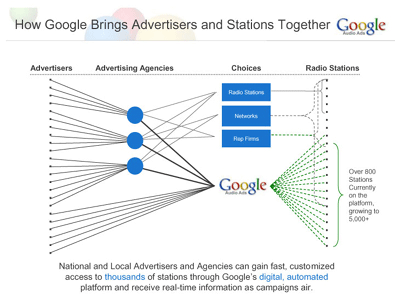
The folks at ZDNet’s Digital Markets have some PowerPoint slides that illustrates how Google Audio Ads work. And this from Voices.com:

“Google has positioned the Audio Ads system to serve both top-level advertisers, as well as the advertising agencies themselves. The graphic also shows 75% of the transactions coming from the agencies, and only 25% from independent advertisers. This is likely because advertising agencies already have media planning and media buying personnel, not to mention existing relationships with local and regional radio stations.”

The lables in the little blue rectangles are: Radio Stations, Networks and Rep Firms. Which suggests that advertisers will simply have another option for placing their ads on radio stations. And if Google can make it easier or cheaper or more effective (i.e. feedback, reports, etc)… they’ve added value to the process.

Update: Google Audio Ads

From Inside AdWords blog: “Over the last year, we’ve been working hard to integrate the dMarc advertising platform into Google AdWords. We’re happy to announce that the integration is now complete and we’ve recently begun a U.S. beta test of Google Audio Ads with a small group of AdWords advertisers.”

If you haven’t been keeping up, here’s how Google describes their Audio Ads:

“Google Audio Ads brings efficiency, accountability, and enhanced ROI to radio advertising by providing advertisers with an online interface for creating and launching radio campaigns. You’ll be able to target your customers by location, station type, day of the week, and time of day. After the radio ads are run, you will be able to view online reports that tell you exactly when your ad played.”

A couple of days ago, Mark Ramsey (Hear 2.0) pointed us to an application page on the Google website.

Ad Specialist Application — Thank you for your interest in joining the Google Ad Creation Marketplace. We’re looking for some of the top audio ad specialists to join our Ad Creation Marketplace – a searchable directory of talent to help AdWords advertisers to create radio advertisements. For advertisers new to the radio space, or who are starting a new campaign, the Marketplace provides an invaluable starting point for finding the talent they need.

So, I decide to buy some Google Audio Ads. I search the Google Ad Creation Marketplace database for someone to write and produce my spot. We agree on a price. I send some copy. They email back an MP3 file. I’m off to the races. Maybe. Mr. Ramsey is skeptical and I confess I am too. But if it works… it could have a profound change on how advertiser buy and place ads.

Update: According to News.com, the radio ads are running in more than 260 metropolitan markets, covering about 87 percent of the country