
Bong Hits for Jesus
“Today the U.S. Supreme Court considers its first major dispute on student free-speech rights in nearly 20 years, a case about the power of school authorities to censor what they viewed as a pro-drug message at a school-sponsored event. At issue is whether a high school principal in Juneau, Alaska, violated a student’s free-speech rights by suspending him for unfurling a banner that read “Bong Hits 4 Jesus.” Student Joseph Frederick says the banner’s language was designed to be meaningless and funny in an effort to get on television as the Winter Olympic torch relay passed by the school in January 2002. But school officials say the phrase “bong hits” referred to smoking marijuana. Principal Deborah Morse suspended Frederick for 10 days because she said the banner advocated or promoted illegal drug use in violation of school policy.”
— Reuters
Update: (5:53 p.m. Central) Supreme struggles with case. I’m gonna leave the masthead up for another day. I kinda like it.
Iraq: How bad will it be?
Rolling Stone convened a panel of experts and asked their opinions on what’s next for Iraq. The panel was comprised of:
- Zbigniew Brzezinski – National security adviser to President Carter
- Gen. Tony McPeak (Retired) – Member of the Joint Chiefs of Staff during the Gulf War
- Paul Pillar – Former lead counterterrorism analyst for the CIA
- Richard Clarke – Counterterrorism czar from 1992-2003
- Bob Graham – Former chair, Senate Intelligence Committee
- Michael Scheuer – Former chief of the CIA’s Osama bin Laden unit; author of Imperial Hubris
- Nir Rosen – Author of In the Belly of the Green Bird, about Iraq’s spiral into civil war
- Chas Freeman – Ambassador to Saudi Arabia during the Gulf War; president of the the Middle East Policy Council
- Juan Cole – Professor of modern Middle East history at the University of Michigan
In the article (Beyond Quagmire, written by Tim Dickin in the March 22, 2007 issue), they asked the panel members for: Best-Case Scenario; Most Likely Scenario; and Worst-Case Scenario.
For years we’ve been hearing “it’s gonna be really bad if we leave,” but I can’t recall anyone getting very specific about that. The Rolling Stone panel seemed to conclude it’s gonna be (is) a shit-story whether we stay or come home. But, finally, someone has provided an answer I can understand.
It’s too late for pounding the Bush administration but General McPeak concluded the article:
“This is a dark chapter in our history. Whatever else happens, our country’s international standing has been frittered away by people who don’t have the foggiest understanding of how the hell the world works. America has been conducting an experiment for the past six years, trying to validate the proposition that it really doesn’t make any difference who you elect president. Now we know the result of that experiment [laughs]. If a guy is stupid, it makes a big difference.”
That’s stinging for me because I was one of those smart-asses that thought/said it really didn’t make any difference who was in the White House. Now I know.
March Madness stats, YouTube deal
“As of 4 p.m. on the first day of the NCAA tournament, CBS Sportsline said it had logged 1.5 million visits and 800,000 registrations to March Madness on Demand, the site’s free live video service. Just before the tip off of the Maryland-Davidson game, 189,000 users were waiting in line to watch the game live. Impressive. Meanwhile, CBS cut another deal with YouTube, this time to stream March Madness highlights on the site. The section is sponsored by Pontiac, which is also sponsoring coverage on the air.” — Lost Remote
Do campaign yard signs work?
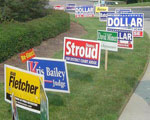 Perhaps what I really want to know is how they work. Front yards bristle with these things leading up to any election (local or national). So they must work at some level but I can’t get my mind around how.
The obvious explanation would be: The candidate with the most signs has the most support and therefore deserves mine. Only in America could that sort of mindless herd logic make sense.
Or, perhaps: Lester down the street has a sign for Congressman Boil…I know and trust Lester…so, Congressman Boil must be the guy to vote for.
I’m old enough to remember a time when yard signs had to be assembled by hand, one at a time. You had posters printed and spent hours tacking (don’t ask, it’s obsolete technology) or stapling them to wooden stakes. The first good rain would turn the sign into a soggy mess. Today these eyesores are stamped out by the thousands, impervious to the elements.
In rural areas like where I grew up, the “big brother” to the yard sign was a 4 x 8 sheet of plywood, displayed along rural highways and intersections.
The popularity of these little “billboards” might have more to do with economics. Buying TV and radio time is probably beyond most local budgets.
I guess the thing that bothers me about all of this is the absence of ideas. These things don’t tell us what the candidate thinks about the issues. Or the quality of their thinking, for that matter.
As long as our leaders can get elected by placing the most brightly colored signs in front lawns (or airing the most 30 second TV and radio “spots”), we’re gonna get empty-headed, venal men and women running our lives.
Sweet Potato Queens
 Just me and the pups this weekend. Barb, her sister Jan, niece Megan and pal Nancy are in Jackson, Mississippi, promoting sisterhood, self esteem and positive thinking with other Sweet Potato Queens.
The Sweet Potato Queens concept has been explained and made popular by a series of books by Jill Conner Browne of Jackson, who came up with the idea in 1982. (Browne is the author of a number of books which form the backbone of the Sweet Potato Queen “movement.”)
It involves a belief in a sisterhood, appealing to mostly middle-aged middle-class women. In 2005, almost ten thousand women dressed up in costumes and came to Jackson for the annual St. Patrick’s Day parade, proceeds from which benefited a local children’s hospital.
How to improve Google rank? Blog
Last night I posted about one of the speakers at a statewide child abuse conference that got underway here in Jefferson City on Wednesday.
Jan Hindman has served on the advisory board of the National Resource Center on Child Sexual Abuse, the National Network for Juvenile Sex Offenders, and she is currently a member of the Oregon Attorney General’s Sexual Assault Task Force. She is also the past president of the Association for the Treatment of Sexual Abusers, as well as being an author of numerous publications and a national trainer, lecturer, and consultant.
Today I had occasion to google “Jan Hindman” and came up with 551 results. As I scanned down the list, I discovered that my post here on smays.com was #48.
I am not all that knowledgable about Google ranking, but that a blog post (on a site with modest traffic) could could show up in the top 10% of the rankings in less than 24 hours says something about the power of blogs.
Update (3/17/07): For some reason my post is no longer showing up in that Google search. As Roseanne Roseannadana used to say, “Never mind.”
Correction courtesy of Bass (3/19/07): Emily Litella said, “Never Mind.” Roseanne Rosannadanna said, “What are you trying to do, make me sick?” Both played by Gilda Radner.
Good is not almost as good as great
Seth Godin on good salespeople and great salespeople. The best sales managers know in their guts this is good advice. They just don’t have the stomach for it.
“The great ones reach out. They work the phones when they’re not first in line. They understand what a customer wants. They’re not just better than good. They’re playing a totally different game.
My best advice: Fire half your sales force. Then, give the remainder, the top people, a big raise, and use the money left over to steal the best salespeople you can find from other industries or even from your competition. You’ll end up with fewer salespeople. But all of them will be great.
And the good guys? Have them go work for the competition.”
Google Audio Ads by the numbers
Mark Ramsey (Hear 2.0) offers still more insight on Google Audio Ads, including some screenshots of pages where you specify the demographic and geographic details of your buy. For businesses that don’t need an “advertising consultant” to show up with a media kit and a coverage map, this might be an effective way to buy radio ads.
Radio Announcers (John Mays and Mr. Rudy)
That’s what they called them when my father and Mr. Rudy (Pylant) were on the air at KBOA in Kennett, Missouri. Pop and Mr. Rudy have since made the transition to Pure Amplitude Modulation but the audio waves of their wonderful voices are still streaking through space.
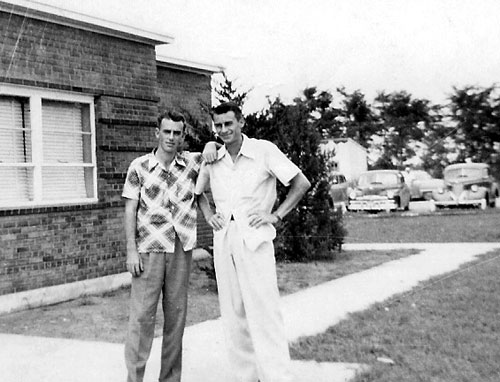
I had never seen this photo of John and Rudy standing in front of the KBOA studio but, based on the automobiles behind them, it could have been as early as ’49 or ’50. The station went on the air in July of 1947 and my father started in 1949. Any of you car freaks able to ID the year of the car at the right edge of this photo?