“Awfulizing” – When your fears distort your reality
Tao is just a name for whatever happens
“The Tao is the pattern of things, but not the enforced law. […] The universe is a harmony or symbiosis of patterns which cannot exist without each other.”
“You can’t diverge from the Tao, for everything, anything, and nothing is Tao.”
“The vague, void-seeming, and indefinable Tao is the intelligence which shapes the world with a skill beyond our understanding.”
I’m at the point in my life when I occasionally stop, turn and look back down the path, marveling at how I got from there to here. I’ve pretty much decided it’s mostly random. Luck. Being at the right place at the right time (or wrong place/wrong time). You’ve seen all the same movies I have so I don’t have to explain what I’m talking about here but I made a short list of those moments that didn’t seem momentous at the time but, in retrospect, made a big difference. Perhaps a few personal examples?
Sometime during college I drove to Columbia, Missouri to take the Law School Admissions Test. I had no interest in law schools but it was a road trip and the girl I was dating knew some people and we wound up partying all night and sleeping on the floor. Next morning I took the test and forgot about it. A couple of years later I graduated and was about to lose my draft deferment. I had applied to a couple of law schools somewhere along the way and got accepted. That kept me out of Viet Nam until Richard Nixon stopped drafting people into that loser of a war and the next day I dropped out of law school. No planning here (at least not conscious planning), just luck.
Couple of years later I applied for a job with the Memphis Police Department. Didn’t get hired so I went to work at hometown radio station. That’s where I met the guy that later hired me and changed my life big time.
What if I hadn’t gone to that honky-tonk on the night that Barb was there with friends? Easy to imagine we would have never met.
I could go on but you get the idea. All these little forks in the road. Few of them seem important and most probably aren’t but I’m only here because I was there. The randomness of this horrifying. Unless things work out well, I guess. Some will argue we are the masters of our fate. Prepare, work hard, make good decisions, etc etc. And let’s not get into Free Will.
I cannot escape the memories of those (seemingly) meaningless decisions or events that changed the course of my life. Is this wisdom? A curse? A better question is: Will I be able to spot the next LCFITR (life changing fork in the road) and would I want to if I could?
Life gets real when the TV goes off
David Cain says things come into sharper focus when the TV is off:
“For some reason just having the TV on seemed to soften the reality of those mornings, and turning it off seemed to intensify my problems. It was like life finally had room to square up and confront me directly, whereas with the TV on it could only make glancing contact.”
Yes. Everything seems to come into sharper focus when the TV is off. I can go days without turning it on when Barb is out of town. As Mr. Cain points out, nothing wrong with watching something on TV, but it’s so often used as mindless background noise. (I confess I tend to use my smaller screens in a similar manner.)
“One of the least-acknowledged peculiarities about human beings is that we can scarcely bear being in the moment we’re already in. It’s rare for us to truly be at ease in an ordinary present moment, if we’re not being entertained, gratified or otherwise occupied by something. We’re always planning better moments than this current one, or at least trying to soften or improve it with entertainment or food, or anything else that delivers some predictability to our experience.”
Planning better moments. There you have it. How many moments have I missed because I was somewhere back in my head planning a better one?
Is the Self-Driving Car Un-American?
I don’t know which is more difficult for me to believe: That humans will be on Mars within my lifetime… or that cars will drive themselves. Apparently, both of those things are going to happen and I’m fine with that. “Our republic of drivers is poised to become a nation of passengers,” writes Robert Moor in New York Magazine. Mr. Moor provides a most thoughtful look at where we’ve been and where we’re headed. A few excerpts:
Will middle-aged men still splurge on outlandishly fast (or, at least, fast-looking) self-driving vehicles? Will young men still buy cheap ones and then blow their paychecks tricking them out? If we are no longer forced to steer our way through a traffic jam, will it become less existentially frustrating, or more? What will become of the cinematic car chase? What about the hackneyed country song where driving is a metaphor for life? Will race-car drivers one day seem as remotely seraphic to us as stunt pilots? Will we all one day assume the entitled air of the habitually chauffeured?
Many readers currently blanch at the news that the roads will one day be filled with cars hurtling brainlessly along at high speed. But those people fail to realize one thing: They already are.
Driving correlates with obesity rates, which, separate studies have shown, correlate with poverty rates. Heavy street traffic lowers real-estate values, and the people who live on those streets tend to spend less time outside and have worse relationships with neighbors. Traffic accidents are the leading cause of death worldwide for people ages 15 to 29. Emissions have a disproportionate effect on the health of communities of color, and nearly 90 percent of air-pollution deaths occur in poorer countries. A quarter of America’s greenhouse gases are released by our transportation, imposing a future climate cost that will be paid mostly by the nation’s, and the world’s, least fortunate. Meanwhile, 80 percent of car capacity goes unused, which means that most cars on the road, which can seat at least five people, carry only one.
For those of us who see driving as a kind of imprisonment — which, spatially speaking, it quite literally is — an extra hour to work or play (or eat, or read, or meditate, or fix our hair and do our makeup) will be cherished. But for those who see driving as a physical expression of freedom — which, spatially speaking, it also quite literally is — the end of driving will feel like confinement.
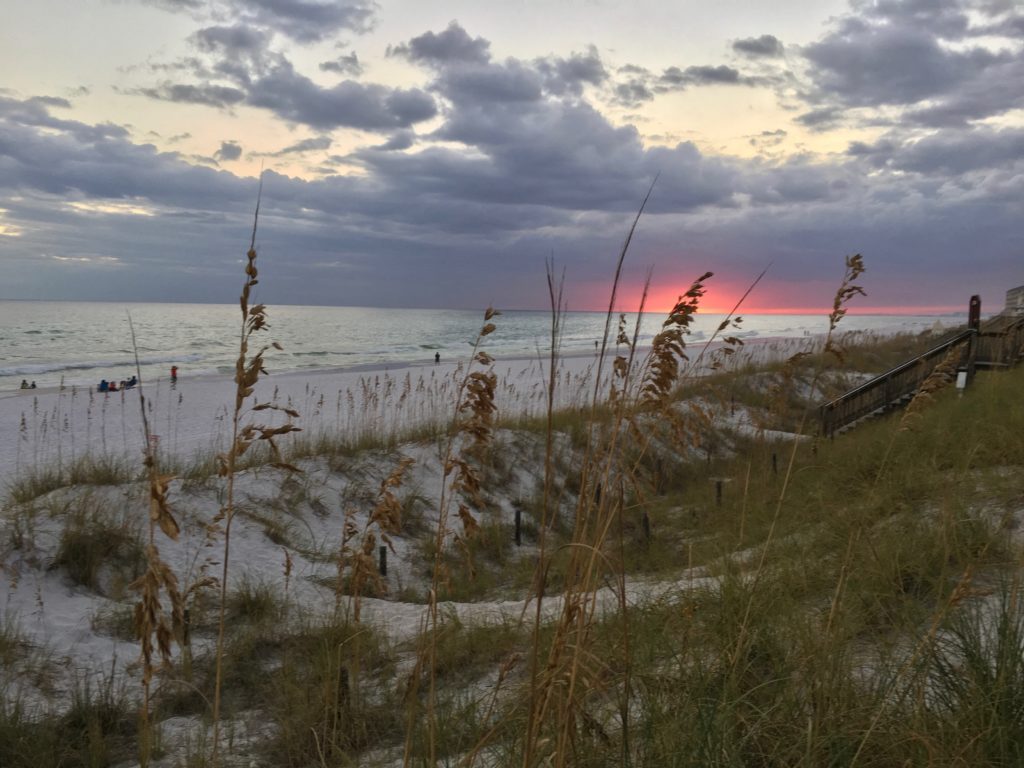
Destin Sunset 10.15.16