Doc’s “story none dare tell”

Doc Searls says we need a new leadership narrative:

“…what’s “super” about U.S. superpower — a near-limitless ability to make high-technology war, backed by a fighting force of finite size with few allies — is an anachronism. I’m not sure the people of any Great Nation are ever ready to face the fact that the height of their military and economic powers has passed. Or that the leadership they most need to assert is no longer only a military and economic one.”

If we can no longer win every war we start and our economy isn’t Number One… is it possible for the U.S. to still be “super?” Let’s hope so.

This is a thoughtful and insightful post on America, leadership and journalism. Worth a read.
Political cybersquatting

“The election has “triggered an avalanche of cybersquatter activity,” according to NetNames, a domain name management service. Speculators have registered nearly 2,000 domain names related to presidential candidates as of last week. Names related to Mrs. Clinton’s candidacy made up over half of the registrations, followed by Mr. Obama with 635 and Mr. McCain with 269.” — The Caucus (the NYT politics blog):

I didn’t see a lot of creativity in the domain names listed in the Times story. HillarysFatAss.com and UppityAfroAmerican.com were conspicuous by their absence.

Twitter growing on me

It started working for me when I stopped thinking about what I was doing and turned my attention to what my friends are doing. I’m only “following” a few people so far (Jamie, David, Andy, Kevin, Jackie, George). For me, this works a little like the Buddy List in iChat. Knowing that George is attending a conference in California or that Kevin is looking for interns, is useful or –at the very least– interesting.

I’m still getting the hang of Twitter but if you are a Twitter-er, let me know so I can “follow” you. Trust me, it’s not as dip-shitty as it sounds.

Blogs = Google Juice

In January I posted a video clip of a guy bouncing a nail on the head of a hammer. Actually, he was juggling the nail on the head of the hammer. Just watch the amazing video.

Yesterday I received notification of a comment on the post. It was from Scot Nery, the man in the video. The clip had been pulled from YouTube and he provided a permanent link to the video.

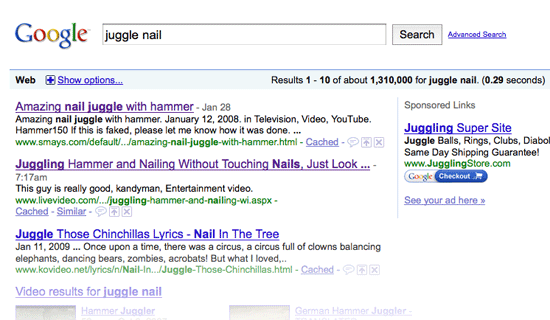
I assumed he found the post with a Google search but since it didn’t include his name or any identifying data, I wondered what he searched for. When I tried “nail juggle” (without the quotation marks), my post was number one out of 213,000 results. If I’m clear on how Google works, those two words would give you every hit with either “nail” or “juggle.”

Think about that. Those are two pretty common words. And a lot of the results pertained to Scot Nery doing the nail thing.

Just one more example of the sweet google juice generated by blogs.

The ravages of time

Stevethennow

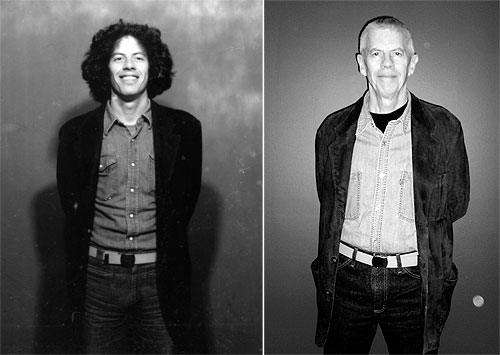
When I showed this "then-and-now" photo to my life-long friend John, he posed the following questions: How are these two people different? How are they the same?

Are we essentially the same person at 60 that we were at 25? Or does a lifetime of experiences change us? I seem to recall reading that our personalities are fully formed at a very early age. So most of the changes are physical (and inconsequential)? The "me" in my head feels exactly like that younger version. And maybe that’s the answer to John’s question. The differences are all positive. If I had to pick one, I’d say I’m a little wiser. But only a little.

More than half of Americans say they tend not to trust the press

That’s one of the findings of a nationwide Harris Poll of 2,302 U.S. adults surveyed online between January 15 and 22, 2008 by Harris Interactive.

“Looking at the press in general, over half (54%) of Americans say they tend not to trust them, with only 30 percent tending to trust the press. Just under half (46%) of Americans say they do not trust television, while one-third (36%) do trust them. Somewhat surprisingly, Internet news and information sites do slightly better as a plurality of Americans (41%) trust them while just one-third (34%) tend not to trust them. And, radio tends to do best among Americans as 44 percent say they tend to trust it and one-third (32%) tend not to trust radio.”

As for “trusting radio,” are they referring to radio news or radio in a broader sense (talk shows, etc). And why does radio (and the net) earn higher trust than TV and newspapers?

Larry David on Hillary Clinton

Hillaryimages

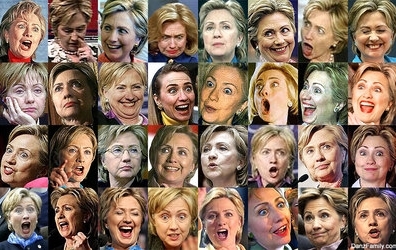
“A few weeks ago, I started to feel sorry for her. Oh Christ, let her win already…Who cares…It’s not worth it. There’s not that much difference between them. She can have it. Anything to avoid watching her descend into madness. So I switched. I started rooting for her. It wasn’t that hard. Compromise comes easy to me. I was on board. And then I saw the ad.

I watched, transfixed, as she took the 3 a.m. call…and I was afraid…very afraid. Suddenly, I realized the last thing this country needs is that woman anywhere near a phone. I don’t care if it’s 3 a.m. or 10 p.m. or any other time. I don’t want her talking to Putin, I don’t want her talking to Kim Jong Il, I don’t want her talking to my nephew. She needs a long rest. She needs to put on a sarong and some sun block and get away from things for a while, a nice beach somewhere — somewhere far away, where there are…no phones.” [Full post]