
This tune isn’t ready for the road it’s proof I’m still practicing. Struggling with good clean chords and smooth changes. Once I get this song memorized and can stop looking at the iPad, these will improve.
I’ll be on the deck if you need me
 The Universe has told me to go sit down and shut the fuck up. So I think I will. For a while at least. Social media is a toxic brew and a break will do me good. When I find something I’d like to share I’ll do that here. Despite my best efforts, I became a little obsessed by the recent political shenanigans and yesterday’s events might just be the icy enema I needed.
Hamra’s Department Store
The photos below were taken by Johnny “Mack” Reeder, probably in the early 50’s but perhaps as early as 1948 or 1949 (maybe a vintage car buff can help me narrow that down). This just off the “courthouse square” in Kennett, MO. The first photo is facing West.
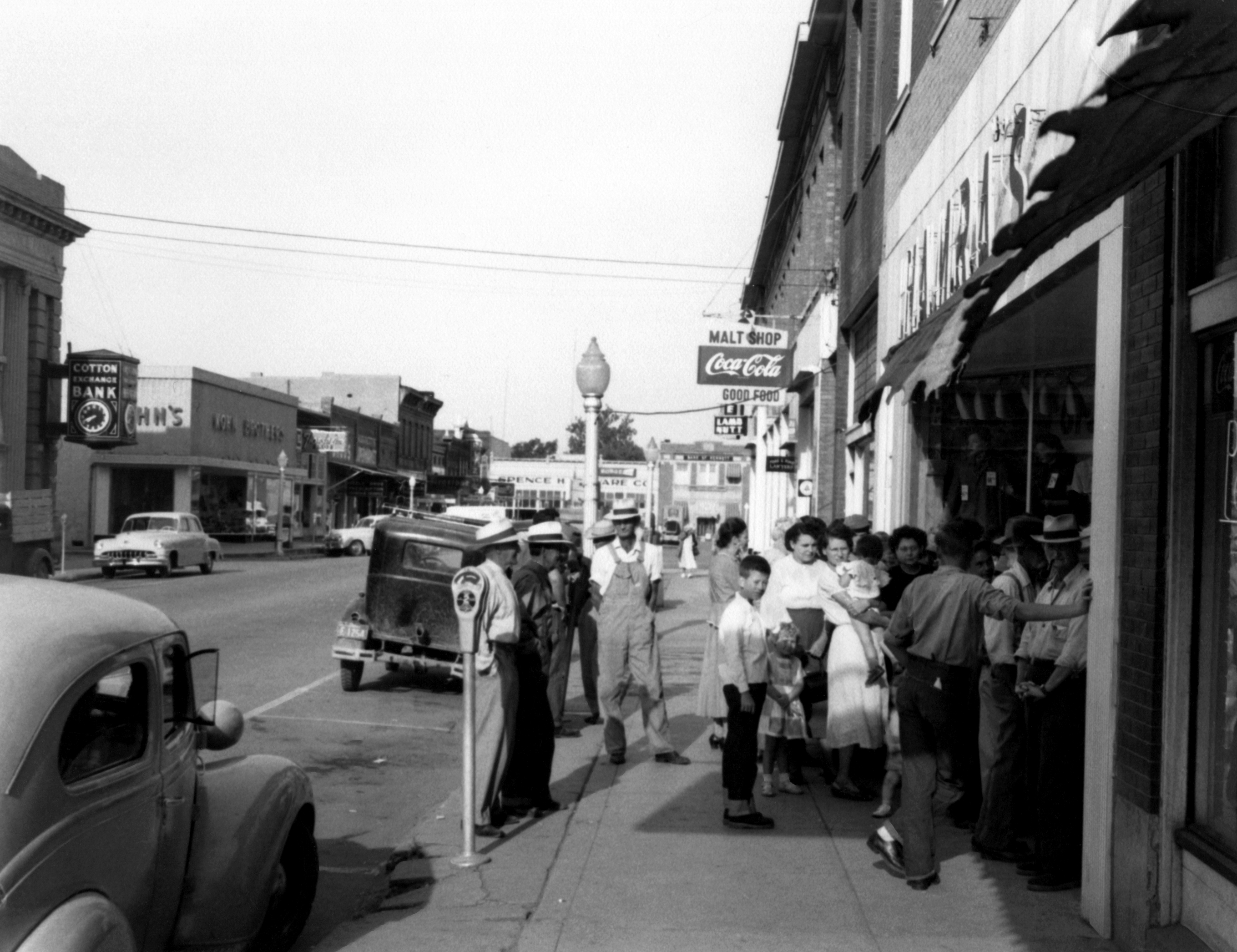
I remember Hamra’s from my youth (born in 1948) but I’m hard-pressed to tell you exactly what they sold. Clothing and fabrics, obviously, and I recall a shoe store next to the main store shown in these photos. There were several stores like this in “downtown” Kennett. Graber’s, James Kahn’s, Penney’s and some I can’t remember.
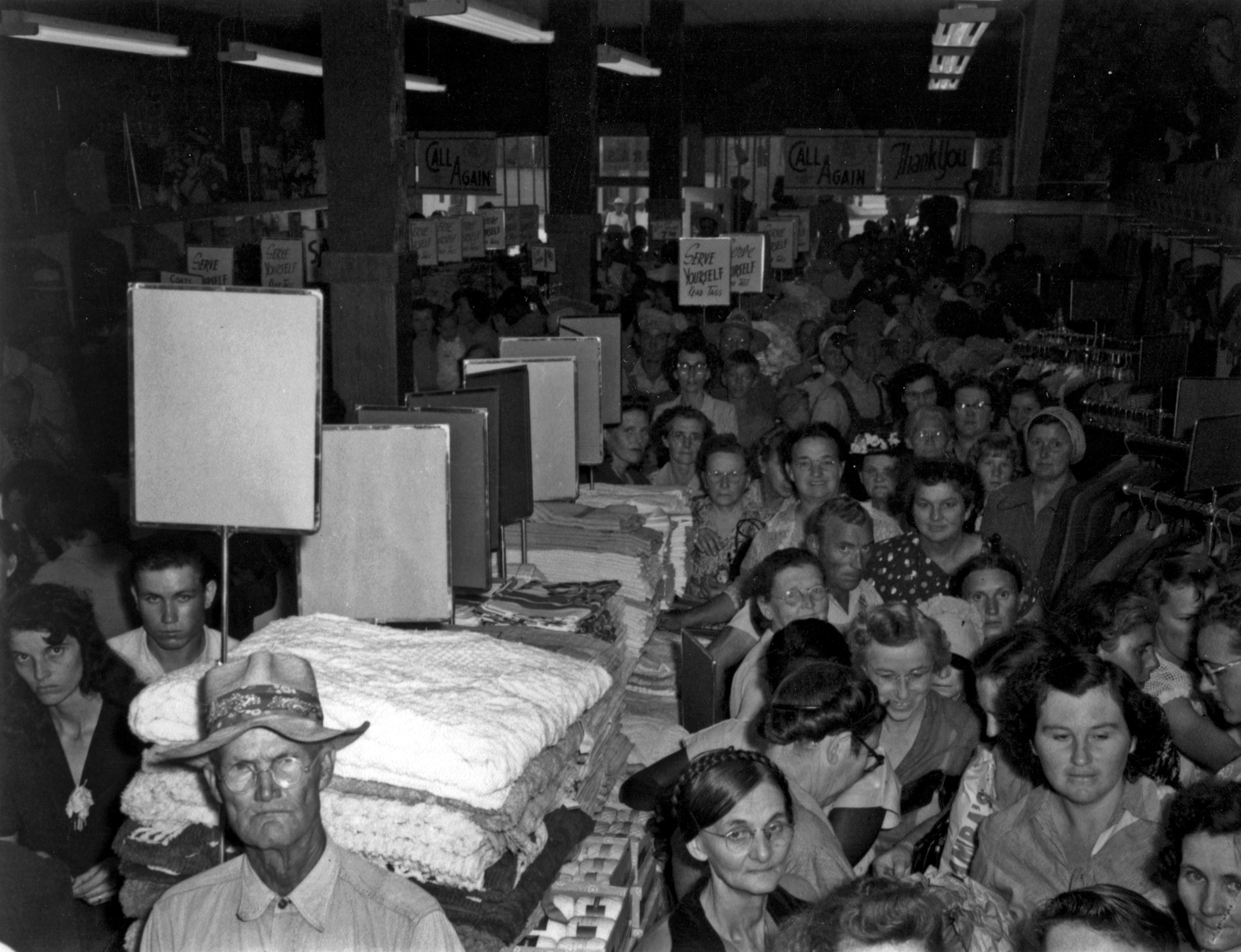
I don’t think this was a “grand opening” so I’m guessing this was some sort of special sale. The photographer was one of the original employees of KBOA (the local radio station) and might have been recording the big crowd that resulted from advertising.
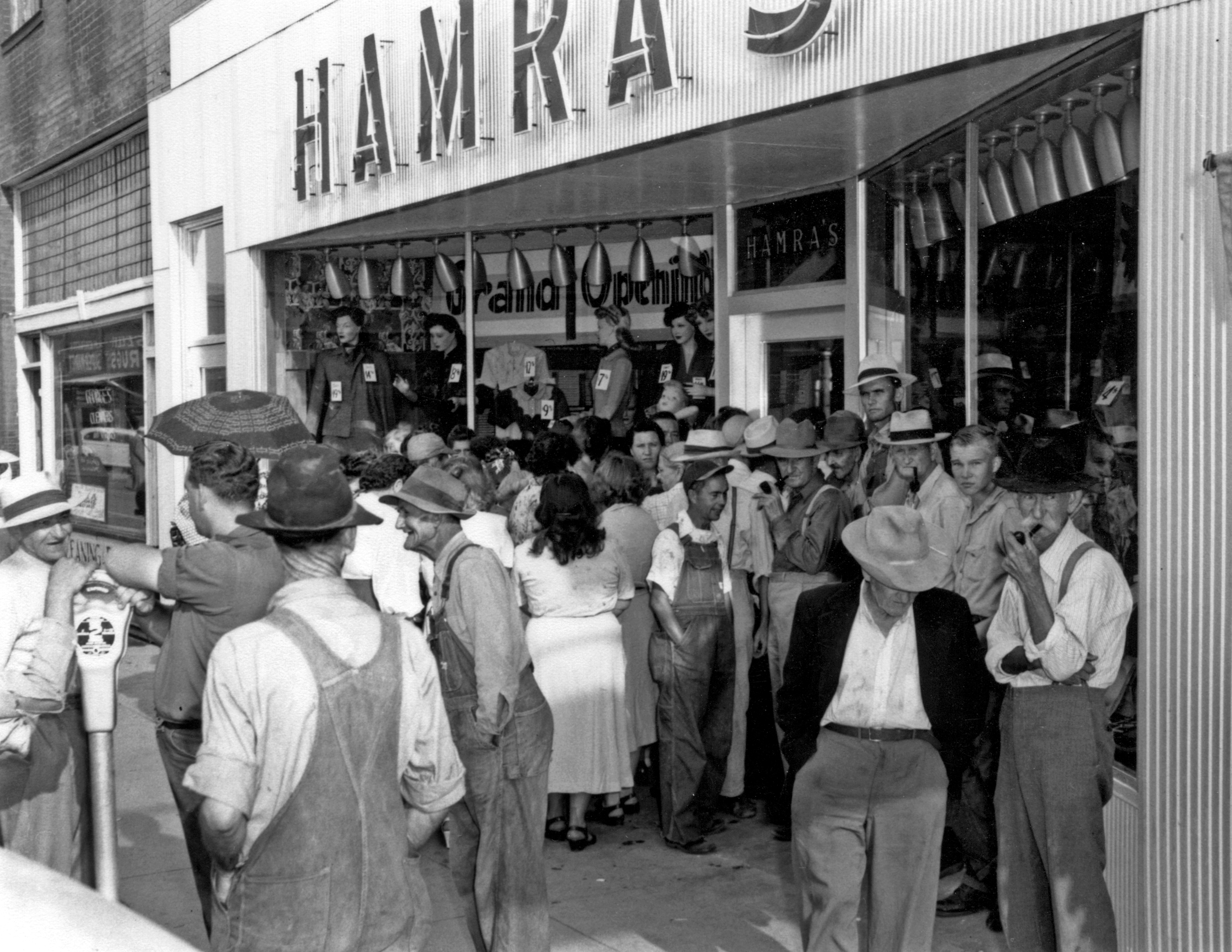
The third photo speaks to the rural flavor of our small town. Lots of bib overalls. I remember hearing stories about hundreds of people flooding into town on a Saturday to purchase supplies for the farms that made up the local economy in those days.
Timeline 3D
“Make timeline charts of world history, family trees, fictional stories or business deadlines.” I’m a sucker for timelines and I purchased this Mac app a few years ago to create a timeline for the company I worked for. Don’t think I ever got around to that but started playing with it recently. 5 minutes.
Gimme Shelter (Playing For Change)
The morning after
I’ll be the first to admit I have a morbid fascination with The Aftermath. What happens after the network news crews have packed up and gone home. A day-in-the-life-of-Bernie Madoff. Who comes to see O. J. on Visiting Day. What will Donald Trump’s life be like if he loses this (what someone called a) “root canal of an election?”
“Business failures, legal woes, and social shunning, without friends or (apparently) a tight family network to sustain him.”
This is the deepest dive I’ve come across on this question.
Trump’s Graying Army
A couple of phrases immediately jumped out at me from this Atlantic piece by Alex Wagner. “a sea of gray and white” and “a bygone generation’s last furious gasp against modernity.” A lot of revealing stats (and insights) in this piece.
“Someone who is 70 today was born in 1946 and grew up in the Beaver Cleaver world of the 1950s, an anomalous period of time in America when the postwar economy was booming and the dominant culture had not yet been disrupted by the civil-rights movement and the sexual revolution. Today’s old people are the last Americans who will ever remember that bygone country—and they see the current election as their last chance to restore it.”
“The voters who are now eligible for Social Security are the last Americans remaining who remember what life was like before the 1960s revolution in American culture. “Those years of the ’50s were the last years of segregation, moms in suburban kitchens, gas-guzzling station wagons, and none of the conveniences of modern technology,” noted UCLA political scientist Lynn Vavreck. Particularly for those who were children at the time, the era carries a romantic cast.”
That would be me. Not sure how romantic I feel about the 50s. A good time to grow up in a small town. If you were white. But people of color had to sit in the balcony at the Palace Theater. They had to use a separate restroom and water fountain at Tommie’s Drive-In. And they couldn’t use the municipal swimming pool at all. So, a little less romantic.
And don’t miss the part about the Villages, “the world’s largest age-restricted gated community—a 40-mile-by-40-mile planned development where only those over 55 may settle. Home to more than 150,000 people, it is the nation’s fastest-growing metropolitan area for several years running.”
Macs are $535 less expensive than PCs
“In 2015, IBM let their employees decide – Windows or Mac. “The goal was to deliver a great employee choice program and strive to achieve the best Mac program,” Previn said. An emerging favorite meant the deployment of 30,000 Macs over the course of the year. But that number has grown. With more employees choosing Mac than ever before, the company now has 90,000 deployed (with only five admins supporting them), making it the largest Mac deployment on earth.”
“But isn’t it expensive, and doesn’t it overload IT? No. IBM found that not only do PCs drive twice the amount of support calls, they’re also three times more expensive. That’s right, depending on the model, IBM is saving anywhere from $273 – $543 per Mac compared to a PC, over a four-year lifespan. “And this reflects the best pricing we’ve ever gotten from Microsoft,” Previn said. Multiply that number by the 100,000+ Macs IBM expects to have deployed by the end of the year, and we’re talking some serious savings.”
Bad Lip Reading: Presidential Poetry Slam
Michael Moore in TrumpLand
 I enjoyed this hour-long stand-up/one-man-show. I’ve seen several of Mr. Moore’s documentaries and liked some better than others. But none of them prepared me for this. If I had to pick one word to describe this… (I really don’t know what to call it. It didn’t feel like a documentary) I guess I go with “personal.” It felt like he was trying to speak “from the heart” as the expression goes to everyone in America. And to Hillary Clinton. Fuck it, there’s no way to describe this and I’d say just watch it but I’m guessing most folks have made up their mind about Michael Moore just as they have everything else (myself included).
I’m a little unclear on his objective. Can’t believe that many people will see this before election day. I watched it on iTunes. I’ll tell you what this reminded me of (a little), a Louis C. K. stand-up special. It was an hour of Moore standing in front of a theater full of people just talking to them. Some jokes, sure, but he really put himself out there. Left me feeling better and it only cost me five bucks.