The Biology of Typing

I didn’t take biology in high school. My mom called the school and told them she didn’t think I needed to take the course. Turns out she was right. But she insisted I take typing. We used real typewriters. Manuals. There were a few electic typewriters in the back of the room but they seemed too exotic and high-tech to use. Every week or so we had these “timed typing” tests to see how many words-per-minute we could type. There some kind of formula…total words minus number of errors, something like that. I quickly figured out that my best shot was to go wide open, with no regard to errors. I frequently had the best score for a document nobody could read. This was 1964 and computers and word processors were years in the future.
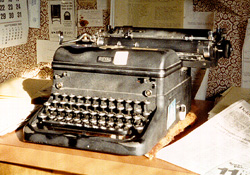
Twenty years later I started working with a guy named Bob Priddy. Bob was (is) a broadcast journalist, author and –in 1984– power typist. His “office” was a cramped, dusty corner of an attic in Jefferson City, Missouri. The digital newsroom was still a few years off and Bob hammered out his news stories on a battered old Royal typewriter. The floor and walls shook when Bob was on deadline. No IBM Selectric for Bob, he was a manual guy all the way. Bob “keyboards” these days. And if he doesn’t pound the keys as he did back then, it’s only because they couldn’t take the punishment.

I recently came across an article by Roger Ebert (In Cyberspace, Writing Is A Performance) that reminded me of Bob and his battered Royal.

“A few moments ago I took the L.C. Smith down from the shelf and tried to type on it, and found that I could not. It’s just so klutzy. My fingers have to travel so far and work so hard to depress a key. You have to manually return the carriage at the end of every line. You have to hit the Tab key to indent. My fingers are no longer trained to hold down the Shift key.”

I love email. I’m trying to get comfortable with Instant Messaging but it’s a struggle. Knowing the other person is sitting there (“Mays is typing you a message”), waiting for me to respond. I find myself drifting back to typing class (“Fuck the typos, I’m going for speed!”).

I don’t think they make manual typewriters any more. Seems like I read that some place. I’m tempted to add, “too bad” but I can’t say why. Sort of like me and biology.
Boiler Room

A great “sales” scene from Boiler Room (2000), written and directed by Ben Younger and staring Giovanni Ribisi, Ben Affleck, Scott Caan, Vin Diesel and Nia Long. The movie was just so-so, but the scene in which Ben Affleck’s character (Jim Young) explains things to a bunch of trainees in a small-time brokerage house is… chilling.

Jim Young: “Goddammit, you fuckin’ guys. I’m gonna keep this short, okay? You passed your sevens over a month ago. Seth’s the only one that’s opened the necessary forty accounts for his team leader. When I was a junior broker I did it in 26 days. Okay? You’re not sendin’ out press packets anymore. None of this Debbie the Time Life operator bullshit. So get on the phones, it’s time to get to work. Get off your ass! Move around. Motion creates emotion. I remember one time I had this guy call me up, wanted to pitch me, right? Wanted to sell me stock. So I let him. I got every fuckin rebuttal outta this guy, kept him on the phone for an hour and a half. Towards the end I started askin him buying questions, like what’s the firm minimum? That’s a buying question, right there that guys gotta take me down. It’s not like I asked him, what’s your 800 number, that’s fuckoff question. I was givin him a run and he blew it. Okay? To a question like what is the firm minimum, the answer is zero. You don’t like the idea, don’t pick up a single share. But this putz is tellin me you know, uhh, 100 shares? Wrong answer! No! You have to be closing all the time. And be aggressive, learn how to push! Talk to ’em. Ask ’em questions… ask ’em rhetorical questions, it doesn’t matter, anything, just get a yes out of ’em. If you’re drowning and I throw you a life jacket would you grab it? Yes! Good. Pick up 200 shares I won’t let you down. Ask them how they’d like to see thirty, forty percent returns. What are they gonna say, no? Fuck you? I don’t wanna see those returns. Stop laughing, it’s not funny. If you can’t learn how to close, you better start thinkin about another career. And I am deadly serious about that. Dead fuckin serious. And have your rebuttals ready, guy says call me tommorrow? Bullshit! Somebody tells you th-they money problems about buyin 200 shares is lying to you. You know what I say to that? I say, hey look, man, tell me you don’t like my firm, tell me you don’t like my idea, tell me you don’t like my fuckin neck tie, but don’t tell me you can’t put together 2,500 bucks. And there is no such thing as a no-sell call. A sell is made on every call you make. Either you sell the client some stock, or he sells you on a reason he can’t. Either way, a sell is made. The only question is: who’s gonna close? You or him?! Now be relentless. That’s it, I’m done.”

Kind of makes me wonder if Ben Younger liked the Glengarry Glen Ross scene as much as I did.

Glengarry Glen Ross (Always be closing)

In thirty years I’ve been in on or part of countless sales meetings, sales seminars and sales calls. But David Mamet boiled it all down to one great scene in the movie Glengarry Glen Ross. It’s the “Always Be Closing, Always Be A Closer” scene in which Blake (Alec Baldwin) is confronting the employees of a tough Chicago real-estate office, Shelley Levene (Jack Lemmon), Ed Moss (Ed Harris) and George Aaronow (Alan Arkin) while their unsympathetic supervisor John Williamson (Kevin Spacey) looks on. If you would like, this monologue I’m sure can be edited into one incredibly long one, if you want to take out the lines from the other actors.


Blake: Let me have your attention for a moment! So you’re talking about what? You’re talking about…(puts out his cigarette)…bitching about that sale you shot, some son of a bitch that doesn’t want to buy, somebody that doesn’t want what you’re selling, some broad you’re trying to screw and so forth. Let’s talk about something important. Are they all here? Continue reading →