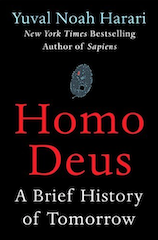
 One measure of a good (non-fiction) book is how much highlighting and underlining I do. The new book by Yuval Harari (Homo Deus: A Brief History of Tomorrow) filled seven pages (PDF) » Homo Deus -A Brief History of Tomorrow (Yuval Noah Harari)
Like his previous book (Sapiens), Homo Deus made me think about a lot of Big Ideas in fresh, new and sometimes uncomfortable ways. He makes some bold predictions but presents them more in terms of trends and in this regard the book reminded me of Kevin Kelley’s The Inevitable. Dr. Harari specializes in World History and macro-historical processes. (Wikipedia)
And the “macro-historical” perspective is what really grabbed in this book. It was good to be jolted out of my ‘election cycle’ time frame. I’ll probably do two or three posts on this book just to keep them from getting impossible long.
I came away with a new — and much broader — understanding of religion which Harari defines as: “any all-encompassing story that confers superhuman legitimacy on human laws, norms and values.”
He includes Liberalism, Communism and other modern creeds but one quickly understand from context that he’s not talking about “liberals vs. conservatives” in the narrow sense of American politics.
“Liberals, communists and followers of other modern creeds dislike describing their own system as a ‘religion’, because they identify religion with superstitions and supernatural powers. If you tell communists or liberals that they are religious, they think you’re accusing them of blindly believing in groundless pipe dreams. In fact, it means only that they believe in some system of moral laws that wasn’t invented by humans, but humans must nevertheless obey.”
This topic gets really interesting in the final chapter of the book but we’ll save that for another post.
The communist laws of history are similar to the commandments of the Christian God, inasmuch as they are superhuman forces that humans cannot change at will. According to Marx, we cannot change the laws of history.
Religion is a tool for preserving social order and for organising large-scale cooperation. […] Without the guiding hand of some religion, it is impossible to maintain large-scale social orders.
Religion is a deal, whereas spirituality is a journey. […] If you obey God, you’ll be admitted to heaven. If you disobey Him, you’ll burn in hell. […] Spiritual journeys take people in mysterious ways towards unknown destinations (Who am I?). […] For religions, spirituality is a dangerous threat.
Religion is interested above all in order. Science is interested above all in power (e.g. to cure diseases, fight wars and produce food.)
Modernity is a surprisingly simple deal. Humans agree to give up meaning in exchange for power.
Is economic growth more important than family bonds? By presuming to make such ethical judgements, free-market capitalism has crossed the border from the land of science into that of religion.
New technologies kill old gods and give birth to new gods. The revolutionary technologies of the twenty-first century are far more likely to spawn unprecedented religious movements than to revive medieval creeds.
Islamic fundamentalists may repeat the mantra that ‘Islam is the answer’, but religions that lose touch with the technological realities of the day forfeit their ability even to understand the questions being asked. […] Hundreds of millions may nevertheless go on believing in Islam, Christianity or Hinduism. But numbers alone don’t count for much in history. History is often shaped by small groups of forward-looking innovators rather than by backward-looking masses.
In the early twenty-first century the train of progress is again pulling out of the station — and this will probably be the last train to ever leave the station called Homo sapiens. Those who miss this train will never get a second chance. In order to get a seat on it you need to understand twenty-first-century technology, and in particular the powers of biotechnology and computer algorithms. […] If Marx came back to life today, he would probably urge his few remaining disciples to devote less time to reading Das Kapital and more time to studying the Internet and the human genome.
Ask yourself: what was the most influential discovery, invention or creation of the twentieth century? That’s a difficult question, because it is hard to choose from a long list of candidates, including scientific discoveries such as antibiotics, technological inventions such as computers, and ideological creations such as feminism. Now ask yourself: what was the most influential discovery, invention or creation of traditional religions such as Islam and Christianity in the twentieth century? This too is a very difficult question, because there is so little to choose from. What did priests, rabbis and muftis discover in the twentieth century that can be mentioned in the same breath as antibiotics, computers or feminism? Having mulled over these two questions, from where do you think the big changes of the twenty-first century will emerge: from the Islamic State, or Google?
The Bible is kept as a source of authority, even though it is no longer a true source of inspiration.

 “There was also no longer any sense of my moving along a timeline. Time was no longer a path with the past behind me and the future before me, as we commonly conceive of it. Instead there was a sense of an eternally unfolding present moment. Rather than time being a journey along a linear path, change appeared to be mandala-like. It seemed to be like a flower seen from above, endlessly unfolding from within, or like a kaleidoscope’s image forever rearranging itself. It struck me as highly misleading to think in terms of there being a past behind us and a future ahead of us. Instead there was only this one present moment, eternally unfolding according to its nature. I found myself in an eternal, timeless present.”