CSPAN meets YouTube


(Business Insider) “A new site called Digital Democracy aims to help voters hold their elected officials accountable by making local government hearings searchable by speaker and subject. You can think of the platform like CSPAN meets YouTube. […] A bot makes daily transcripts of state senate and assembly hearings. It uses facial recognition to monitor who’s talking. Users can see legislators’ financial ties on the platform, and easily share video clips on social media. […] Users can look up hearings by date, topic, speaker, or committee. Or if you want to hear a specific speaker, the video will automatically jump to the point when that person starts talking.”

“Digital Democracy only posts footage from hearings in New York and California right now (the nonprofit launched the platform in California in 2015, and it became available in New York in February). But Blakeslee says that his team hopes to eventually expand the platform nationwide.”

Will we see a day when I can tell my personal AI to find everything my state rep says on topic XYZ? (Sound of thousand of tiny cockroach feet scurrying from kitchen light)

Homo Deus: Religion

One measure of a good (non-fiction) book is how much highlighting and underlining I do. The new book by Yuval Harari (Homo Deus: A Brief History of Tomorrow) filled seven pages (PDF) » Homo Deus -A Brief History of Tomorrow (Yuval Noah Harari)

Like his previous book (Sapiens), Homo Deus made me think about a lot of Big Ideas in fresh, new and sometimes uncomfortable ways. He makes some bold predictions but presents them more in terms of trends and in this regard the book reminded me of Kevin Kelley’s The Inevitable. Dr. Harari specializes in World History and macro-historical processes. (Wikipedia)

And the “macro-historical” perspective is what really grabbed in this book. It was good to be jolted out of my ‘election cycle’ time frame. I’ll probably do two or three posts on this book just to keep them from getting impossible long.

I came away with a new — and much broader — understanding of religion which Harari defines as: “any all-encompassing story that confers superhuman legitimacy on human laws, norms and values.”

He includes Liberalism, Communism and other modern creeds but one quickly understand from context that he’s not talking about “liberals vs. conservatives” in the narrow sense of American politics.

“Liberals, communists and followers of other modern creeds dislike describing their own system as a ‘religion’, because they identify religion with superstitions and supernatural powers. If you tell communists or liberals that they are religious, they think you’re accusing them of blindly believing in groundless pipe dreams. In fact, it means only that they believe in some system of moral laws that wasn’t invented by humans, but humans must nevertheless obey.”

This topic gets really interesting in the final chapter of the book but we’ll save that for another post.


The communist laws of history are similar to the commandments of the Christian God, inasmuch as they are superhuman forces that humans cannot change at will. According to Marx, we cannot change the laws of history.

Religion is a tool for preserving social order and for organising large-scale cooperation. […] Without the guiding hand of some religion, it is impossible to maintain large-scale social orders.

Religion is a deal, whereas spirituality is a journey. […] If you obey God, you’ll be admitted to heaven. If you disobey Him, you’ll burn in hell. […] Spiritual journeys take people in mysterious ways towards unknown destinations (Who am I?). […] For religions, spirituality is a dangerous threat.

Religion is interested above all in order. Science is interested above all in power (e.g. to cure diseases, fight wars and produce food.)

Modernity is a surprisingly simple deal. Humans agree to give up meaning in exchange for power.

Is economic growth more important than family bonds? By presuming to make such ethical judgements, free-market capitalism has crossed the border from the land of science into that of religion.

New technologies kill old gods and give birth to new gods. The revolutionary technologies of the twenty-first century are far more likely to spawn unprecedented religious movements than to revive medieval creeds.

Islamic fundamentalists may repeat the mantra that ‘Islam is the answer’, but religions that lose touch with the technological realities of the day forfeit their ability even to understand the questions being asked. […] Hundreds of millions may nevertheless go on believing in Islam, Christianity or Hinduism. But numbers alone don’t count for much in history. History is often shaped by small groups of forward-looking innovators rather than by backward-looking masses.

In the early twenty-first century the train of progress is again pulling out of the station — and this will probably be the last train to ever leave the station called Homo sapiens. Those who miss this train will never get a second chance. In order to get a seat on it you need to understand twenty-first-century technology, and in particular the powers of biotechnology and computer algorithms. […] If Marx came back to life today, he would probably urge his few remaining disciples to devote less time to reading Das Kapital and more time to studying the Internet and the human genome.

Ask yourself: what was the most influential discovery, invention or creation of the twentieth century? That’s a difficult question, because it is hard to choose from a long list of candidates, including scientific discoveries such as antibiotics, technological inventions such as computers, and ideological creations such as feminism. Now ask yourself: what was the most influential discovery, invention or creation of traditional religions such as Islam and Christianity in the twentieth century? This too is a very difficult question, because there is so little to choose from. What did priests, rabbis and muftis discover in the twentieth century that can be mentioned in the same breath as antibiotics, computers or feminism? Having mulled over these two questions, from where do you think the big changes of the twenty-first century will emerge: from the Islamic State, or Google?

The Bible is kept as a source of authority, even though it is no longer a true source of inspiration.


Time as kaleidoscope

“There was also no longer any sense of my moving along a timeline. Time was no longer a path with the past behind me and the future before me, as we commonly conceive of it. Instead there was a sense of an eternally unfolding present moment. Rather than time being a journey along a linear path, change appeared to be mandala-like. It seemed to be like a flower seen from above, endlessly unfolding from within, or like a kaleidoscope’s image forever rearranging itself. It struck me as highly misleading to think in terms of there being a past behind us and a future ahead of us. Instead there was only this one present moment, eternally unfolding according to its nature. I found myself in an eternal, timeless present.”

The passage above is from Living As A River. I have a little trouble with the flower image but really like the kaleidoscope analogy. I even bought a small one and enjoy watching the tiny pieces of glass rearranging themselves. How many different patterns are possible, I wondered. I thought it would be a matter of permutations and combinations but couldn’t find a formula. I did find this from the Encyclopaedia Britannica:

“The kaleidoscope was invented by Sir David Brewster about 1816 and patented in 1817. Sold usually as a toy, the kaleidoscope also has value for the pattern designer. […] The number of combinations and patterns is effectively without limit.

That surprises me a little. If there are x pieces of glass, it would seem there would be a finite number of combinations. But for the purposes of the analogy, “without limit” works just fine. But another question occurs to me: Is there a way to compute the probability the exact same pattern will repeat? But I’ve drifted pretty far from the “present moment.”

The image of our lives as a road stretching from birth to death, always in one direction, is pretty grooved into my psyche. But I like the kaleidoscope better. All the tiny, colored pieces of my existence, rearranging themselves, moment to moment, never the exact same pattern twice. Yes. That’s a more interesting way to imagine time.

What is Reality?

“Emergence theory is a new physics model currently being developed by a Los Angeles based team of scientists. Emergence theory intricately – yet simply – weaves together quantum mechanics, general and special relativity, the standard model and other mainstream physics theories into a complete, fundamental picture of a discretized, self-actualizing universe.”

“Physics allows the possibility that all the energy of the universe can be converted into a single, conscious system that itself is a network of conscious systems. Given enough time, what can happen will eventually happen. By this axiom, universal emergent consciousness has emerged via self-organization somewhere ahead of us in 4D spacetime. And because it is possible, it is inevitable. In fact, according to the evidence of retro-causality time loops, that inevitable future is co-creating us right now just as we are co-creating it.”

What does a successful transition to a digital government look like?

Well, it looks like Estonia. In the 20 minute interview above, Toomas Hendrik Ilves, former President of Estonia talks about how that country made the transition from Soviet satellite to one — if not THE — most tech savvy countries on the planet. They are sooo far ahead of the US.

At one point in the interview he makes reference to the “borderless world” in which we live. Build all the walls you want, double the TSA goons… but we’re all connected now and more so every day. Put the cap on the toothpaste. Since I first heard the sweet screech of a modem, my sense of place and geography has been fading. I’ve never thought of myself as a “Missourian” and “American exceptionalism” has always seemed like something a shirtless Packers fan would scream at the other team.

Corny as it sounds, I’ve long felt like a citizen of the world. Even though I haven’t seen most of it. So to hear how countries like Estonia and Finland are using technology to better serve their citizens feels like a win for “our team.” Listen to the interview for a glimpse of what can be.

One other point: the person doing the interview (if he even said his name I missed it) was excellent. Short, concise questions. Allowed Ilves time to answer, without interruption.

Everything is exactly the same

“Everything is made of some other thing. And those things in turn are made of other things. Over the next hundred years, scientists will uncover layer after layer of building blocks, each smaller than the last. At each layer the differences between types of matter will be fewer. At the lowest layer everything is exactly the same. Matter is uniform. Those are the bits of God.”

— God’s Debris by Scott Adams

“Matter is incredibly, mind-bogglingly empty. An atom is like a miniature Solar System, with a tight nucleus playing the role of a Sun orbited by electrons like planets. But the nucleus is incredibly tiny compared with the orbits of the electrons. Tom Stoppard, the playwright, had the best image. He said, if the nucleus is like the altar of St Paul’s cathedral, an electron is like a moth in the cathedral, one moment by the altar, the next by the dome. Imagine squeezing all the space out of an atom. Well, if you did that to all the atoms in all the people in the world, you could indeed fit the entire human race in the volume of a sugar cube.” — Physics.org


A few months ago I read James Gleick’s biography of Richard Feynman (Genius: The Life and Science of Richard Feynman). Lots of math and physics (all way over my head, but fascinating nonetheless) and a deep-dive into particle physics, at least for me. My simplistic take-away: 1) Matter and energy are the same thing. Sometimes. 2) Everything is made of this energy/matter. Everything. My hat. My body. Donald Trump. All made of the same stuff.

It would be difficult to get through the day if we experienced reality at this sub-atomic level so our brains (consciousness?) process it in a way that won’t make our heads explode. Nevertheless, I find it comforting to think of it in this way. Little bits of god or the Universe or whatever… winking in and out of existence.

To the moon!

SPACEX TO SEND PRIVATELY CREWED SPACECRAFT BEYOND MOON NEXT YEAR
“We are excited to announce that SpaceX has been approached to fly two private citizens on a trip around the moon late next year. They have already paid a significant deposit to do a moon mission. Like the Apollo astronauts before them, these individuals will travel into space carrying the hopes and dreams of all humankind, driven by the universal human spirit of exploration. We expect to conduct health and fitness tests, as well as begin initial training later this year. Other flight teams have also expressed strong interest and we expect more to follow. Additional information will be released about the flight teams, contingent upon their approval and confirmation of the health and fitness test results.”

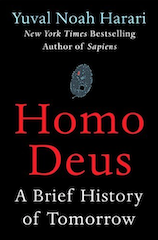
Homo Deus: A Brief History of Tomorrow

The new book by Yuval Noah Harari (Homo Deus -A Brief History of Tomorrow (Yuval Noah Harari-PDF) sounds like just what I need.

“For the first time ever, more people die from eating too much than from eating too little; more people die from old age than from infectious diseases; and more people commit suicide than are killed by soldiers, terrorists and criminals put together. The average American is a thousand times more likely to die from binging at McDonalds than from being blown up by Al Qaeda.” Amazon

Mr. (Doctor?) Harari wrote the bestseller Sapiens: A Brief History of Humankind


From a brief interview (WIRED) interview with the author:

Dataism is a new ethical system that says, yes, humans were special and important because up until now they were the most sophisticated data processing system in the universe, but this is no longer the case. The tipping point is when you have an external algorithm that understands you—your feelings, emotions, choices, desires—better than you understand them yourself. That’s the point when there is the switch from amplifying humans to making them redundant.

Will tech companies become our new rulers, even gods?

When you talk about God and religion, in the end it’s all a question of authority. What is the highest source of authority that you turn to when you have a problem in your life? A thousand years ago you’d turn to the church. Today, we expect algorithms to provide us with the answer—who to date, where to live, how to deal with an economic problem. So more and more authority is shifting to these (technology) corporations.

Brain shape linked to personality differences

“Florida State University College of Medicine Associate Professor Antonio Terracciano joined a team of researchers from the United States, United Kingdom and Italy to examine the connection between personality traits and brain structure. […] The traits include neuroticism, the tendency to be in a negative emotional state; extraversion, the tendency to be sociable and enthusiastic; openness, how open-minded a person is; agreeableness, a measure of altruism and cooperativeness; and conscientiousness, a measure of self-control and determination. As people get older, neuroticism goes down — people become better at handling emotions — while conscientiousness and agreeableness go up — people become progressively more responsible and less antagonistic.”

Science News

Airbus to test flying car by end of year

“The autonomous vertical take-off and landing (VTOL) vehicle called Vahana, is going to be for individual passenger and cargo transport and is supposed to utilize clean technology. The aircraft is composed of eight rotors on two sets of wings, both of which tilt depending on whether the vehicle is flying vertically or horizontally. While initially CityAirbus would be operated by a pilot (similarly to a helicopter) to allow for quick entry into the market, it would switch over to full autonomous operations once regulations are in place.”

BigThink.com