Why Doctors Hate Their Computers

This is a long article (like all New Yorker articles) but very interesting. A few nuggets:

More than ninety per cent of American hospitals have been computerized during the past decade, and more than half of Americans have their health information in the Epic system.

A 2016 study found that physicians spent about two hours doing computer work for every hour spent face to face with a patient—whatever the brand of medical software.

A team at the Mayo Clinic discovered that one of the strongest predictors of burnout was how much time an individual spent tied up doing computer documentation.

21 Lessons for the 21st Century

I’m not up to reviewing Yuval Noah Harari’s latest book (21 Lessons for the 21st Century) but I liked this one by The Guardian. I really liked his two previous books, Sapiens and Homo Deus, and you can read some of my favorite excerpts in previous posts. I’m doing the same below but first I’ll say this book made me questions some of my long held beliefs. Nationalism, Religion and Immigration, just to name a few. This is a good example of what I mean when I suggest you ditch Facebook and TV news and read a book.


“The Industrial Revolution has bequeathed us the production-line theory of education. In the middle of town there is a large concrete building divided into many identical rooms, each room equipped with rows of desks and chairs. At the sound of a bell, you go to one of these rooms together with thirty other kids who were all born the same year as you. Every hour a different grown-up walks in and starts talking. The grown-ups are all paid to do so by the government. One of them tells you about the shape of the earth, another tells you about the human past, and a third tells you about the human body.”

“If somebody describes the world of the mid-twenty-first century to you and it sounds like science fiction, it is probably false. But then again, if somebody describes the world of the mid-twenty-first century to you and it doesn’t sound like science fiction, it is certainly false.”

“When a thousand people believe some made-up story for one month, that’s fake news. When a billion people believe it for a thousand years, that’s a religion.” 

“As a species, humans prefer power to truth.”

Trust in the dollar and in the wisdom of the Federal Reserve is so firm that it is shared even by Islamic fundamentalists, Mexican drug lords, and North Korean tyrants.”

“A priest is not somebody who knows how to perform the rain dance and end the drought. A priest is somebody who knows how to justify why the rain dance failed.”

“In 2016, despite wars in Syria, Ukraine, and several other hot spots, fewer people died from human violence than from obesity, car accidents, or suicide.”

““Once AI makes better decisions than we do about careers and perhaps even relationships, our concept of humanity and of life will have to change.“”

““Democracy in its present form cannot survive the merger of biotech and infotech. Either democracy will successfully reinvent itself in a radically new form or humans will come to live in “digital dictatorships.””

“In the twenty-first century data will eclipse both land and machinery as the most important asset, and politics will be a struggle to control the flow of data. If data becomes concentrated in too few hands, humankind will split into different species.”

“So in the twenty-first century religions don’t bring rain, they don’t cure illnesses, they don’t build bombs—but they do get to determine who are “us” and who are “them,” whom we should cure and whom we should bomb.”

“We think we know a lot, even though individually we know very little, because we treat knowledge in the minds of others as if it were our own.”

“If you cannot afford to waste time, you will never find the truth.”


Sam Harris “conversation” with Yuval Noah Harari

Goodbye DSL

I remember my excitement, all those years ago (2005), when I upgraded from dial-up internet access to “high speed” DSL. It was never great but it was the best thing available (we can’t get cable). The local phone company (CenturyLink) advertised 10mbps download (1mbps up) but we never got more than 8 and that was good enough. But for the last six months we’ve had continual problems. Good fast connection one minute… then almost nothing five minutes later. Lots of phone calls and two visits by technicians (image of large man scratching his head) and the service is still unreliable. So today is the day we cancel the service (which only costs $45/mo).

I’ve replaced it with AT&T’s wireless internet service. I’m now getting — on average — 35mbps down and 5mbps up. More than 4x faster! And almost certainly more reliable.

I’m paying $60 per month for the service and that gets me 50gb of data a month. Because we’re also DirecTV customers, they give us an additional 50gb. 100gb/mo should be enough but if we run over, we have an additional 30gb on our phones which can serve as wifi hotspots. I’ll monitor this for a few months to see what our usage looks like. DSL is ancient tech and while it has been mostly a good experience, I happy to see it go.

UPDATE 10/17/18: Or maybe not. Looks like we’ve used three quarters of our 100gb just halfway through our billing period. The overages could mount up fast. And we just don’t want to have to watch and budget. So we’re going back to DSL and will learn to live with slow speeds and unreliable service. But hey, I remember dial-up.

DSL vs. AT&T Wireless

We have a DSL line from our local telco for internet access. We pay $45 a month for 10 megabits download speed (never get more than 8) and less than 1 megabit upload speed. Not great but all that’s available where we live.

Been having problems for the last couple of weeks with technicians coming up to check lines, etc. Keep thinking they have it fixed but the problem persists so we’ve been using the hotspot feature on our iPhones. Yesterday I stopped by the local AT&T store to talk about our data plan to avoid getting surprised by a huge bill.

We’re currently paying $130 a months for 15gb that Barb and I share. Historically, we use very little of this but if we start making heavy use of the hotspot feature that could change. Without getting any further into the weeds here, I upgraded to an “unlimited” data plan for $150 a month. But the plan lets us stop paying for HBO and we get some other discounts so the faster service winds up costing me less than I was paying.

I’d never checked to see what kind of speeds I get from our AT&T wireless so I figured this was a good time to take a look. We’re getting 18 mbs down and 5.6 mbs up. More than twice as fast as the DSL line!

We don’t stream a lot of movies but do have Netflix, Amazon Prime and Apple TV. I’ll keep the DSL service for a few months while we monitor our wireless data use, but I’m thinking I can adios the DSL.

This is might be more noteworthy to me because I remember the dial-up modem days. 2400, 14,400, 56K. Dark days? An exciting time? Could never have imagined I’d be able to connect to the internet with a mobile phone. Could never have imagined a mobile phone.

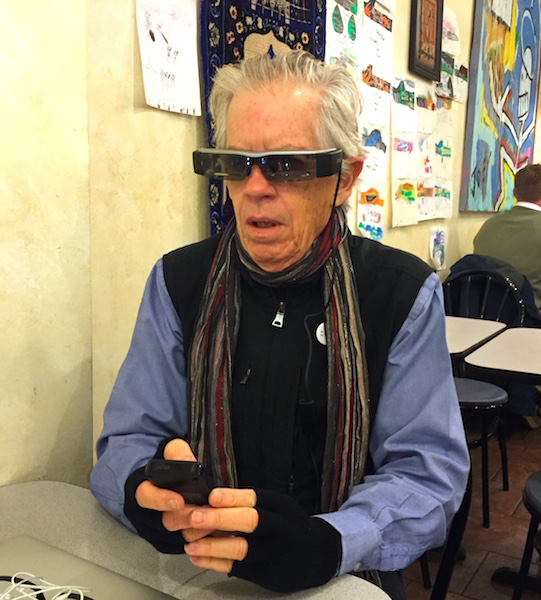
Smart glasses

I’d pay $1,000 for really smart eyeglasses. People who have LASIK surgery tend to rave about how it changed their lives for the better. Fortunately I’ve been blessed with good vision because I just don’t think I could let someone cut on my eyes unless there was no option. These surgical (?) techniques will — I assume — get better and better. That’s a good but I’m counting on eye glasses getting smarter.

A lens that could monitor what’s happening with my eyes as well as my surroundings (light, motion, etc), and adjust on the fly. Reading a book, looking at a laptop screen or a mobile device; watching TV or a movie.

One more thing. A coating on the lens that is impervious to greasy fingerprints.

Beyond the Bitcoin Bubble

Excerpts from a really good article by Steven Johnson in the New York Times.

The real promise of these new technologies, many of their evangelists believe, lies not in displacing our currencies but in replacing much of what we now think of as the internet, while at the same time returning the online world to a more decentralized and egalitarian system. If you believe the evangelists, the blockchain is the future. But it is also a way of getting back to the internet’s roots.

After a period of experimentation in which we dabbled in social-media start-ups like Myspace and Friendster, the market settled on what is essentially a proprietary standard for establishing who you are and whom you know. That standard is Facebook.

What Nakamoto ushered into the world was a way of agreeing on the contents of a database without anyone being “in charge” of the database, and a way of compensating people for helping make that database more valuable, without those people being on an official payroll or owning shares in a corporate entity.

If you think the internet is not working in its current incarnation, you can’t change the system through think-pieces and F.C.C. regulations alone. You need new code.