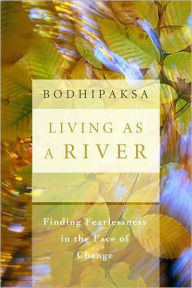
 Finding Fearlessness in the Face of Change
The ultimate act of letting go is to abandon the delusion that consciousness and the world are separate things.
Because we fear our own eventual extinction, we construct the idea of a permanent self.
(The Buddha) saw the self as composed of a number of ever-changing processes.
Knowing that I exist, it’s hard for me to imagine never having existed, and so in my own mind there’s a certain inevitability about my existence.
When we try to imagine death, what comes to mind is imagining an experience of nothingness, as if we’d still be around to have a non-experience. […] We simply cannot imagine not being able to experience anything at all, because experience is all we know, and so we’re forced to imagine experiencing non-experience.
Since we assume that the self existed before conception and will exist after death, we’ll inevitably imagine that it persists — unchanged — throughout life.
Once we start naming things, our language reinforces our underlying tendency to see them as fixed. We name things, and then we assume that because the name is static, so too is the thing named. The mind takes the language it uses to label reality as if it were reality.
It is (the) flow of events that constitutes what we call consciousness. Consciousness is not seen as being something separate that “has” experiences. Consciousness is the activity of experiencing.
The sage at peace recognizes that aging and dying are simply stories we weave for ourselves.
The opposite of suffering turns out not to be simple happiness, but something indefinable.
We may try to shelter ourselves from an awareness of impermanence by identifying with a nation or religion or with an abstract principle such as progress. […] To cling is to seek a stable refuge in the midst of a torrent of impermanence. […] The more our sense of well-being is dependent upon something impermanent, the more there is an undercurrent of fear. […] Fear leads to clinging, which leads to fear.
Insight is not the same as intellectual understanding but is a direct recognition of impermanence in our experience.
Everything that constitutes us is in fact a process, rather than a thing or object.
“Verbal thinking” – a scrolling tickertape of more-or-less connected words that streams endlessly through the mind.
(The body is) a process that has continuity rather than identity. […] There is no being, only becoming. There is no identity, only change.
In sensing my body as a river, I begin to realize that I do not know what I am. I begin to realize that there is nothing — “no thing” — to cling to or to identify with. One cannot hold onto a river.
If the earth were shrunk to the size of a soccer ball, the average depth of the ocean covering it would be sixty-five microns, or about twice the thickness of a grocery-store plastic bag.
Life is the sustainable self-organization of energy within the material world. […] Life itself is flow, and the energy of life cannot be grasped or possessed.
We need to hold definitions lightly, remembering that they are the map rather than the territory.
Despite Copernicus, we tend to think that we are at the center of the universe — that it all exists in order to serve us. But rather, we are scavengers of energy, peripheral to the vast processes unfolding around us.
Clouds make a good analogy for the illusory nature of the self. There’s nothing permanent in a cloud, just as there’s nothing permanent to be found in the self. The cloud is not separate from its environment, just as my self has no separateness. Just as the cloud lacks the essential qualities I assume a “thing” has, so too does my self lack the qualities I assume a self has. In looking at mists or a cloud; we can see a form, often with an apparently well-defined edge, and yet there’s nothing there that can be grasped. The fact that we name something a “cloud” often seems to create in the mind the assumption that the thing that’s being named is as static as the label applied to it. Often we’ll glance at a particular cloud and then look at it a short while later. Nothing much seems to have changed, because the human mind is not well-equipped to perceive change—especially not in something as amorphous as a cloud.
All concepts are simply labels superimposed upon the reality we perceive.
As we move toward the idea of abandoning the idea of a separate selfhood, we may need to go through a phase of treating the whole of creation as if it were us. […] Extend the idea of the self out far enough, and the idea of the self becomes meaningless.
As I sit breathing in my meditation practice, I might find myself wondering exactly at what point a particular molecule of air could be said to be “in” the body. Is it when it crosses some arbitrarily drawn plane enclosed by the rims of my nostrils? Is it once it’s crossed into the bloodstream? Or bonded to a molecule of hemoglobin? Any line I choose to draw would be purely arbitrary. I look for the boundary of my physical self and can’t find one.
Noticing how my gaze can often fixate on a narrow area in front of me, I become aware of the entirety of my visual field, allowing into awareness everything from the center of my visual field to the periphery. It’s like moving from a kind of “dial-up” connection between the world and my brain to a “broadband” one. Doing this generally has a very calming effect on my inner chatter, as if the sheer volume of incoming data I’m paying attention to leaves no bandwidth available for my inner dramas.
All experience takes place in the mind. […] We can know nothing beyond our sensory experience.
Consciousness is the activity of being aware of something. There can, by definition, be no consciousness separate from the things of which it is aware. […] We can never know objective things separate from our sense-impressions, which are interpretations rather than reality.
There can be no consciousness without something to be conscious of.
There is nothing stable within the mind. There is no permanent core. Perceptions, feelings, thoughts, and emotions are simply flowing through us, but are not us. Consciousness is an activity. It’s there when it happens.
Our identity depends on the internalization of the consciousness of others. Consciousness, like all the other elements, is therefore something that extends beyond the individual and that, in some sense, flows through us like a river.
Each event of cognizing is “a consciousness.” Since perceptions come and go, so too will consciousness come and go. Each response to a perception is another consciousness. There is no enduring consciousness, no permanent watcher at the helm of our being, observing everything that happens and making decisions. There are just the multiple overlapping waves of consciousness, rising and falling, rising and falling.
Our decision-making is a post-hoc conscious labeling of activities that begin outside of awareness.
Where is the self when conscious awareness is absent?
Memories are not etched permanently in the brain. Instead, every time a memory is retrieved, it is destroyed and then re-created, and it becomes a memory of a memory. Any current memories we have are copies of copies of copies… many times over depending on how many times we have recalled that particular experience. Because of this process of creating, destroying, and re-creating memories, our recollections are unstable and subject to alteration. Each time we recall an event from our lives, the memory of that event can change. […] We never have a full recollection of anything that’s happened to us, and our memories are constructed from hints, scraps and traces found within the mind.
“We are never conscious of anything but a particular perception; man is a bundle or collection of different perceptions that succeed one another with an inconceivable rapidity and are in perpetual flux and movement.” — David Hume
The underlying principle of selfhood in Buddhism: there is continuity but no identity.
I am a field of awareness in which all my experiences arise.
It’s largely our thoughts, and the emotional qualities associated with them that create our experience. […] In every moment of perception, we are able to choose between (fear and love). Fear is marked by clinging, aggression, doubt, anxiety, and denial. Love is marked by letting go, being flexible, compassionate regard, confidence, and intelligent curiosity. We have these choices in every moment of our lives.
Every time we make a choice, we play a part in forming a new version of the self, and we also remind ourselves of the self’s unfixed nature. We begin to see more and more clearly that our present experience is produced by largely unconscious patterns of thought.
There is no succession of fleetingly short selves, but instead a never-ending process of change. (No self!)
We simply let go of identifying any part of our experience as the self. Since we don’t cling to anything as being the self, we also don’t think of anything as being other than the self. […] There is simply experience, with no absolute distinction between subject and object. There is no idea “I am perceiving.” there’s no idea that there’s a separate world being perceived. There’s just experience.