Not matter how deep your cynicism, or how low your opinion of the people who run things in Washington D.C. — and the people who “report” on our government — this book will take you a little deeper into that cesspool. A few of my favorites from the book:
“…the members of The Club nourish the idea that the nation’s main actors talk to the same twelve people every day. They can evoke a time-warped sense of a political herd that never dies or gets older, only jowlier, richer, and more heavily made-up. Real or posed, these insiders have always been here— either these people literally or as a broader “establishment.” But they are more of a swarm now: bigger, shinier, online, and working it all that much harder.”
“The anti-Washington reflex in American politics has been honed for centuries, often by candidates who deride the capital as a swamp, only to settle into the place as if it were a soothing whirlpool bath once they get elected. The city exists to be condemned. … You still hear the term “public service” thrown around, but often with irony and full knowledge that “self-service” is now the real insider play.”
“Washington may not serve the country well but has in fact worked splendidly for Washington itself— a city of beautifully busy people constantly writing the story of their own lives.”
“I have lots of Washington friends and also some real ones.”
“You know someone big has died when they play “Amazing Grace” on the bagpipes.”
“The city of Washington feels like a conspiracy we’re all in together, and nobody else in America quite understands, even though they pay for it.”
“God just loves Washington; of that we are certain. His presence is indeed potent at the Kennedy Center, although everyone keeps looking around for someone more important to talk to.”
“Fly on the wall,” a journalistic practice that is both a cliché and a misnomer: no one notices an actual fly on the wall while everyone is fully mindful of the maggot reporter taking notes.”
“No single development has altered the workings of American democracy in the last century so much as political consulting,” Jill Lepore wrote in the New Yorker.”
“Political Washington is an inbred company town where party differences are easily subsumed by membership in The Club.”
“Whether journalists are gathered on a physical bus or reading a virtual document, it is a shared space. They are encountering the same names and characters and, after a while, acquiring a shared language and sensibility. “If there was a consensus,” Crouse wrote, “it was simply because all the national political reporters lived in Washington, saw the same people, used the same sources, belonged to the same background groups, and swore by the same omens. They arrived at their answers just as independently as a class of honest seventh-graders using the same geometry text— they did not have to cheat off each other to come up with the same answer.”
“Parallels between Facebook and D.C. come up a lot. Both are spaces to collect people, show off our shiny hordes, and leverage our “connections.” … Like D.C., Facebook is a vast and growing network, evolving and under some assault, but secure in its permanence as an empire.”
“By the middle of 2011, at least 160 former lawmakers were working as lobbyists in Washington, according to First Street, a website that tracks lobbying trends in D.C., in April 2013. The Center for Responsive Politics listed 412 former members who are influence peddling, 305 of whom are registered as federal lobbyists.”

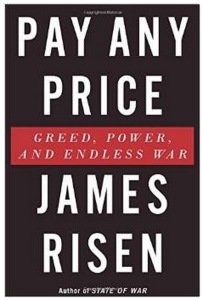 I’m not sure how anyone can have much hope for the future of America by the time they get to the last page of this book. Every institution fails. The military. Congress. Our courts. The White House. The Free Press we were once so proud of. Greed and corruption, up and down the line. Risen introduces us to some good people who tried to do something but they all paid (are paying) a high price and the bad guys are still winning.
 We ain’t the good guys anymore. That was my take-away from Citizenfour, Laura Poitras’ documentary on Edward Snowden. This is far and away the best documentary I’ve ever seen and it was damning. As for who’s a good guy and who isn’t, well, maybe there aren’t any good guys anymore. I’ll tell you who is not a good guy… Barack Obama. Yep, the guy I voted for, twice. Even made some donations to the first campaign. I’d say I fucked up but come on… Sarah Palin?!



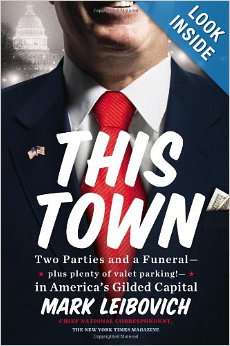 This Town: Two Parties and a Funeral – Plus, Plenty of Valet Parking! – in America’s Gilded Capital