“The Republicans are the problem”

“We have been studying Washington politics and Congress for more than 40 years, and never have we seen them this dysfunctional. In our past writings, we have criticized both parties when we believed it was warranted. Today, however, we have no choice but to acknowledge that the core of the problem lies with the Republican Party. The GOP has become an insurgent outlier in American politics. It is ideologically extreme; scornful of compromise; unmoved by conventional understanding of facts, evidence and science; and dismissive of the legitimacy of its political opposition.”

Washington Post op-ed by Thomas E. Mann, senior fellow at the Brookings Institution, and Norman J. Ornstein, resident scholar at the American Enterprise Institute

An actual Trump sentence


Clip of Presidential Candidate Donald Trump campaign event in South Carolina (July 21, 2015)

“Look, having nuclear—my uncle was a great professor and scientist and engineer, Dr. John Trump at MIT; good genes, very good genes, OK, very smart, the Wharton School of Finance, very good, very smart —you know, if you’re a conservative Republican, if I were a liberal, if, like, OK, if I ran as a liberal Democrat, they would say I’m one of the smartest people anywhere in the world—it’s true!—but when you’re a conservative Republican they try—oh, do they do a number—that’s why I always start off: Went to Wharton, was a good student, went there, went there, did this, built a fortune—you know I have to give my like credentials all the time, because we’re a little disadvantaged—but you look at the nuclear deal, the thing that really bothers me—it would have been so easy, and it’s not as important as these lives are (nuclear is powerful; my uncle explained that to me many, many years ago, the power and that was 35 years ago; he would explain the power of what’s going to happen and he was right—who would have thought?), but when you look at what’s going on with the four prisoners—now it used to be three, now it’s four—but when it was three and even now, I would have said it’s all in the messenger; fellas, and it is fellas because, you know, they don’t, they haven’t figured that the women are smarter right now than the men, so, you know, it’s gonna take them about another 150 years—but the Persians are great negotiators, the Iranians are great negotiators, so, and they, they just killed, they just killed us.”

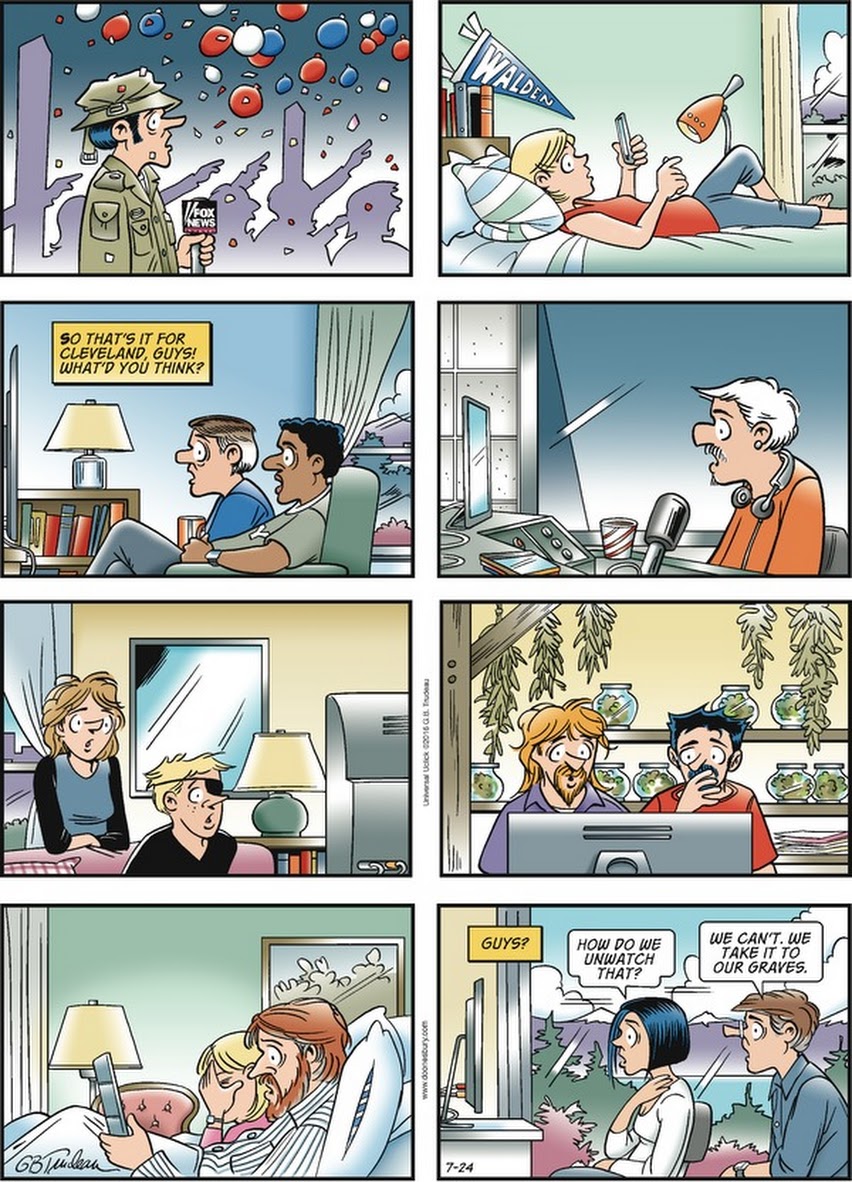
There’s No Such Thing As A Protest Vote

In 2016, (the U.S. electoral system) will offer 130 million or so voters just three options:
A. I prefer Donald Trump be President, rather than Hillary Clinton.
B. I prefer Hillary Clinton be President, rather than Donald Trump.
C. Whatever everybody else decides is OK with me.

That’s it. Those are the choices. All strategies other than a preference for Trump over Clinton or vice-versa reduce to Option C.

Clay Shirky: There’s No Such Thing As A Protest Vote

Will you ever retire?

What it will mean to be an elderly millennial (Vice)

“Sometime before death, but after your useful phase, there’s supposed to be this in-between time called “retirement” that sounds pretty great—sorta like childhood, but without anyone trying to teach you anything, and with more drinking.”

And if your plan is to keep working…

“There’s no evidence that jobs for millennials in their 70s will exist. “In terms of their ability to work or keep up with their logical progress—the job requirements are changing a lot faster than human beings can be trained.”

Donald Trump’s Ghostwriter Tells All

God damn, this was a depressing read. But it’s a good example of something I don’t have a good name for. Sort of a you-know-the-truth-when-you-hear-it. It’s a combination of details and phrasing, maybe? Are humans wired to know when someone’s lying? The guy that wrote The Art of the Deal fucked up and knows it.

“But I knew I was selling out. Literally, the term was invented to describe what I did.” Soon Spy was calling him “former journalist Tony Schwartz.”

That is a heavy weight to carry and it might get a lot heavier.

During the eighteen months that he observed Trump, Schwartz said, he never saw a book on Trump’s desk, or elsewhere in his office, or in his apartment.

I’ll confess this is a bias of mine. I always feel a little superior to people to don’t read books. I wonder how many books (and screenplays) are in the works about Trump. I wonder if he knows the difference between famous and infamous. Or cares.

The worst thing Donald Trump could do

donald

I suspect even the staunchest Trump supporter gets a little twinge in his bowels at the thought of The Donald’s tiny finger on the nuke trigger, but I wonder if he could do almost as much damage to the U.S. by sitting in his bathtub and blowing his brains out. That seems less likely than a Trident missile launch but it would fuck this country up for fifty years. Nobody would ever believe the man wasn’t assassinated. Once this thought popped into my head, I tried to think of any way the man might die that wouldn’t be suspicious (to someone). The best I could come up with was meteor strike (earthquake?) I think the world might survive a Trump presidency but if he jumped from the Trump Tower penthouse, I think he might take our country with him.

Racism

[From my series: Broad, Sweeping Generalizations Based On Little or No Knowledge]

The only book I recall reading on the sociology of racism is Black Like Me by John Howard Griffin (1961) but I’ve been thinking about racism and I have some assumptions and some questions.

Assumption: Forming opinions about someone based on the color of their skin is learned behavior. Someone (a parent, other children) has to “teach” a child that black people are lazy or red people are drunks or asians are good a math. (Is there any evidence that racism is hereditary?)

Q: Is racism a disease? (Or disease like) Is it a condition over which the person has no control? Like autism? Treatable but incurable. I don’t recall ever meeting someone who admitted to once having been racists in their thoughts and actions but changed. I would expect the “cure rate” to be on par with ebola. A few people do survive it.

Q: If one lives in a country where a significant number of people hold strong, negative opinions about their fellow countrymen based on the color of their skin, what do you do about that? Education? If you’re talking about educating young people, yeah, sure, that’s a good idea but if they’re getting a constant diet of “nigger” and “spic” from family and friends, I’m not sure education can have much effect. As for educating (re-educating?) adults? I’m skeptical.

Thought experiment: Let’s say someone develops a vaccine for racism. One injection that modifies a few neurons in the medulla whatchamacallit, eliminating the tendency to judge people based on color. Who would take this vaccine? Nobody. Our beliefs define us. A core part of identity. (All Buddhists may leave the room) We don’t want to change how we think and feel about things and people. Because we don’t think there is anything wrong with those thoughts and beliefs. You can keep your vaccine, thanks.

To further belabor my disease analogy, will racism only die when racists die, like a cholera epidemic? In the meantime we inoculate as many as we can?