The Upswing: How America Came Together a Century Ago and How We Can Do It Again
“In a sweeping overview of more than a century of history, drawing on his inimitable combination of statistical analysis and storytelling, Robert Putnam analyzes a remarkable confluence of trends that brought us from an “I” society to a “We” society and then back again.” (Amazon)
I’m only a few chapters into this book and remain skeptical America can ever be a “We” society again. Perhaps the authors can convince me before I’m done. I’ll post a few excerpts without comment because… I wouldn’t know what to say.
“Buoyed by his landslide victory in 1964, LBJ moved to the left on issues of race and inequality, beginning to open an ideological divide that would widen steadily for the next half century. Nevertheless, across LBJ’s far-reaching Great Society initiatives (the War on Poverty, Civil Rights, Voting Rights, Medicare/Medicaid, federal aid to education, and immigration reform—the very issues at the core of intense party polarization in our own period, a half century later), all major bills were supported by majorities or substantial minorities within both parties. On average, these bills were supported by 74 percent of congressional Democrats and 63 percent of congressional Republicans, a fact forgotten by later Republicans who would rail against the leftist extremism of the Great Society programs.”
“This increasing affective polarization has influenced even attitudes to intermarriage. Between 1960 and 2010 opposition to one’s offspring marrying an out-partisan rose from 4 percent to 33 percent among Democrats and from 5 percent to 49 percent among Republicans. This partisan prejudice shows up both in online dating and in actual marriages, as people are increasingly choosing their partners on the basis of political affiliation, even more than on the basis of education or religious orientation. Over the last half century marriage across racial and religious lines has become much more common than either used to be, whereas marriage across party lines has become much less common. This increasing agreement between husband and wife about politics in turn strengthens the inheritance of party identity by the next generation, since we know that children are more likely to inherit party identity when both parents agree politically. In this very intimate way, over the last half century partisanship has gradually replaced religion as the main basis of “tribal” affiliation in America.” (Emphasis mine)

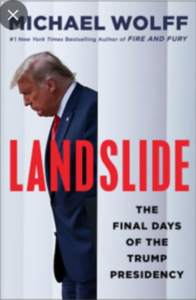 To say that I “couldn’t put this book down,” is a time-worn cliche. And let’s face it, I can put just about any non-fiction book down. But I read this book in 24 hours which is really fast for me. I picked this book because I like the way Michael Wolff writes. I’ll let others judge his reporting, but the man knows how to tell a story. In Landslide, he comes as close as anyone could to making sense of the chaos and madness of Donald Trump’s final days. This book reads like a thriller (or a horror story).