
Category Archives: Philosophy
One less decision
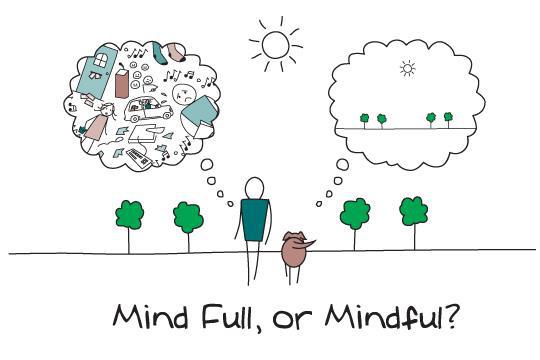
For the past two weeks, breakfast has been cereal with fruit, OJ and (sometimes) toast. This didn’t seem like an important decision until I read David Cain’s post: Why the minimalists do what they do.
“After years of being confronted with a decision shortly after waking, I decided to be done with deciding what was for breakfast. My usual is now the only thing on the menu, and since I stopped deciding what’s for breakfast, mornings have had a significantly different feel. They are clearer and more spacious.”
And it’s about more than what we have for breakfast.
“When we’re faced with a number of options, we’re always going to assume that one of them is better than all the rest. This means the more options there are, the more likely we are to choose one that isn’t the best one. […] Our satisfaction with what we have shrinks as the number of things we don’t have — or could have — grows.”
This notion resonates with me. Even to having fewer shirts or pants to select from each morning.
Your head would explode
I’ve never met David Cain but when I think of “enlightenment,” he comes to mind. If I could pick one person to give me tips on how to live, I think it might be him. From a recent post:
“I now see all instances of minor physical discomfort as a chance to get better at being relaxed. I relax into the discomfort, I let it hang out with me. When you first try it it’s an exhilarating experiment — to voluntarily open up to minor pain when that’s what the moment brings you, to refrain from listening to the impulse to cringe or harden. It feels like you’re walking freely in an area you thought you weren’t allowed to go.”
“The present moment is the only concrete reality you will ever have to deal with. Sometimes it contains pain. We prefer that our realities don’t contain pain. But that can only ever be a preference, because ultimately we don’t have control over the present once it becomes the present. If you truly needed reality to be something other than reality, your head would explode that instant. But it doesn’t. You prefer it to be one way, but don’t need it to be.”
In the can
 While watching the new Tom Cruise movie last week, I found myself feeling anxious about some situation his character was in. A little worried about how it was going to come out. It was clearly a moment of suspended disbelief. And then, sitting in that dark, nearly empty theater, I had a moment of insight. The movie I was watching was already “in the can.” The story I was watching had ended, long ago.
Things might work out for Tom’s character (they usually do), or they might not. But that had already been decided. Nothing happening in my head, in that theater, would change how the movie ended. As that dawned on me, I had a very strong feeling the same is true for my story as well. I’m saying the lines and doing the stunts but the story was written long ago and the movie is in the can. I can’t change the story or how it ends. Like Mr. Cruise, I can say my lines a little differently in each take, but the plot is done.
I know this is a very disturbing notion for many people. A ridiculous idea for some. But the more I think about it, the more convinced I become. No, “convinced” is not right. It’s more of a feeling. A recognition. ‘Ah, yes. This is how it is.’
I choose not to try to ‘understand’ this.
The God Argument
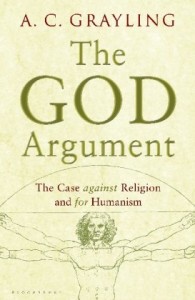 The God Argument (The Case Against Religion and for Humanism) by A. C. Grayling was a bit of a slow read for me, compared to a few other books I’ve read on this topic. This was, I believe, my first brush with secular humanism and it’s nice to have a basic definition of the concepts.
“Secularism is the principle of maintaining a separation between religious interests and bodies, on the one hand, and the state, on the other hand, on the premise that religion has no greater claim than any other self-interest outlook in debates about matters of government and public policy.”
“The basis of humanism is that we are to answer the most fundamental of all questions, the question of how to live, by reflection on the facts of human experience in the real world, and not on the basis of religion. […] As a broad ethical outlook, humanism involves no sectarian divisions or strife, no supernaturalism, no taboos, no food and dress codes, no restrictive sexual morality other than what is implicit in the demand to treat others with respect, consideration and kindness.”
Humanism’s two fundamental premises: 1) “there are no supernatural agencies in the universe,” 2) “our ethics must be drawn from, and responsive to, the nature and circumstances of human experience.”
“A key requirement (of humanism) is that individuals should think for themselves about what they are and how they should live. […] It imposes no obligations on people other than to think for themselves.”
Same for stoicism which, at first glances, seems to share some ideas with Buddhism.
“Stoicism’s main doctrine was that one should cultivate two capacities: ‘indifference’, and self-control. They used the term ‘indifference’ in the strict sense of this term to men neutrality, detachment, as in not taking sides on a question, or being disengaged from a quarrel.”
A few more ideas that got some highlighter »
Continue reading