Buddha’s Brain

Amazon: “Rick Hanson and Richard Mendius, a neuropsychologist and a neurologist and both practicing Buddhists, show us just how the brain programs us to experience the world a certain way by combining information from the external world with information held in neural pathways within the brain. These pathways operate in the background of our awareness, influencing our conscious mental activity.”

This book was a bit of a struggle for me so the following notes are intended for my own reference and make little sense outside the context of the book.

The self is like someone running behind a parade that is already well under way, continually calling out: “See what I created!” (pg 212)

In the brain, every manifestation of self is impermanent. The self is continually constructed, deconstructed, and constructed again. (pg 212)

We experience “now” not as a thin sliver of time in which each snapshot of experience appears sharply and ends abruptly, but as a moving interval roughly 1-3 seconds long that blurs and fades at each end. (pg 213)

At any moment, the parts of the self that are present depend on many factors, including genetic heritage, personal history, temperament, and situations. In particular, self depends on a lot of feeling tone of experience. When the feeling tone is neutral, the self tends to fade into the background. But as soon as something distinctly pleasant or unpleasant appears, the self quickly mobilizes. The self organizes around strong desires. Which comes first: Do “I” form a desire? Or does desire from and “I?” (pg 213)

The self has no inherent, unconditional, absolute existence apart from the network of causes it arises from, in, and as. (pg 213)

The self is truly a fictional character. (pg 214)
The One True Faith. Mine.

I’ve always wondered how deeply religious people could be so certain their “faith” was the real deal and everyone else’s was bogus. Brian Hines wonders, too:

“People will reject unsubstantiated claims in holy books… except the book they believe in. People will reject miracle stories… except miracles related by their own faith. People will reject the divinity of living prophets or messengers of God… except the person they accept as a genuine spiritual teacher.

Every religious believer, aside from the few who are genuinely open-minded, considers that he or she has found the One True Faith among the 4,199 or so false faiths. Yet how is this possible, logically or realistically?

It’s like Garrison Keillor’s Lake Woebegon, where all the children are above average.

There are good reasons for belonging to a religious, spiritual, or mystical group. But having a lock on cosmic truth isn’t one of them. Nobody knows what lies at the heart of reality, or even if there is such a thing: a heart, a core, a central truth.

So the only honest attitude is “I don’t know.” Along with, “You don’t know either.” This leaves us all on the same unknowing level.”

Carpenter’s Tools

When I began working at KBOA in 1972, they were using the same basic style of headphones that they had been using for 20 years. WWII era Bakelite’s designed for durability, rather than fidelity or comfort.

When they became available (a couple of years later?) I bought a pair of Sennheiser HD 414’s. As I recall, I paid about $60 for them, out of my own pocket. A lot of money in those days (I was making about $14K when I left KBOA in 1984).

But they were wonderful. Light, soft foam ear pieces… and they sounded GREAT. The music sounded great and I sounded great. I looked forward to putting those headphones on.

In the nearly 40 years since, I have purchased a lot of what I considered to be the “tools of my trade.” Microhones; my first computer; digital audio recorders; laser printer; CD drive; video cameras; laptops; and –most recently– the iPad.

I have always looked on these purchases as investments. Not in my company, rather in me. I could have waited until the company thought it made sense to purchase these tools but I was impatient. And I was right. The things I learned (still learning) usually improved my skills and enhanced my value.

Most of my co-workers throughout the years took a different view. If the company wanted them to have and use the latest tools, the company should pay for them. Can’t argue with that.

But I’ve always thought of these purchases as the “carpenter’s tools.” A carpenter friend once explained to me that master carpenters would not think of using someone else’s tools. They took pride in the things they built and insisted on having and using their own tools, that went with them from job to job.

And, if you have a good accountant, you can take the expense as a deduction. Happy Tax Day.

Scott Adams: Religion as road maps

“Religions are like different maps whose routes all lead to the collective good of society. Some maps take their followers over rugged terrain. Other maps have easier paths. Some of the travelers of each route will be assigned the job of being the protectors and interpreters of the map. They will teach the young to respect it and be suspicious of other maps.

“Okay,” I said, “but who made the maps in the first place?”

“The maps were made by the people who went first and didn’t die. The maps that survive are the ones that work,” he said.

At last, he had presented a target for me to attack. “Are you saying that all the religions work? What about all the people who have been killed in religious wars?”

“You can’t judge the value of a thing by looking only at costs. In many countries, more people die from hospital errors than religious wars, but no one accuses hospitals of being evil. Religious people are happier, they live longer, have fewer accidents, and stay out of trouble compared to nonreligious people. From society’s viewpoint, religion works.”

— From God’s Debris by Scott Adams

Religion and ego

Brian Hines finds it strange “that religiosity is so often associated with humility, selflessness, and lack of ego. Actually, the religious impulse is highly egotistical.”

How would religious belief be affected if it was known that our sensations of being connected with, of under the care of, a higher power were entirely contained within our own personal mind/brain?

The mystical and spiritual experiences would feel the same. But no longer would we believe that we were contacting a transcendent divinity. We couldn’t claim a special relationship with some supernatural being, because that “higher power” would be us.

An expanded us, to be sure. An us that encompassed normally untapped areas of the mind/brain. An us that wasn’t as split, searching, anxious, uncertain, and self-doubting as we are now.

This would eliminate a lot of unnecessary religious egotism. No one would be a member of a chosen people, or a special beloved of God. We’d all just be human beings, having human experiences, making the best use possible of our human psyches.

I’m grateful we live in a country where it’s still okay wonder and write about such things. And yet, any candidate fo higher office who dared make such a connection between religion and ego would be toast.

Don’t interfere with the flow

“There is a profound Buddhist doctrine that speaks of a great river that flows through all of reality. Once you have found yourself, there is no more cause for action. The river picks you up and carries you along forever after. In other words, effort from the personal level, the kind of effort all of us are used to in daily life, becomes pointless after a certain point. This includes mental effort. Once you become self-aware, you realize that the flow of life needs no analysis or control, because it’s all you. The great river only seems to pick you up. Actually, you have picked yourself up — not as an isolated person, but as a phenomenon of the cosmos. No one gave you the job of steering the river. You can enjoy the ride and observe the scenery.”

I like that. I found it in a book by Deepak Chopra (“Reinventing the Body, Resurrecting the Soul”). I’m not recommending the book (you’ll read it if you’re supposed to). But this is where I jot done some of the lines and passages that I want to remember or find again.

Continue reading

Scott Adams: The building blocks of God

“Humanity is developing a sort of global eyesight as millions of video cameras on satellites, desktops, and street corners are connected to the Internet. In your lifetime, it will be possible to see almost anything on the planet from any computer. And society’s intelligence is merging over the Internet, creating, in effect, a global mind that can do vastly more than any individual mind. Eventually everything that is known by one person will be available to all. A decision can be made by the collective mind of humanity and instantly communicated to the body of society.

A billion years from now, if a visitor from another dimension observed humanity, he might perceive it to be one large entity with a consciousness and purpose, and not a collection of relatively uninteresting individuals.”

“Are you saying we’re evolving into God?”

“I’m saying we’re the building blocks of  God, in the early stages of reassembling.”

— From God’s Debris: A Thought Experiment, by Scott Adams

Scott Adams: Reality

“I believe our reality is a holographic simulation, and you and I are just software running within it. Our creator, or creators, who presumably had bodies like ours, made this simulated universe so they could live forever, in a fashion, because their own reality was about to be annihilated in some sort of cosmic catastrophe. Or maybe we’re someone’s seventh grade science project. The point is that we only think we are real because that’s how we were programmed.”

Excerpted from Mr. Adams’ blog. I happen to subscribe to a marginally more spiritual version of this theory.

The Rev. Knute Rockne will deliver today’s message

This morning I overhead two friends discussing religion. Their “conversation” quickly became tense and strained with one party walking away angry.

Kids, listen to your Uncle Steve. The ONLY safe place to talk about religion is in a big room with a bunch of people who feel exactly the way you do about it.

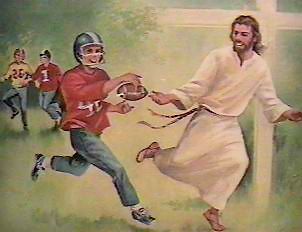
jesus_footballOrganized religion (a redundancy) is like the NFL. It’s made up leagues (Catholic, Jewish, Protestant, Hindu, etc) and the leagues are made up of teams (Southern Baptist, Methodist, Lutheran, Sunni, Shia, etc).

Now, the league officials (the Pope and whatever they call the top guys in the other leagues) don’t want you just getting together on a Saturday afternoon, choosing teams and playing touch football for a couple of hours. That might be fun, but you won’t make it to the Big Leagues like that and those pick-up games sure won’ keep the lights on.

You need uniforms, play books, cheer leaders, a band… and officials to blow the whistle when you break the rules.

With verrrryyyy rare exceptions… every “discussion” of religion (and politics, for that matter) is one person validating his or her beliefs by demonstrating that yours are wrong.