Thoughts without a thinker

“This is why, for Buddhism, the point is not to discover one’s “true Self,” but to accept that there is no such thing, that the “Self ” as such is an illusion, an imposture. In more psychoanalytic terms: not only should one analyze resistances, but, ultimately, “there is really nothing but resistance to be analyzed; there is no true self waiting in the wings to be released.” The self is a disruptive, false, and, as such, unnecessary metaphor for the process of awareness and knowing: when we awaken to knowing, we realize that all that goes on in us is a flow of “thoughts without a thinker.”

One’s True Self (Slavoj Žižek)

Self? What self?

“When we awaken to knowing, we realize that all that goes on in us is a flow of “thoughts without a thinker. The impossibility of figuring out who or what we really are is inherent, since there is nothing that we “really are,” just a void at the core of our being. Consequently, in the process of Buddhist Enlightenment, we do not quit this terrestrial world for another truer reality — we just accept its non-substantial, fleeting, illusory character; we embrace the process of “going to pieces without falling apart.”

Buddhism and the Self

“Unpredictable Freedom and Sweetness of Chaos”

Embrace not knowing what will happen. This is the ultimate freedom. You don’t know what you’re going to do today, nor what will come up. You are locked into nothing. You are completely free to do anything, to pursue any creative pursuit, to try new things as they come up, to be open to meeting new people. It can be scary at first, but if you smile when you think of not knowing, you’ll soon realize it’s a joyous thing.”

When you’re not focused on one outcome, you open the possibility for many outcomes. Most people are focused on specific goals (outcomes), and relentlessly pursue that outcome. They then dismiss other possibilities as distractions. But what if you have no predetermined outcome? What if you say that anywhere you end up could be good? You now open an infinite amount of possibilities, and you’re much more likely to learn something than if you only try to do the things and learn the things that support your predetermined outcome.”

From a post at Zen Habits

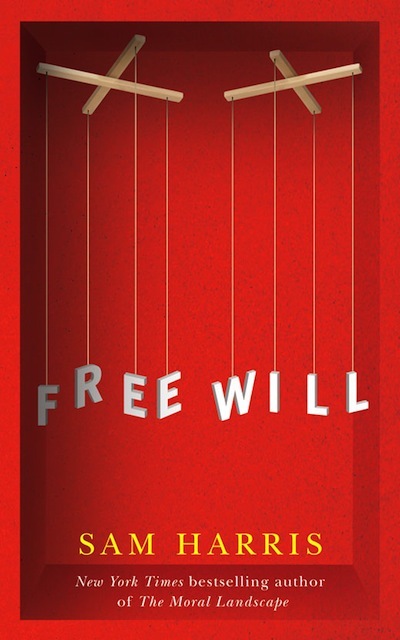
Free Will by Sam Harris

Sam Harris is the author of the New York Times bestsellers, The End of Faith, Letter to a Christian Nation, and The Moral Landscape. Mr. Harris is a Co-Founder and CEO of Project Reason, a nonprofit foundation devoted to spreading scientific knowledge and secular values in society. He received a degree in philosophy from Stanford University and a Ph.D. in neuroscience from UCLA.

A lot of my reading over the last few years has touched on the idea of free will. Real or illusory? I’ll confess that it sure feels as though I have free will. But the more I read about the subject… and think about it… the less certain I am.


The intention to do one thing and not another does not originate in consciousness — rather, it appears in consciousness, as does any thought or impulse that might oppose it.

Some moments before you are aware of what you will do next — a time in which you subjectively appear to have complete freedom to behave however you please — your brain has already determined what you will do. You then become conscious of this “decision” and believe that you are are in the process of making it.

I cannot decide what I will next think or intend until a thought or intention arises.

You are not controlling the storm, and you are not lost in it. You are the storm.

Unconscious neural events determine our thoughts and actions — and are themselves determined by prior causes of which we are subjectively unaware.

The next choice you make will come out of the darkness of prior causes that you, the conscious witness of your experience, did not bring into being.

You are no more responsible for the next thing you think (and therefor do) than you are for the fact that you were born into this world.

You can decide what you decide to do — but you cannot decide what you will decide to do.

My choices matter — and there are paths toward making wiser ones — but I cannot choose what I choose.

What I will do next, and why, remains, at bottom, a mystery — one that is fully determined by the prior state of the universe and the laws of nature (including the contributions of chance).

Take a moment to think about the context in which your next decision will occur: You did not pick your parents or the time and place of your birth. You didn’t choose your gender or most of your life experiences. You had no control whatsoever over your genome or the development of your brain. And now your brain is making choices on the basis of preferences and beliefs that have been hammered into it over a lifetime — by your genes, your physical development since the moment you were conceived, and the interactions you have had with other people, events, and ideas. Where is the freedom in this?

You will do whatever it is you do, and it is meaningless to assert that you could have done otherwise.


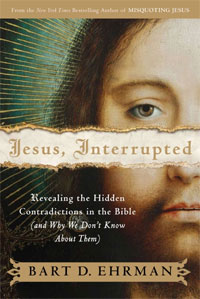
Jesus, Interrupted

The full title of the book is: Jesus, Interrupted: Revealing the Hidden Contradictions in the Bible (And Why We Don’t Know About Them). The author, Bart D. Ehrman, began studying the Bible and its original languages at the Moody Bible Institute and is a 1978 graduate of Wheaton College in Illinois. He received his PhD and M.Div. from Princeton Theological Seminary, where he studied under Bruce Metzger. He received magna cum laude for both his BA in 1978 and PhD in 1985.

I have not read the Bible and — before reading this book — knew almost nothing about it from an historical, scholarly perspective. Here are a few excerpts I highlighted:

The New Testament, consisting of twenty-seven books, was written by maybe sixteen or seventeen authors over a period of seventy years.

A Christianity dependent on the inerrancy of the Bible probably cannot survive the reality of the discrepancies.

Since the nineteenth century, scholars have recognized that Mark was the first Gospel to be written, around 65-70 CE. Continue reading

Words create words, reality is silent

Most of the words I utter in the course of a day just aren’t that necessary. Sure, I have to communicate with co-workers and friends, but that requires far fewer words than I was using. A lot of my recent reading has tugged me in this direction, most recently a collection of conversations titled, I Am That. An excerpt:

“The moment you start talking you create a verbal universe, a universe of words, ideas, concepts and abstractions, interwoven and interdependent, most wonderfully generating, supporting and explaining each other and yet all without essence or substance, mere creations of the mind. Words create words, reality is silent.”

If that’s too woo woo for you, here’s George Carlin:

“More than half of what comes out of your mouth in that client presentation is mindless, pointless, idiotic sounding, space-filling blather. Don’t you want meetings to be shorter? Aren’t you sick of fake words that mean nothing? Wouldn’t you rather be actually creating something rather than killing it with the boatload of words you throw at it before you ever show it to the client? Of course you would. So stop talking like an idiot.”

I’d love to have a transcript of every conversation I had for 24 hours. I’d highlight just the stuff that needed to be said. What percent do you think that might be?

Scott Adams: Ideas

“According to my robot perspective, ideas are the most important force. Humans merely serve as incubators, filters, and transmission facilities for the ideas. It’s a symbiotic relationship because wherever you see the healthiest environments for ideas, humans are usually thriving too.

In this context, I see myself as a collector, combiner, and broadcaster of ideas, both good and bad. I spray ideas into the universe and let the ideas fight for their own survival. With the help of their human hosts, the best ideas will evolve and reproduce, and the worst ideas will go to their resting places on the Internet.

The ideas I unleashed yesterday are already waging a guerrilla war with the status quo. The ideas are hopping from host to host, and if any are worthy, they will evolve and survive.

I see life as a process, not a goal. If my goal had been to create world-changing ideas that worked right away, I would be a complete failure. But I don’t have that goal. Instead, I have a process that involves seeding the universe with ideas and waiting for the strongest to evolve and make a difference. The worst case scenario is that my ideas cause the eventual best ideas to compete harder and evolve to even better forms.”

— From essay by Scott Adams


The Power of Now

I read Eckhart Tolle’s classic The Power of Now in August of 2010. My usual practice for books like this is to highlight passages I find interesting and share them here. I highlighted so many parts of this book, I never go around to it. If you haven’t read the book, the lack of context will make most of these seem, well, just weird. I can assure you everyone line has been valuable to me.

nothing I ever did could possibly add anything to what I already had.

Self = a fiction of the mind

You have it already. You just can’t feel it because your mind is making too much noise.

the knower in you who dwells behind the thinker

All I can do is remind you of what you have forgotten.

Not to be able to stop thinking is a dreadful affliction.

You believe that you are your mind. This is the delusion.

The beginning of freedom is the realization that you are not the possessing entity — the thinker. Knowing this enables you to observe the entity. The moment you start watching the thinker, a higher level of consciousness becomes activated. You then begin to realize that there is a vast realm of intelligence beyond thought, that thought is only a tiny aspect of that intelligence. You also realize that all the things that truly matter — beauty, love, creativity, joy, inner peace — arise from beyond the mind. You begin to awaken.

The voice isn’t necessarily relevant to the situation you find yourself in at the time; it may be reviving the recent or distant past or rehearsing or imagining possible future situations. Here it often imagines things going wrong and negative outcomes; this is called worry. This is because the voice belongs to your conditioned mind.

“watching the thinker” — listen to the voice in your head, be there as the witnessing presence. … The thought then loses its power over you and quickly subsides, because you are no longer energizing the mind through identification with it.

aware but not thinking. This is the essence of meditation.

Because you are identified with it … you derive your sense of self from the content and activity of your mind. Because you believe that you would cease to be if you stopped thinking.

(Ego) a false self, created by unconscious identification with the mind. (It) can only be kept going through constant thinking.

Even when the ego seems to be concerned with the present, it is not the present that it sees: It misperceives it completely because it looks at it through the eyes of the past. Or it reduces the present to a means to an end, an end that always lies in the mind-projected future. The present moment holds the key to liberation. But you cannot find the present moment as long as you are your mind.

Thinking and consciousness are not synonymous. Thinking is only a small aspect of consciousness. Thought cannot exist without consciousness, but consciousness does not need thought.

The mind is essentially a survival machine. It is not at all creative.

Emotion (is) the body’s reaction to the mind.

If there is an apparent conflict between them, the thought will be the lie, the emotion will be the truth.

You will not be free of pain until you cease to derive your sense of self from identification with the mind, which is to say from ego.

Glimpses of love and joy or brief moments of deep peace are possible whenever a gap occurs in the stream of thought. Usually, such moments are short-lived, as the mind quickly resumes its noise-making activity that we call thinking.

Pleasure is always derived from something outside you, whereas joy arises from within.

Become present. Be there as the observer of the mind.

The pain that you create now is always some form of nonacceptance, some form of unconscious resistance to what is.

The mind always seeks to deny the Now and to escape from it. In other words, the more you are identified with your mind, the more you suffer.

Time and mind are in fact inseparable. … The mind, to ensure that it remains in control, seeks continuously to cover up the present moment with past and future,

Unconscious = a complete absence of the watcher.

You can always cope with the present moment, but you cannot cope with something that is only a mind projection — you cannot cope with the future.

ultimately all fear is the ego’s fear of death,

End the delusion of time. Time and mind are inseparable. Remove time from the mind and it stops

Nothing ever happened in the past; it happened in the Now.
Nothing will ever happen in the future; it will happen in the Now.

In the Now, in the absence of time, all your problems dissolve.

The moment you realize you are not present, you are present. Whenever you are able to observe your mind, you are no longer trapped in it.

Usually, the future is a replica of the past.

Ultimately, this is not about solving your problems. It’s about realizing that there are no problems. Only situations — to be dealt with now, or to be left alone and accepted as part of the “isness” of the present moment until they change or can be dealt with. Problems are mind-made and need time to survive. They cannot survive in the actuality of the Now.

it is impossible to have a problem when your attention is fully in the Now

The mind unconsciously loves problems because they give you an identity of sorts

Everything is honored, but nothing matters.

To complain is always nonacceptance of what is. … leave the situation or accept it. All else is madness.

Die to the past every moment. You don’t need it. Only refer to it when it is absolutely relevant to the present.

You can always cope with the Now, but you can never cope with the future — nor do you have to. The answer, the strength, the right action or the resource will be there when you need it, not before, not after.

Eternity does not mean endless time, but no time.

Being cannot become an object of knowledge.

You are cut off from Being as long as your mind takes up all your attention. When this happens — and it happens continuously for most people — you are not in your body. The mind absorbs all your consciousness and transforms it into mind stuff. You cannot stop thinking. Compulsive thinking has become a collective disease. Your whole sense of who you are is then derived from mind activity

Feeling will get you closer to the truth of who you are than thinking.

As there is more consciousness in the body, its molecular structure actually becomes less dense. More consciousness means a lessening of the illusion of materiality.

when presence becomes your normal mode of consciousness and past and future no longer dominate your attention, you do not accumulate time anymore in your psyche and in the cells of the body. The accumulation of time as the psychological burden of past and future greatly impairs the cells’ capacity for self-renewal.

see yourself surrounded by light or immersed in a luminous substance — a sea of consciousness. Then breathe in that light. Feel that luminous substance filling up your body and making it luminous also.

nothing in this world is so like God as silence

You “get” there by realizing that you are there already. You find God the moment you realize that you don’t need to seek God.

the moment that judgment stops through acceptance of what is, you are free of the mind.

Ego is the unobserved mind that runs your life when you are not present as the witnessing consciousness, the watcher.

You cannot have an argument with a fully conscious person.

The whole advertising industry and consumer society would collapse if people became enlightened and no longer sought to find their identity through things.

every moment — is the best. That is enlightenment.

there is no objective world out there. Every moment, your consciousness creates the world that you inhabit.

Only those who have transcended the world can bring about a better world.

who you are is always a more vital teaching and a more powerful transformer of the world than what you say, and more essential even than what you do.

to surrender is to accept the present moment unconditionally and without reservation.

You are walking along a path at night, surrounded by a thick fog. But you have a powerful flashlight that cuts through the fog and creates a narrow, clear space in front of you. The fog is your life situation, which includes past and future; the flashlight is your conscious presence; the clear space is the Now.

Surrender does not transform what is, at least not directly. Surrender transforms you. When you are transformed, your whole world is transformed, because the world is only a reflection.

The amazing and incomprehensible fact is not that you can become conscious of God but that you are not conscious of God.

 

Scott Adams: You are what you learn

“It’s easy to feel trapped in your own life. Circumstances can sometimes feel as if they form a jail around you. But there’s almost nothing you can’t learn your way out of. If you don’t like who you are, you have the option of learning until you become someone else. Life is like a jail with an unlocked, heavy door. You’re free the minute you realize the door will open if you simply lean into it.”