
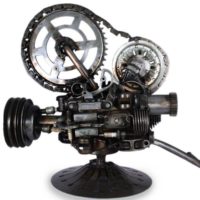
Fear Hologram Projector

The brain has the ability to generate vivid, life-like images and scenes. It does this seemingly on its own. These scenes can appear in one’s consciousness at any moment and they can be nearly indistinguishable from reality (‘out there’ as opposed to ‘in your head’). These thoughts, in my experience, are mostly beyond ‘our’ control. They happen to us. And while we can’t prevent them, we can — with practice — observe them. See them for what they are. The analogy that best captures this for me is a Fear Hologram Projector.

“Fear” because the scenarios that trouble me most involve fear and worry and anxiety. “Hologram” because these little mental vignettes are so incredibly real. I don’t know why the brain (some brains) persists in creating these but the brain in my head pulls from a lifetime of images and situations and mashes them up with the most negative of emotions and ideas.

It’s like walking down one of the endless passages in my brain and suddenly finding myself in one of these holograms. And the more mental attention I give it, the sharper and more detailed it seems. The hologram seems to need the energy of my attention to project. The fear hologram can loop endlessly for days or weeks. Or longer.

The brain can, of course, create a more positive, pleasant scenario. We like to imagine good and happy things happening. It would seem to be just as easy to create that kind of hologram as the awful kind. If ‘I’ am going to imagine some future, why wouldn’t I choose to something pleasant? The only answer I can come up with is I don’t get to choose. These mostly just happen. They come unbidden.

How do we turn off the Fear Hologram Projector?

Well, we can’t turn it off until we recognize what’s happening. We can’t see the projector when we’re in the middle of the hologram loop. The key here is probably mindfulness. Seeing what is really occurring. Not in your head but in the real, objective world around you (if you believe in such a thing). We might think of this as “experiential reality.” What we see, hear, touch, smell, taste.

When I find myself trapped in a fear hologram, it feels dark, like a movie theater. The images on the screen are more vivid in a darkened theater. And I can’t see the projector because I don’t know to look for it, or where to look.

But if I can be mindful enough to recognize I’m in a hologram — something generated by a (I choose not to say ‘my’) mind — I can bring up the house lights of my awareness! And in that instant I can see that the images are not real. They’re brain stuff. Stuff ‘I’ didn’t choose. Under the bright light of my awareness, the hologram images fade and as my awareness stops powering the projector, the images disappear. My belief, my buy-in is necessary for the hologram to exist.

I’m reminded of lines from my reading about Buddhism and Taoism.

“Am I conscious now? It troubles me that I seem so often to be unconscious. I wonder what this unconsciousness is. I cannot believe I spend most of my life in a kind of darkness. Surely that cannot be so. Yet every time I ask the question it feels as though I am waking up, or that a light is switching on.” – Ten Zen Questions

“Belief is at best an educated, informed conjecture about Reality. In contrast, seeing — raw, direct, unadulterated experience — is the direct perception of Reality Itself. […] Base your actions on what you see, rather than on what you think.” – Buddhism Plain and Simple

The bad news: our brains (okay, fuck it! My brain) have an endless capacity for materializing FHP’s (Fear Hologram Projectors), twenty-four/seven. And a lifetime of material from which to create the loops. Access to all our fears and anxieties.

The good news: it’s pretty easy to hit the house lights, spot the projector and pull the attention plug. If we can stay mindful. Of course, mindfulness doesn’t necessarily mean a state of meditative bliss. If you’re rocketing down a black ski slope; lining up for a night landing on an aircraft carrier; or in the middle of brain surgery… you’re probably not trapped on some mental fear loop. And lots of daily, less challenging tasks, can help us stay in the moment. But the mind never stops. You can hit the house lights and pull the plug on the fear projector… and find yourself back in some anxious future 30 seconds later. And this can repeat over and over, day and night.

At the risk of oversimplifying, I am either ‘awake’ or not-awake. Not-awake can take several forms, of course. There the subconscious which is probably what I’ve been talking about. How frustrating that it handles all of those life and death tasks (breathing, heart, etc) without any help from the conscious me…. and still finds time to gin up endless fear and anxiety scenarios.

Then there are dreams — which tend to be more real than the Fear Holograms — but there’s nothing we can do about those. Fortunately, mine seem to fade quickly upon awakening. And I’ve read that we also experience unconsciousness most nights. Dreamless sleep. Would like to have more of that.

I expect to be reaching for the switch to the house lights for the rest of my life. Endlessly pulling the plug on the FHP. But I find some comfort in the belief that “Thoughts think themselves.” I don’t control them. That’s the subconscious, forever and always.

And I have the cushion. Meditation. Observing the mind, allowing it to become quieter (rarely quiet). Awakening, if only for a moment.

When You Can’t Stop Looking Ahead, Look Backwards

More wisdom from David Cain:

This is the ephemeral nature of human experience, and remembering the gist of it can really take the edge off our current worries. So when it seems like you can’t stop looking forward, look back. They all came and went, and few of them seem to justify the worry we suffered over them.

Because we overlook the ephemeral, passing quality of the events in our lives, we engage in this habit of obsessing over the latest uncertainty, stretching its potential pain into days or weeks of guaranteed pain, in the form of worry. By perpetually trying to guarantee for ourselves a painless future, we are perpetually creating a painful present.

When You Can’t Stop Looking Ahead, Look Backwards

Changed Skilled

I expect to see more change and more dramatic, accelerated change in the next 10 to 15 years (yes, I expect to live that long) than I’ve seen in the previous 69 years. It will be tempting to characterize the changes as good or bad but if I’ve learned anything along the way, it’s those are meaningless terms.

I expect to say, “Whoa!” a lot in coming years. I mean, really, a car that fucking drives itself? Are you shitting me? Virtual realities that are indistinguishable from from “real realities.” (We’re gonna need new ways of talking)

I expect the pace and scope of these changes will kill some folks. Their heads will explode (but only on the inside). We’re seeing some of this now and the big stuff hasn’t started. As always, the young will adapt since they have less world to get rocked. But people my age? Baby Boomers? A lot of us will lose. their. shit.

My plan is to become changed skilled. A phrase I first heard 30 years ago at a management retreat. It’s stuck with me. What a great skill to possess. To adapt to change. You can not do that if you’re holding on tight. But “letting go” is now a tattered old bumper sticker. Real hard to do.

I WANT THINGS TO BE THE WAY I WANT THINGS TO BE!

When my shit was all lined up just the way I like it… don’t anybody move… this is perfect. And then everything changed.

And when things were going horribly…

COME ON! COME ON! COME ON! LET’S GET SOME CHANGE UP IN HERE. WHAT THE FUCK IS THE HOLD UP?!

How does one become change skilled, you ask? Easy. You just endure a lot of change and try to unclench your anus. (I also find meditation helps).

Is time real?

A pretty good (admittedly brief) look at two views of time:

  • Presentism: there’s nothing but the eternal now. Here, the past and the future are only present in our minds.
  • Eternalism: The past, present, and future aren’t the makings of our conscious mind. They’re as real as the dimensions of space. ‘Now’ is to time, as ‘here’ is to space.

Alas, they both make sense to me.

The Path

1. Becoming aware there is a Path (and watching for it)
2. Stumbling upon the Path and becoming aware of when one is on (or off) it
3. Understanding one was always on the Path
4. Realizing the Path does not come from or go anywhere has no beginning and no end

Our extended self

I’m rereading Kevin Kelly’s The Inevitable: Understanding the 12 Technological Forces That Will Shape Our Future.

“If I re-google my own email (stored in a cloud) to find out what I said (which I do) or rely on the cloud for my memory, where does my “I” end and the cloud start? If all the images of my life, and all the snippets of my interests, and all of my notes and all my chitchat with friends, and all my choices, and all my recommendations, and all my thoughts, and all my wishes — if all this is sitting somewhere, but nowhere in particular, it changes how I think of myself. […] The cloud is our extended soul. Or, if you prefer, our extended self.”

The Inevitable (Kevin Kelly) (PDF)

Do we have control over our thoughts?

If the answer is “yes,” when and how do we choose what we’re going to think next? And does that mean it’s possible to know what my next thought is going to be before I think it? (I don’t think so) And if we can choose what we are going to think, can we choose to think nothing for the next 30 seconds?

I’ve been reading up on this for a good while now and I’ve concluded it only feels like I’m thinking my thoughts. In fact, the thoughts are thinking me. I’m that little kid in the toy car on the front of the grocery cart. I’m turning the steering wheel left and right and — occasionally — the car turns in the direction I steered. And before you ask, no, I have no fucking idea who’s pushing the cart… I just know it ain’t me.

Comfortable with Emptiness

I came across the following eight or nine years ago on a blog called Beyond Karma. The title of the post was “Cease to Cherish Opinion” and the line that has stuck with me is: “Do not seek the truth; only cease to cherish opinions.” You can and will have opinions, of course… but hold them lightly. Don’t cherish them. At least that’s been my understanding. But the “Do not seek the truth” part has always puzzled me. Why wouldn’t you want to seek the truth? Because (I think) “truth” is a concept. A word we’ll come back to in a minute.

“Rely only on direct experience. It may feel little uncomfortable to rely only direct experience, because what do we really know from direct experience? If you go into it, there isn’t much we can be sure of. “I exist,” there is Awareness, and all experience is in the Now. That’s about it.”

“Get comfortable with the emptiness of no beliefs, no ideas, no concepts, no knowing, no desires, no anticipation, no system, and no future.”

The notion of “emptiness” comes up a lot in Buddhism and Taoism. But what does it mean to to have no beliefs, no ideas, and all the rest. I’ve read that last sentence so many times the words lost all meaning and became just sounds coming out of my mouth. So I looked up the definitions.

Belief – an acceptance that a statement is true or that something exists.
Doesn’t sound all that iron-clad, does it. “I’m not certain, but I believe…” Okay, I can sorta see no beliefs.

Idea – a thought or suggestion as to a possible course of action; the aim or purpose.
A “possible course of action” isn’t the sort of thing you can take to the bank, is it. And who hasn’t admitted to being “fresh out of ideas.” Sure. No ideas.

Concept – an abstract idea; a general notion.
I’m thinking I could go for a while without a concept. I thought an ‘idea’ seemed a little ‘abstract’ so an ‘abstract idea’ is fuzzy enough to put down for a bit.

Knowing – be aware of through observation, inquiry, or information.
To know something through “inquiry or information” doesn’t seem that rock solid. We get bad information all the time. But isn’t observation as good as it gets, reliance-wise? David Blaine says no. Our powers of observation aren’t really that powerful. I can get comfortable with no knowing.

Desire – a strong feeling of wanting to have something or wishing for something to happen.
This one sounds easy to give up but we all want things to be the way we want them to be. Even after they aren’t, if you know what I mean. But desire feels like an emergent property to me. I don’t decide to desire. Desire just is. From out of nowhere (probably the brain). I’d be happy to relinquish desire if someone can tell me how.

Anticipation – the action of anticipating something; expectation or prediction.
This is sort of a ground ball. Maybe. Anticipation must be of a future event or time but the anticipating can only happen now. The future is, after all, imaginary. Not real. Not yet. If I’m anticipating something — even something very pleasant — I’m missing out on the here and now which is the only real time. So let’s “be in the moment” and no anticipation.

System – set of connected things or parts forming a complex whole, in particular.
This one has me stumped. What would it mean to be comfortable with no system? And why would we want to? If I had to guess, this has something to do with spontaneity. Don’t plan, just wait and see what happens.

Future – the time or a period of time following the moment of speaking or writing; time regarded as still to come.
Did we cover this with anticipation? The future only exists in my head. Mind stuff. Sure, I can think about the future but I can only do that thinking in this moment. Now. Put me down for no future.

So we’re “comfortable with the emptiness of no beliefs, no ideas, no concepts, no knowing, no desires, no anticipation, no system, and no future.” What is this state of being? What could be happening?

I could hear a bird singing. I could feel the sun on my face. I could smell that first delicious whiff of a double espresso.

Seems to me the one thing beliefs and ideas and concepts and all the rest have in common is thinking. Thoughts. But no thinking is required for most of the really good stuff. I’m not sure it’s possible to intentionally stop thinking but we do experience moments where the mind becomes still and focused. Jumping the boat’s wake at 40mph is something you do (not me but you, probably) without thinking. The guitarist completely in the groove, playing that song she’s practiced a thousand times. Those moments in deep meditation when the chattering voice in your head becomes silent for just a moment. Emptiness filled with a special kind of awareness, perhaps.