
Making radio relevant again

I’ve been reading Douglas Rushkoff’s latest book (Get Back In theBox: Innovation from the Inside Out) and was delighted to come across an interview with Rushkoff at Radio Marketing Nexus. Mark Ramsey talked with Rushkoff about “how to make radio relevant again.” Ruskoff misses the same things about radio that I do. AUDIO

“Because of my book tours I’ve been in a lot of radio stations, and even from 1995 to 2005 the amount of change I’ve seen has been shocking. There used to be this kind of quality to an FM radio station – I hate to be stereotypical, but there was a certain kind of chick who would be the receptionist at an FM radio station. There was a certain kind of guy that worked in the album room organizing the albums. There was a certain kind of geek figuring out the emphasis rack.

But FM stations are not really like that anymore. They feel much more like almost any other office, and if you didn’t see the control room you wouldn’t know you were in a radio station at all. They don’t ooze their culture anymore.

There was a smell and a quality and a texture to everything radio that I think was the fun of the industry. There was something so real about it. In the early days when I was a kid, you had Ron Lundy and Cousin Brucie – you just somehow knew those guys were there even though they were playing top 40 stuff. You knew it was a world of guys with records and personalities. And there’s so little of that on the radio today.

There’s almost nothing in mainstream radio that has that sense of this as a club of people in a cool place having a great time sharing some of their ecstasy with those of us driving to work or sitting in our bedrooms who wanted to have a taste of what it’s like to be an adult who understands music, who reads “Rolling Stone,” who understands why we’re fighting the Gulf War, or whatever it is. And I want to piece of that.

When I turn on the radio now I don’t feel that these folks have a piece of anything that I can’t get a piece of by going into Allstate to work in the morning. It’s just another working stiff with some computer telling them what to play and when to play it and when to read the ads.

I don’t trust the voice behind the music anymore because I don’t know that he’s really an expert or that he really cares. He’s not part of a living, breathing, fertile culture whereas if I go online and look at these Podcasts I know these people have done it not for the money but for the love of it. And radio is going to have to go a long way now to convince me that there’s somebody there who cares about what they’re doing for some reason other than the cash.

Finally, I would say the purpose of radio is to keep people company. And in order to keep people company there’s got to be a human being on the other side of it. The more truly human your radio station is the better it is at keeping people company. And the more computerized and business-like it is the farther outside the box you’ll find yourself.”

So there you have it. The pure, distilled essence of what’s wrong with radio today. And it seems like it would be very easy to fix. To get back in the box. But I fear we don’t even remember where we put the box.

RadioWarren.com

Warren KrechNow we’re talking. Long-time radio guy Warren Krech has started posting some interviews at RadioWarren.com. I immediately spotted several that I’ll want to listen to. I assume these are interviews he did on local talker KLIK and the station has blessed this re-purposing of the interviews. Good move Mr. Manager. I don’t listen to radio at work so I’ve never heard these. Now I will. And it might prompt me to listen to KLIK to hear more. See what’s happening here?
I looked for, but didn’t see, the feed link. Warren is almost podcasting and will, I’m sure, get that final piece in place. I want to be able to subscribe so I won’t miss any interviews. Or whatever interesting, informative audio (or video?) he comes up with.

And by posting these to an RSS enabled blog, he can open up the comments so we listeners can get in on the conversation. If you lose your way, I’ve added Warren to the blog roll and slotted RadioWarren.com under Links.

Online school closing network in Nebraska

The following item appeared in a recent RTNDA regional newslettter:

Thirty broadcasters in Nebraska have joined a network of stations sharing winter closing information. The idea started in Kearney at KRNY-FM and has grown into an on-line and on-air entity known as weatherthreat.com. The most notable feature of the service is its price—free. Schools, organizations, and the media can all use the service at no cost. On the network’s web site, creator Travis Hollman adds, “But along with being priced right, I would say weatherthreat.com is unique in that it is a non-exclusive network that is operated around the clock by local media working together for a common good.” The system works by giving accounts to all who participate, allowing them to log in and post or check closings. Hollman says he may expand to other states.

At first glance, this looks like a pretty good idea, well executed. These kinds of things almost have to be collaborative to work and getting a bunch of radio stations to cooperate is a good trick. But even if they can’t make this thing regional, it could work on a district-by-district basis. (Thanks, Kay)

Network Affiliate Relations 2.0

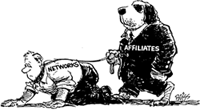
Affiliate RelationsIn the previous post I offered some ideas for using the web and related technologies to “connect” with local radio listeners and advertisers. I took a nap and had a sub sandwich and now I’m ready make a list for network affiliate relations. What is that you ask?

From the mid-eighties to the late nineties, part of my job was “selling” our network services to radio stations. We provided news and and sports programming in exchange for commercials on the local station, which we in turn tried to sell. The trick was to keep the stations you had while adding new stations when and where you could.

I drove all over half a dozen states, meeting with station managers, program directors and news directors. For the most part, this was pre-consolidation and I was talking to the station owner or a manager who was almost completely autonomous. They could make a decision without checking with anyone up the food chain. They were at or near the top of that chain. No longer the reality.

Where was I? Oh. How would I use today’s communication and publishing tools if I were doing that job? First, I’m not sure I would have the balls to do what I’m about to propose. There would be some risk. As much as doing business “the old way?” Don’t know. And, fortunately, no longer my call. But here goes:

Blogging

I’d create the “MyState Radio Network Affiliate Relations Blog.” It would be right out there on the web with the rest of the blogs. No password. The target audience would be the men and women that worked at radio stations affiliated with our network. Topics would include (but not be limited to): Programming, Sales, Traffic, etc. We’d talk about how stations use the network programming and why they sometimes don’t (it’s called clearance).

That sound you hear is the first alarm going off. If we publically acknowledge that some of our affilaites don’t air all of our programming, an advertiser might read the post and become concerned. Fact is, the advertisers already know that or can find out easily enough. By engagaing our affiliates in a frank and open discussion of this topic, we might learn something that could help us improve our clearance.

I’d let stations know about upcoming advertising campaigns and –where possible– offer suggestions on how they can take advantage of this locally. The traditional fear is that if they stations know –in advance– some of them might do or say something that could torpedo the network buy. Not much trust there.

I’d open up the comments and encourage the stations to let us know what they think about what we’re doing. If I got a hot one, I’d jump on the phone (or in my car) and deal with it.

What would an advertiser think of this public exchange? Not sure. We might get some points for being open and transparent. Nothing to hide. Radio stations might take the same view.

Here at the end of 2005 we communiate with our affiliates using the web, email, fax, telephone and in-station visits. All good and all necessary. And safe. Or at least the illusion of safety and control. Whatever the stations think and say about us, they’re thinking and saying. It’s critical to get them to say it to me and say it early.

Podcasting

I’d do a weekly podcast targeted at affiliates but out there for anyone to listen to. Who would I chat with? My news staff; my affiliate relations reps; my sales manager and his account execs; station managers, program directors and news directors… anybody and everybody involved in this business. We’d talk about anything and everything. If we –the network– does something really stupid, we hang it out there and talk about it. Why we did it. How we might do it differently in the future. What if an advertiser heard one of these? Great. If the “conversation” is going to take place, I want to be in on it.

As I said at the beginning of this post, I’m not sure I’d have the nerve to try such…”non-traditional” tactics. I’m not aware of any networks that are but if you know of one, send me a link.

Radio 2.0

Web 2.0 is a term often applied to a perceived ongoing transition of the World Wide Web from a collection of websites to a full-fledged computing platform serving web applications to end users. Ultimately Web 2.0 services are expected to replace desktop computing applications for many purposes. [Wikipedia]

If I owned a radio station (let’s narrow this to “small market” radio station since I have no first-hand experience in large markets), how might I use the Web and related technologies (blogging, podcasting, SMS, etc) to better serve my listeners and advertisers? I have to believe that any idea I might come up with is arleady in place and has been for some time. But just for fun, he’s a few off the top of my head (in no particular order):

1. High-speed Internet access to every office and studio in the radio station. If you still have someone doing “live” radio, they need access to the web.
2. A station website. Doesn’t have to be elaborate or expensive but it does need someone to feed and care for it. Don’t make them do this on their own time. More on content later.
3. A station blog. If I had to choose between one of the “traditional” black-background-lots-of-album-covers sites…and a well tended blog on Blogger or Typepad…I’d go with the blog.
4. Buy at least one digital audio recorder. I can think of no reason to ever buy another analog recorder.
5. If you do school closings and lunch room menus, post these to your site. If your schools are already doing this on their sites, link to them.
6. If you do obits on your station, post these to your website. Better yet, set up a database with a password protected form and let your local funeral homes post and update their announcments.
7. Provide a place where your local churches can post news or link to their websites if they’re already doing this.
8. If you do a daily “Tradio” sell-stuff-on-the-air program, record it and make it available as a podcast. You should also provide an online dB where listeners can post items for sale (a la craig’s list)
9. Record your major newscasts and post these as podcasts. Will take an extra 10 min but will greatly extend the audience for this programming.
10. Take the digital audio recorder to every city council meeting, chamber of commerce meeting, school board meeting, hospital board meeting, etc and record them gavel-to-gavel. Pull some cuts for the on-air news but post the full proceeding as a podcast. If you don’t do this, someone else will. And if you can’t staff these, ask for volunteers. Some of your techie listeners can probably do this better faster than you can and would love to be involved.
11. Create a business directory post short video tours/interviews. If video is just too much, do audio with accompanying photo gallery.
12. If they don’t already have them (and they will), set up blog for each of your loca civic organizations and help them get started. Link from the station site/blog and promote them on the air. Do the same leading up to the county fair or any other annual event.
13. Record the play-by-play audio of your local high school games and post to your website/blog as a podcast. Yes, you can sell sponsorships. Podcast the weekly Coach’s Corner, too.
14. If your local churches are not already “godcasting” their weekly services, offer to help them do this.
15. Find and encourage local bloggers and be sure you have them on the station blogroll.
16. If you have local bands, ask them to send you MP3 files of their recordings and include these on the station website. You’ll probably need a section for different genres (CW, Rock, etc)
17. Produce a local garden or home fix-up show and podcast these from the station website.

If you didn’t recognize a number of the terms I used above, find someone who can clue you in and ask them to help. I’d like to think that anyone currently working in radio (I left in 1984) could expand this list to 100 ideas. Or 200.

If all of this sounds “too local” or corny then forget it because you’re hopelessly screwed. The next generation of listeners are not going to be tuning you in for the tunes. If they listen at all, it will be for this kind of engagement with their lives. Ironically, this is where radio started half a century ago and we were very good at it. Some are still good at it and we better figure out how to get good at it again. Fast.

But don’t worry about your community. They’ll be fine and they can execute every one of the ideas above without any help from the local radio station.

Use the comments link below to let me know what I’ve missed.

Bob Dylan to host weekly show on XM

Bob Dylan has signed on to host a weekly show on XM Satellite Radio, the D.C.-based pay-radio provider. Dylan will select the music, offer commentary, interview guests and answer e-mail from listeners during the one-hour program, which will start in March. Now, just tell me this: Is there anybody that Bob Fucking Dylan can’t get to be on his show? I’m trying to understand why Bob Dylan would do this. It’s not the money. Maybe he’s bored and this sounds like fun.

These are strange and wonderful times. I don’t ever remember seeing anything as big or as disruptive as what we’re seeing now. Color TV was big. Cable TV didn’t seem big at first but it got to be big. I was at the NAB meeting in Chicago when the announced MTV. That was big for a while. But the flood gates (sorry, New Orleans) are open and things just aren’t gonna ever be the same again. I honestly don’t know what it means for me and all my radio buddies but I’m glad it’s finally here. The anticipation (and the need to prepare or do something) has been exhausting. I can’t say we haven’t had a chance to gear up for this sea change, because it’s been ten long years. I’m pooped. But I can finally shut the fuck up about the changes “blowin’ in the wind” because they are here.

CBS Sheds Infinity Name

As Viacom prepares to split into two companies, the CBS Corporation side plans to rename its radio arm, which will become more like an “audio” arm given the new ways to deliver that content. Infinity Broadcasting, which operates 179 radio stations, will be rebranded as CBS Radio. The group will use the slogan “Broadcast….HD…Streaming….On-Demand.” The group’s name change takes it back to its roots. In 1928, CBS formed CBS Radio by purchasing 16 radio stations and forming one of the first radio networks. [B&C. Thanks, Morris]

Newsroom naming rights

Madison radio station WIBA has sold the naming rights to its newsroom. According to a story in the Wisconsin State Journal, beginning January 1, the WIBA newsroom will be called the Amcore Bank News Center. Jeff Tyler, vice president of Clear Channel Radio-Madison, says the deal will not affect news content.

(Disclosure) Our company does business with WIBA and I met Jeff Tyler some years ago. A very sharp guy and a well-respected radio station.

What happens if the FDIC decides to investigate some of the Amcore Banks in Wisconsin? If WIBA does a story (or does not), a listener might wonder if there was any influence. Now that I think about it, it won’t matter. A swarm of bloggers will be all of any such story. Just one more missing frog in the broadcast journalism ecosystem.

Dont’ write Jack off

Russ Schell says don’t dismiss the JACK radio format just because I haven’t heard it:

“I launched the 3rd JACK station in the U.S. and found it, among the very few I’ve programmed, one I actually enjoyed listening to for extended periods. (It was also a ratings smash before I quit.) Most people don’t realize that every incarnation of JACK is different from another. There’s a very loose guideline, of course, in terms of presentation and production values but you won’t find all of the same songs on JACK stations in different parts of the country. There IS localization. There are collaborations with local values and local tastes when it’s done well. There are “air talents” on some JACK stations and none on others. It’s not satellite, it’s not syndication… it’s a concept, and one left open to wide interpretation. That’s the part that the naysayers don’t get.”

“Your Nano is good. Fine. Excellent for a road trip through Kansas… but Nano is a cocoon. Your own music, your way, without any outside intervention or appeal. It’s limiting in that sense and has nothing more “local” than your own brain and own “mix.” I can talk to myself all day… but that doesn’t make me interesting, challenging, compelling, or unique. Hopefully, somehow, that’s what radio can be.”

Russ tried to post this as a comment to an earlier post that linked to a post by Chris Anderson. (I can’t seem to get comments working properly here at Typepad) As far as I know, the Jack format is great radio. I just have not heard it. So I’m certainly not ready to dismiss it. There must be a place where I can stream it and take a listen.

As for the iPod nano: “nothing more local than your own brain and own mix” sounds pretty good to me, Russ. The good news (or bad, depending on your perspective) is, listeners will decide the fate of radio. If it’s good and entertaining and informative…we will listen. The new factor in the equation is all the choices we now have that didn’t exist a few years ago (Internet, iPods, satellite). Radio had a captive audience… and now it doesn’t.

I forgot about the Mothboard on this topic. The perfect place for Russ to have shared his comments. I’ll have to provide a more prominent link.

Is Jack FM the long tail of radio?

The main problem with radio is not the relatively small size of the playlists (although that doesn’t help); it’s that music is polarizing–people may like one song but hate the next, so they’re prone to switch stations or switch off entirely. As MTV found out a decade ago, there simply is no single playlist that can keep enough people listening long enough to please the advertisers. MTV switched to reality shows because they’re sticky. Radio is switching to talk for the same reason.

It is the curse of broadcast: with just a few dozen stations in each city, most must aggregate audiences in the tens of thousands. In an era of infinite choice and narrowcasting, such mass-market broadcast distribution–the ultimate one-size-fits-all model–just can’t compete.

— Chris Anderson on the future of music on radio

I have not heard the Jack format and think it unlikely I will. The little nano is getting more and more of my limited listening time (mostly podcasts, some music). I’m even listening to XM less since getting the little iPod.