“Radio” listening up UK

According to figures released yesterday, the number of radio listeners in Britain is at a record high of more than 45 million every week. The increase is attributed to growing numbers of people tuning in on the internet, digital television and mobile phones.

Almost 8 per cent of people aged 15 and above listen to the radio on their mobile phones, a 24 per cent increase over the same period of 2005. A quarter of 15- to 24-year-olds said they tuned in this way. Listening over the internet rose by 10 per cent and by 9 per cent on digital television.

Podcasts are also more popular. More than two million people, the equivalent of 17 per cent of all owners of MP3 players, listen to the audio downloads – a rise of 15 per cent on the previous three months. [Thanks, Bob]

iPods no threat to radio?

Mark Ramsey at Hear 2.0:

“Every so often someone in the radio industry trots out a study which says iPods really aren’t that threatening to the radio industry’s long-term health and welfare. ‘Folks get tired of maintaining them,’ they will say. ‘They’re just a new form of Walkman,’ say others.”

And the radio industry has (apparently) spent a bazillion dollars promoting HD radio. Check out the Google Trends graph posted as one of the comments.

Everything might turn out roses and sunshine for Radio but it won’t be because of HD.

Bloggers take on talk radio hosts

A San Francisco talk radio station pre-empted three hours of programming on Friday in response to a campaign by bloggers who have recorded extreme comments by several hosts and passed on digital copies to advertisers. This article at NYTimes.com explains and I posted on this when it first came up.

For a dozen years (a long time ago) I co-hosted a one-hour daily call-in show. We did silly shit and almost never got into politics. But we picked the topics for the most part and if the water had gotten too hot, we’d have just stopped taking calls.

That bloggers can now record what we say and send those recordings to our advertisers, urging them to stop advertising on our show… well, that just changes the rules of the game. Big time. Nothing gets a station manager’s attention like a cancellation from a sponsor. “We can always find a new talk show host. Sponsors? Not so easy.”

Your politics will dictate who’s “right” in the story above. But like it or not, yesterday’s “broadcast” is today’s “conversation.” And sometimes it’s all shouting.

Google deal with CBS Radio imminent?

Merrill Lynch broadcast analyst Jessica Reif Cohen expects Google will team with a CBS Radio in a wide-ranging advertising deal. In a nutshell, Google would allow advertisers to bid for radio airtime using some of the same functionality as its online sales tool. But again, no deal has been announced.

Cohen estimated that a Google deal to sell 10% of CBS Radio’s advertising inventory would generate approximately $200 million in revenues and that the upside for CBS would be two-fold: “1) attracting new (likely smaller) advertisers to its platforms a la Google’s experience with search, and 2) creating a more efficient sales model that reduces the friction/cost of selling advertising.” [LostRemote]

Internet access in your car

It’s early days but it is here. And Mark Ramsey looks (not so very far) ahead at what it means for radio stations:

“In the world of mobile radio, our distribution is currently both universal and exclusive. But when “the box” belongs to a third party, we are assured of neither easy distribution nor universal access. The “box owners” will do what Apple does with iTunes: Yes, anyone can post a podcast. But a very few are “featured” while most are not. The “filters” control the value. And in this scenario you and I are no longer the filters.”

I think it’s just very hard for most radio folks to believe that their listeners would listen to another station if they could. If a market has three radio stations, one might be pop…another country…and one doing news/talk. The listening pie is nicely divided, everybody gets a pretty good slice.

When all cars have high-speed net access (and they will), your station won’t be one of a hand full of listening options, it will be one of hundreds.

Will your radio station be in every Ford?

Ford Motor Company and Microsoft are expected to announce new “Windows Automotive” software called “Sync,” that will make it possible (easier?) to make hands-free cell phone calls and download music or receive email.

Chicken Little“If you can use your car to download music, you can also use it to stream music. And if you can stream music then you can do so from any number of music providers, not just your radio station.”

“What is YOUR group doing to be in front of this trend? What is YOUR group doing to be in every car in every way in 2007 and beyond? What content do you have that every Ford will want to stream?” — Mark Ramsey at Hear 2.0

If I were still a radio station program director, I might grab a program schedule and go through the day asking that question about each programming element. I think there will be lots of stuff folks in my local market will want to hear (news, weather, sports, etc) but they won’t want to make an appointment to listen to it. They’ll want to have it automatically downloaded to their cars so they can hear it when they want it. Podcasts.

Good look at the Google Ad Creation Marketplace

Can Google Audio Ads be as easy and effesctive as Google AdWords? That was the question Donna Bogatin (Digital Markets) put to André Bergeron, owner/operator of Babble-On Recording Studios. She wanted “a radio production talent insider take” on how the Google Ad Creation Marketplace will impact the radio advertising industry. Bergeron seems to know what he’s talking about.

“Dollar-A-Holler Radio ads have been around forever. The local Hi-Fi Store owner could always go into the local station and bark off a series of sale prices in shrill tones that would annoy anyone within earshot. This would be no different, really. There is so much more to effective messaging, to branding, to understanding how people listen to the radio than simply writing down “for all your underwear needs” and handing it off to Johnny promo voice to record.

Part of why people can’t stand listening to the radio is the quality of the ads, they’re, by most estimations, shouted, boring, and insultingly simplistic, and, if there are a lot of them, it just magnifies the mind-numbing nature of them.”

I think that sentence really sums it up. That reality will ultimately prove to be The Big Problem for radio going forward. Shitty commercials in an era when we no longer have to listen to them in order to hear the news and music we want.

Andre Bergeron emails an additional thought:

Throughout a programming day, the station dresses itself with a carefully crafted image using music, personalities, promotions, etc – to create “a brand”, if you will. Then a stopset comes on and it’s like the advertisers are allowed to dress the station in clown’s clothes, leisure suites or horizontal stripes.”


Results, not ears

“Who cares if people are hearing the spots unless they’re hearing those spots and acting on them or unless their opinions and intentions are being altered in such fashion that the advertising expenditure is an investment rather than money out the window?

We need to get past the issue of whether or not listeners stay tuned through a break and focus instead on giving the advertiser what they’re paying for: Results, not ears.”

— Mark Ramsey

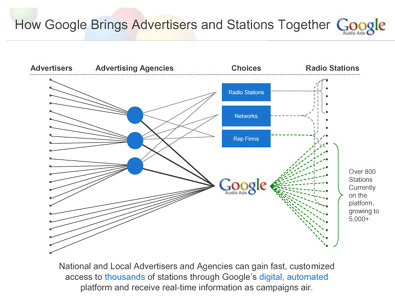
How Google Audio Ads work (PowerPoint slides)

The folks at ZDNet’s Digital Markets have some PowerPoint slides that illustrates how Google Audio Ads work. And this from Voices.com:

“Google has positioned the Audio Ads system to serve both top-level advertisers, as well as the advertising agencies themselves. The graphic also shows 75% of the transactions coming from the agencies, and only 25% from independent advertisers. This is likely because advertising agencies already have media planning and media buying personnel, not to mention existing relationships with local and regional radio stations.”

The lables in the little blue rectangles are: Radio Stations, Networks and Rep Firms. Which suggests that advertisers will simply have another option for placing their ads on radio stations. And if Google can make it easier or cheaper or more effective (i.e. feedback, reports, etc)… they’ve added value to the process.

Clear Channel’s niche play online

“The days of listening to two or three radio stations on a regular basis are long gone, a sign of the times Clear Channel is more than willing to acknowledge. In a direct nod to podcasts and satellite radio, the terrestrial leader is looking to expand its online reach by creating its own hyper-targeted programming for two of the most underserved niche audiences on the airwaves — Nascar fans and the gay community.” — AdAge.com

RadioSomebody(s) at Clear Channel has figured out “this Internet thing.” This article is worth a read.

There are probably some NASCAR formats on the air but I’ve never heard one. And I sure don’t expect to hear a station programmed for the gay community. I think this is a brilliant move and would like to hear some of the stuff they produce.

In a very short time, Rock, Country, Easy Listening, News/Talk and similar formats will seem quaint and anachronistic.

I know what you’re thinking. Why not program for gay NASCAR drivers? Why indeed?