
Some of Dr. Domke’s “sleep hygiene techniques”: 1) Get up at same time every day 2) Don’t take naps 3) Don’t go to bed until you feel sleepy 4) Your body will tell you how much sleep you need 5) Exercise best predictor of a good night’s sleep. Recorded December 21, 2005
Category Archives: Podcasting
Network Affiliate Relations 2.0
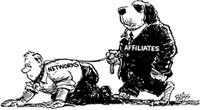 In the previous post I offered some ideas for using the web and related technologies to “connect” with local radio listeners and advertisers. I took a nap and had a sub sandwich and now I’m ready make a list for network affiliate relations. What is that you ask?
From the mid-eighties to the late nineties, part of my job was “selling” our network services to radio stations. We provided news and and sports programming in exchange for commercials on the local station, which we in turn tried to sell. The trick was to keep the stations you had while adding new stations when and where you could.
I drove all over half a dozen states, meeting with station managers, program directors and news directors. For the most part, this was pre-consolidation and I was talking to the station owner or a manager who was almost completely autonomous. They could make a decision without checking with anyone up the food chain. They were at or near the top of that chain. No longer the reality.
Where was I? Oh. How would I use today’s communication and publishing tools if I were doing that job? First, I’m not sure I would have the balls to do what I’m about to propose. There would be some risk. As much as doing business “the old way?” Don’t know. And, fortunately, no longer my call. But here goes:
Blogging
I’d create the “MyState Radio Network Affiliate Relations Blog.” It would be right out there on the web with the rest of the blogs. No password. The target audience would be the men and women that worked at radio stations affiliated with our network. Topics would include (but not be limited to): Programming, Sales, Traffic, etc. We’d talk about how stations use the network programming and why they sometimes don’t (it’s called clearance).
That sound you hear is the first alarm going off. If we publically acknowledge that some of our affilaites don’t air all of our programming, an advertiser might read the post and become concerned. Fact is, the advertisers already know that or can find out easily enough. By engagaing our affiliates in a frank and open discussion of this topic, we might learn something that could help us improve our clearance.
I’d let stations know about upcoming advertising campaigns and –where possible– offer suggestions on how they can take advantage of this locally. The traditional fear is that if they stations know –in advance– some of them might do or say something that could torpedo the network buy. Not much trust there.
I’d open up the comments and encourage the stations to let us know what they think about what we’re doing. If I got a hot one, I’d jump on the phone (or in my car) and deal with it.
What would an advertiser think of this public exchange? Not sure. We might get some points for being open and transparent. Nothing to hide. Radio stations might take the same view.
Here at the end of 2005 we communiate with our affiliates using the web, email, fax, telephone and in-station visits. All good and all necessary. And safe. Or at least the illusion of safety and control. Whatever the stations think and say about us, they’re thinking and saying. It’s critical to get them to say it to me and say it early.
Podcasting
I’d do a weekly podcast targeted at affiliates but out there for anyone to listen to. Who would I chat with? My news staff; my affiliate relations reps; my sales manager and his account execs; station managers, program directors and news directors… anybody and everybody involved in this business. We’d talk about anything and everything. If we –the network– does something really stupid, we hang it out there and talk about it. Why we did it. How we might do it differently in the future. What if an advertiser heard one of these? Great. If the “conversation” is going to take place, I want to be in on it.
As I said at the beginning of this post, I’m not sure I’d have the nerve to try such…”non-traditional” tactics. I’m not aware of any networks that are but if you know of one, send me a link.
Living Healthy (08) – Exercise
Al Franken podcast newscast
According to the folks at Air America Radio, beginning in January Franken will launch a daily podcast newscast. It will be Franken’s voice, but according to Air America, the audio will be lip-synced by attractive underwear models, with both male and female versions. [B&C]
How I would have loved to have been in the meeting where that idea was first floated.
Living Healthy (07) – Smoking
How to Stop Smoking
 I thought I had heard about all there was to hear on the subject of smoking but I learned some new things from this week’s Living Healthy Podcast (show #7, by the way). If you smoke or have a friend or family member that smokes, this episode is worth a listen. Dr. Domke told a chilling story about an acquaintence (a doctor!) who had not smoked for 12 years…smoked one cigarette at a party or bar or something…and still smokes today, years later. The addictive quality of nicotine is staggering. Of those who stop, only 10% are still smoke-free one year later. But Henry is convinced that smokers can quit. No question, this is our best show to date.
Henry and I are having a hell of a good time doing these. And they remind me of all the interviews and radio shows I produced back in the day. But podcasting is sort of the distilled essence of that “radio” experience. It peels away everything but the fun. To all my old radio buddies who saw corporate PD’s and greedy owners suck the joy and life from “radio as we knew it,” I highly recommend podcasting.
Everything you ever wanted to know about the flu
Our little podcast experiment is rolling right along. In show #6, Henry talks about the flu. Who should get flu shots? Can they make me sick? Can I still get the flu, even if I get the shot? Is there a pill I can take for the flu? Are there different kinds of flu? Henry doesn’t tackle Avian Flu in this show because he thinks we are at much higher risk from the regular flu.
The good doctor is in Florida for a couple of weeks but we have three shows in the can. Next week the topic is Smoking; the week after, How to Start an Excercise Program.
Henry is having a lot of fun with this but wonders why more people aren’t downloading and listening to the show. I explain that we’re still kind of on the front end of the podcasting thing. According to a study by research firm Ipsos Insight, about 28 percent of web users know what a podcast is, but only about 2 percent of that group has actually listened to one. But that number is growing. iTunes lists more than 15,000 free podcasts.
Okay, now were talking more about podcasting than the flu but the segue was nearly perfect, so… I might have mentioned that four of my coworkers recently got iPods. These are all long-time radio people and I’m eager to hear their (user) experiences with podcasting. To what kinds of programs will they subscribe? When and where will they listen? What ideas –if any– will these new listening experiences spark?
Living Healthy (06) – Influenza
Living Healthy (05) – Cholesterol
Living Healthy Podcast: Shows 6 and 7
We now have seven Living Healthy Podcasts online or in the can. We’ve been recording two shows at a time to get a bit ahead. Henry’s idea, and a good one. The most recent shows (Influenza and Smoking) are the best to date (IMO). I’m hearing some things for the first time and it’s all useful stuff you can put into practice (or not). And some of it’s just interesting. For example, people who succeed in quitting smoking attempted it seven times. The new shows go up on December 3 and 10.