
Can corporations podcast?

Stephen Baker (Blogspotting) says the novelty of podcasting has worn off (for him, perhaps others). He prefers “pure music” when he works out (not Coverville). He points to a recent consumer survey conducted by Bridge Data that indicates more 80% of podcast downloads never make it to a portable player or another device – they are consumed on the PC (or, worse, never listened or deleted).”

I subscribe to half a dozen favorite podcasts (Diggnation, TWIT, Business Week, Podcast 411) and listen to them on my nano. But I’m not surprised that most folks can’t/don’t choose to do so. I thought about this a good deal this past week as we met with various businesses and organizations to talk about podcasting and how it could be used to communicate with a variety of audiences (internal and external). Imagine a bunch of grown-ups calling some teenagers into the conference room: “We’ve decided we want to hold a company rave and we’d like for you to tell us what this is all about and how to do a good one.”

While it’s relatively inexpensive to produce a podcast, it’s damned hard to do a good one. Companies think in terms of ROI and I’m not sure podcasting will pass that test when you are conditioned to buying “spots” in radio and TV shows with ready-made audiences.

Here’s what I think will happen. A few really savvy businesses or organizations will find someone that really understands podcasting and trust them enough to produce a good one for them. They might hire this person or “sponsor” an existing podcast. Over time, the podcast will develop a following. But we’re talking hundreds of listeners (maybe thousands if it’s REALLY good)…not hundreds of thousands or millions. How much trouble and/or expense will a company go to in oder to reach this relatively small, albeit targeted, audience?

Another possible scenerio is what I think of as the “homegrown podcast.” Some guy that works at Lowe’s, for example, starts doing a weekly home improvement podcast. He’s pretty good at it and gets a little following. He plays it for the boss who likes what he hears and agrees to pick up the costs and buy some better recording equipment. In return for a couple of brief –non-intrusive– mentions about this week’s specials. In the Hollywood version of this story, Lowe’s corporate jumps on the bandwagon.

My gut tells me this is a bottom-up medium. It requires a lot of passion…some juice. People have “passion” and “juice.” Corporations do not. Corporations have spreadsheets. Really good ideas come from individuals, not organizations and institutions. I wonder if that isn’t true of blogs and podcasts as well.
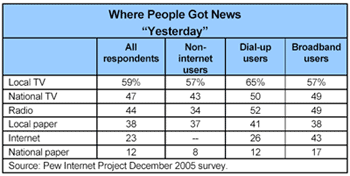
Where did you get the news yesterday?

Pew_news

Interesting answers to that question in the latest PEW study (PDF). For those of us with broadband, 49% got yesterday’s news from the radio…while 43% got it from the Internet. Will there come a time when more people get the news from the Internet than radio? If so, what does that mean for News/Talk radio? What does that mean for regional news networks like ours? [via Radio Marketing Nexus]

Living Healthy (22) – Allergies


This week’s Living Healthy Podcast was nice and laid back. Henry gave us the 411 on allergies. My favorite moment was when he suggested a “cat-ectomy” for people allergic to felines. In just four more shows we will have been at this for six months.

Many of Henry’s patients –our target audience– seem unable to figure out how to listen or subscribe to the podcast. I tend to take a lot of this for granted and would welcome any suggestions on how we could make that process more intuitive. We’re using the standard icons, badges and text links (“Download MP3 file”). Take a look and email or comment ideas on how to improve.

Radio host fired for “racial epithet”

I don’t know about this one. KTRS (St. Louis) talk show host Dave Lenihan was immediately fired after he used the word “coon,” a racial slur, instead of “coup” in describing (Condoleezza Rice’s) attributes for the post of NFL commissioner.

“She’s been chancellor of Stanford. She’s got the patent resume of somebody that has serious skill. She loves football. She’s African-American, which would kind of be a big coon. A big coon. Oh my God. I am totally, totally, totally, totally, totally sorry for that.”

I don’t know about this one. It sounds like a one-time, slip-of-the-tongue. Fruedian? Maybe. But there appears to be no history of bias or racial slurs. Anybody that’s been on the air knows that –eventually– something slips. You have to look at intent here. If Mr. Lenihan is a racist… it’s probably not hard to tell that. Read the transcipt and tell me if I’m wrong here. Why not ask the listeners? Not just the folks that grabbed the phone and called to complain, but a reasonable sample. If there’s a clean concesus that his remark was intentional, he’s gone. If there’s even a possibility it was a slip, with no malice… keep him on. I think I might have taken Mr. Lenihan off the air…had a long talk…maybe talk to members of the community…and then make a decision.

Nobody panics when Rush Limbaugh refers to “these people,” clearly referring to people of color. But Rush is bringing home the bacon. Sounds like Mr. Lenihan was new enough to be expendable.

Sports highlights podcast

Chuck gave me this one at lunch and I couldn’t wait to try it on a couple folks when I got back to the office.

Our company produces the play-by-play broadcasts for some of the top colleges in the country. We pull audio highlights from each game and end up with dozens by the end of a game day. Arguably, the very best moments of the game.

I’d put a couple of sports goofs in a studio with 30 or 40 of these little nuggets and just have them play them, one after other. Just a little set-up on the front end and maye a few seconds of react. Lay some funky music under the entire thing. No mind-numbing analysis or second-guessing. Just play the highlights. And then put it up as a weekly podcast. I think fans would eat this up with a spoon.

Reaction was mixed. I used to pitch ideas like this as though my life depended on them. These days, I toss them out like cheap beads from a Mardi Gras float. If you catch one, good for you. If not, they were only cheap beads.

Nielsen: 68% of active US Net users have broadband at home

“Nielsen//NetRatings… announced today that the number of active broadband users from home increased 28% year-over-year, from 74.3 million in February 2005 to 95.5 million in February 2006. Broadband composition among the U.S. active online population has seen vigorous growth during the past three years, increasing at least ten percentage points annually and hitting an all-time high of 68% for active Internet users in February 2006.” [via RAIN]

Doing what radio does best

Tornados hammered parts of the midwest Sunday night, including Springfield, Illinois. TV was off, cable down, power out, Internet out, newspaper 12 hours from publication…but radio station WMAY was on the air, doing what radio does best. GM Glen Gardner shares this sement from a caller that illustates how to keep radio relevant. [AUDIO: 2 min MP3]

Notice that the person on the air who took the call didn’t interrupt. Didn’t feel the need to jump in and start yapping. That is so rare. If radio has a future –and I hope it does– it won’t be endlessly playing the same 400 songs or turning the signal over to Rush for 3 hours. It will be in on-the-ground, local relevance like this. Thanks, Glen.