Retirement: Relic of the Industrial Age

“Funny thing about getting older. Time goes faster. When you’re young you do time on the bunny slope, easing along at a slow and careful pace. Then as you grow up and become an adult, you go over to the intermediate slope, making the most of time rushing by. Not quite finally, as your dotage approaches, you move over to the black diamond slope, and you carreen downward to Certain Death. … I’m enjoying work now more than ever, running life’s slalom like a wacko skier in a Warren Miller movie. The certainty of death doesn’t bother me. If anything, it motivates me. But the word “retirement” creeps me out. It’s a relic of the Industrial Age I’ve devoted my life to ending.” — Doc Searls

Every time the idea of “retirement” comes up, I’m the only one in the room who hopes to work until the day I die. It’s comforting to know there are others out there.

Who do you resemble?

This genealogy website compares the facial characteristics of an uploaded photo to those of celebrity photos in their database. My best match (61%) was Jean Chretien, the 20th Prime Minister of Canada. I look less like Paul Newman (44%) and bear a similar resemblance to Barbara Streisand and George W. Bush (42%). Thanks to Jeff who is the spitting image of Jack Ruby, Steven Spielberg and Christina Aguilera.

Online school closing network in Nebraska

The following item appeared in a recent RTNDA regional newslettter:

Thirty broadcasters in Nebraska have joined a network of stations sharing winter closing information. The idea started in Kearney at KRNY-FM and has grown into an on-line and on-air entity known as weatherthreat.com. The most notable feature of the service is its price—free. Schools, organizations, and the media can all use the service at no cost. On the network’s web site, creator Travis Hollman adds, “But along with being priced right, I would say weatherthreat.com is unique in that it is a non-exclusive network that is operated around the clock by local media working together for a common good.” The system works by giving accounts to all who participate, allowing them to log in and post or check closings. Hollman says he may expand to other states.

At first glance, this looks like a pretty good idea, well executed. These kinds of things almost have to be collaborative to work and getting a bunch of radio stations to cooperate is a good trick. But even if they can’t make this thing regional, it could work on a district-by-district basis. (Thanks, Kay)

Sound trucks and book clubs

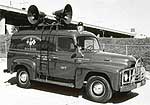
SoundtruckIt’s happening more frequently. One of our sales reps gets asked about podcasting. Technical considerations (RSS, enclosures, etc) aside… I struggle to explain the conceptual differences between a traditional broadcast and a podcast. After it’s all said and done it’s just audio and that makes it easy to confuse the two. But let’s try this:

Broadcasting is driving a sound truck around town (or a thousand sound trucks in a thosuand cities and towns) with music or talk blaring from the speakers. Some people are paying attention… some or not, but we know that everyone in town could hear us.

Podcasting is a book club that meets every Tuesday night in the basement of the Presbyterian Church. We put a note on the church bulletin board to let folks know and they stop by and join the discussion if the book is interesting. If they have a good time, they come back next week.

The guys in the trucks want (and need) to count everyone in town as a listener. But we know exactly how many people show up for each week’s book club meeting. So, can we “advertise” or “market” to the book club? Maybe.

BAD: “Can you hold that thought for just a minute, Ralph? I’ve asked one of the folks from Piggly Wiggly to say a few words about some of the items they have on special this week.”

BETTER: “I’d like to thank everyone for coming out tonight. Before we get started, I’d like to thank Piggly Wiggly for providing the coffee and donuts.”

We (broadcasters) are quite capable of producing quality podcasts. And we’ll figure out a way to sell some kind of sponsorship or ads. But learning to listen to and really engage our listeners will take some practice.

BASF gets it

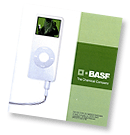
BASF nanoRemember when your insurance agent would send you a calendar for Christmas? The tech-savey marketing folks at BASF sent a few of our reporters 4 gig iPod nanos.

You spend the entire year listening to the needs of your audience. So for all of your attentive support, we would like to present a holiday gift that will enable you to hear our heartfelt appreciation. (Don’t worry – this gift doesn’t involve us caroling on your doorstep.) Since BASF is a leader in crop protection technology, we thought it would be appropriate to give you the latest advance in audio technology: the iPod nano.

It’s important to know that this gift extends beyound its small dimensions. You will have already received an email from us with a recorded holiday greeting. Now go to www.AgMediaCentral.com to hear the second part of our message, which you can listen to online or download to your new iPod.

This link also includes a few questions that will help us to listen to your needs. When you visit this link, you’ll receive an additional gift with our appreciation: a prepaid iTunes Music Card worth $15.

Media Maturity

Jon Fine (BusinessWeek online) on mature media:

“You can’t imagine letting people leave comments about you for everyone to see. You can’t imagine rank amateurs’ content being more attractive than that produced by a Mature Medium. (You silently scream: “It took me decades to get where I am!”) You can’t see that News Corp. and Suzuki have calculated — zenlike — that the only way to maintain control is to give it up. That they realize media go both ways now. That they can’t hide behind their accustomed walls. To do so may protect your flank, but at the risk of closing yourself off to the Next Big Thing.”

I am making a concerted effort to not talk about “all of this,” because it is simply impossible to grok what’s happening if you are not participating in it. Non-bloggers can’t see the attraction, let alone the implications. Those who aren’t listening to podcasts, can’t understand why anyone would or how it might impact their business. Like they say in the hospital movies, “I’m afraid all we can do now is try to keep him comfortable.”

Network Affiliate Relations 2.0

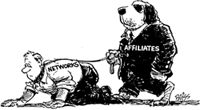
Affiliate RelationsIn the previous post I offered some ideas for using the web and related technologies to “connect” with local radio listeners and advertisers. I took a nap and had a sub sandwich and now I’m ready make a list for network affiliate relations. What is that you ask?

From the mid-eighties to the late nineties, part of my job was “selling” our network services to radio stations. We provided news and and sports programming in exchange for commercials on the local station, which we in turn tried to sell. The trick was to keep the stations you had while adding new stations when and where you could.

I drove all over half a dozen states, meeting with station managers, program directors and news directors. For the most part, this was pre-consolidation and I was talking to the station owner or a manager who was almost completely autonomous. They could make a decision without checking with anyone up the food chain. They were at or near the top of that chain. No longer the reality.

Where was I? Oh. How would I use today’s communication and publishing tools if I were doing that job? First, I’m not sure I would have the balls to do what I’m about to propose. There would be some risk. As much as doing business “the old way?” Don’t know. And, fortunately, no longer my call. But here goes:

Blogging

I’d create the “MyState Radio Network Affiliate Relations Blog.” It would be right out there on the web with the rest of the blogs. No password. The target audience would be the men and women that worked at radio stations affiliated with our network. Topics would include (but not be limited to): Programming, Sales, Traffic, etc. We’d talk about how stations use the network programming and why they sometimes don’t (it’s called clearance).

That sound you hear is the first alarm going off. If we publically acknowledge that some of our affilaites don’t air all of our programming, an advertiser might read the post and become concerned. Fact is, the advertisers already know that or can find out easily enough. By engagaing our affiliates in a frank and open discussion of this topic, we might learn something that could help us improve our clearance.

I’d let stations know about upcoming advertising campaigns and –where possible– offer suggestions on how they can take advantage of this locally. The traditional fear is that if they stations know –in advance– some of them might do or say something that could torpedo the network buy. Not much trust there.

I’d open up the comments and encourage the stations to let us know what they think about what we’re doing. If I got a hot one, I’d jump on the phone (or in my car) and deal with it.

What would an advertiser think of this public exchange? Not sure. We might get some points for being open and transparent. Nothing to hide. Radio stations might take the same view.

Here at the end of 2005 we communiate with our affiliates using the web, email, fax, telephone and in-station visits. All good and all necessary. And safe. Or at least the illusion of safety and control. Whatever the stations think and say about us, they’re thinking and saying. It’s critical to get them to say it to me and say it early.

Podcasting

I’d do a weekly podcast targeted at affiliates but out there for anyone to listen to. Who would I chat with? My news staff; my affiliate relations reps; my sales manager and his account execs; station managers, program directors and news directors… anybody and everybody involved in this business. We’d talk about anything and everything. If we –the network– does something really stupid, we hang it out there and talk about it. Why we did it. How we might do it differently in the future. What if an advertiser heard one of these? Great. If the “conversation” is going to take place, I want to be in on it.

As I said at the beginning of this post, I’m not sure I’d have the nerve to try such…”non-traditional” tactics. I’m not aware of any networks that are but if you know of one, send me a link.

Radio 2.0

Web 2.0 is a term often applied to a perceived ongoing transition of the World Wide Web from a collection of websites to a full-fledged computing platform serving web applications to end users. Ultimately Web 2.0 services are expected to replace desktop computing applications for many purposes. [Wikipedia]

If I owned a radio station (let’s narrow this to “small market” radio station since I have no first-hand experience in large markets), how might I use the Web and related technologies (blogging, podcasting, SMS, etc) to better serve my listeners and advertisers? I have to believe that any idea I might come up with is arleady in place and has been for some time. But just for fun, he’s a few off the top of my head (in no particular order):

1. High-speed Internet access to every office and studio in the radio station. If you still have someone doing “live” radio, they need access to the web.
2. A station website. Doesn’t have to be elaborate or expensive but it does need someone to feed and care for it. Don’t make them do this on their own time. More on content later.
3. A station blog. If I had to choose between one of the “traditional” black-background-lots-of-album-covers sites…and a well tended blog on Blogger or Typepad…I’d go with the blog.
4. Buy at least one digital audio recorder. I can think of no reason to ever buy another analog recorder.
5. If you do school closings and lunch room menus, post these to your site. If your schools are already doing this on their sites, link to them.
6. If you do obits on your station, post these to your website. Better yet, set up a database with a password protected form and let your local funeral homes post and update their announcments.
7. Provide a place where your local churches can post news or link to their websites if they’re already doing this.
8. If you do a daily “Tradio” sell-stuff-on-the-air program, record it and make it available as a podcast. You should also provide an online dB where listeners can post items for sale (a la craig’s list)
9. Record your major newscasts and post these as podcasts. Will take an extra 10 min but will greatly extend the audience for this programming.
10. Take the digital audio recorder to every city council meeting, chamber of commerce meeting, school board meeting, hospital board meeting, etc and record them gavel-to-gavel. Pull some cuts for the on-air news but post the full proceeding as a podcast. If you don’t do this, someone else will. And if you can’t staff these, ask for volunteers. Some of your techie listeners can probably do this better faster than you can and would love to be involved.
11. Create a business directory post short video tours/interviews. If video is just too much, do audio with accompanying photo gallery.
12. If they don’t already have them (and they will), set up blog for each of your loca civic organizations and help them get started. Link from the station site/blog and promote them on the air. Do the same leading up to the county fair or any other annual event.
13. Record the play-by-play audio of your local high school games and post to your website/blog as a podcast. Yes, you can sell sponsorships. Podcast the weekly Coach’s Corner, too.
14. If your local churches are not already “godcasting” their weekly services, offer to help them do this.
15. Find and encourage local bloggers and be sure you have them on the station blogroll.
16. If you have local bands, ask them to send you MP3 files of their recordings and include these on the station website. You’ll probably need a section for different genres (CW, Rock, etc)
17. Produce a local garden or home fix-up show and podcast these from the station website.

If you didn’t recognize a number of the terms I used above, find someone who can clue you in and ask them to help. I’d like to think that anyone currently working in radio (I left in 1984) could expand this list to 100 ideas. Or 200.

If all of this sounds “too local” or corny then forget it because you’re hopelessly screwed. The next generation of listeners are not going to be tuning you in for the tunes. If they listen at all, it will be for this kind of engagement with their lives. Ironically, this is where radio started half a century ago and we were very good at it. Some are still good at it and we better figure out how to get good at it again. Fast.

But don’t worry about your community. They’ll be fine and they can execute every one of the ideas above without any help from the local radio station.

Use the comments link below to let me know what I’ve missed.