Non-American health care

Good old American health care is all I’ve ever known. I remember when the family doctor made house calls. I think I even remember when the insurance company existed to help us (but that could have just been a dream).

We can’t really call what’s happening a national “debate” on health care — more of a national shriek– but there are those who think we have the best health care in the world. Since I haven’t been a lot of places in the world, I decided to get the opinion of some of my over-seas pen pals.

Keith Povall lives in or near Birmingham, UK and has recently had more of their national health care than he would have liked. You can read his full assessment in the comments, but here’s an excerpt:

“In modern times, much criticism has been leveled at the NHS because there is a lot of truth in the opinion that it is a monster grown out of control. It is the largest employer in Europe for example and many say / believe that there are too many chiefs and not enough Indians (to coin a phrase). Over the years, governments have thrown billions at it and the monster gobbles up the cash. It is believed governments would like to introduce a private service to replace it, but in the main “the people” love the NHS, something that is there as a safety net for when they need it and whilst you will hear complaints about income tax and stealth taxes, no one complains about their NI contributions.”

Peter is a psychiatric nurse in the Netherlands and –as a health care provider– might be less than objective on this subject. On the other hand, he has first-hand knowledge of his country’s system.

“The insurance companies want to control everything; they even want to control what professionals like me should do or not. The basis of their policy is not what the clients want (those who put money in the big jar) but what the shareholders want. Their goal is not good health care for their members, but profit and big bonus for a couple of hotshots. A very bad development which surely will be changed the moment the issue is hot again and elections are due. As you see we are quite a normal country in this.”

Again, I hope you’ll read Peter’s full email in the comments.

I’m still waiting to hear from a friend in Belgium and will add her thoughts if and when we get them. My thanks to Keith and Peter for taking time to respond to a serious inquiry from me. Something they are rarely called upon to do.
Alzheimer’s Disease iPhone app

My father and Barb's father suffered from Alzheimer's Disease and died from  related illnesses. But I am no kind of expert on the disease. Please keep that in mind as you follow along with this post.

I checked the iPhone apps store and didn't find anything like what I'm going to try to describe. Probably a good reason for that. And the application I'm imagining would be targeted at those in the early and mid stages of the disease. And if they refused to keep the phone with them or couldn't remember to take it, game over. But let's assume they're on board.

The iPhone app would launch whenever the phone was turned on. It would be programmed with information about the patient (for lack of a better term).

The map would have pins for the patient's favorites spots (corner market, hair salon, friends, etc). If they clicked on one of the pins, a small bubble would appear with the person photo and some info about them. A video link would play a short video clip ("Hello, Mrs. Johnson. Steve Mays here. Looking forward to your next visit.") and, of course a phone number to call the person.

The patient and family would decide on a radius that covered most of the places they were likely to go. Let's say 20 miles. If they go outside that radius, the phone wakes up and a familiar (?) voice says something along the lines of: "Hi, mom. It's me, Janice. Please give me a call. Just hit the green button.")

This repeats a couple of times and if ignored, the iPhone begins calling family and –if necessary– the authorities.

My father would go to morning coffee and on the way home make a wrong turn and just get confused about where he was. With an app like this he could have turned it on (maybe by just shaking it?) and seen the blue pin for where he is and the red pin for home. Or just say, "Help" or "I'm lost" and get assistance.

And before you point out "if they can't work the Tivo…" Remember I'm talking about people who grew up with mobile phones and –eventually– iPhones. We're gonna be freaked if we don't have the things in bath robes.

If this already exists, send me a link. I'd love to see it. If you have ideas for features I didn't think of, share those in the comments.

And if you are some brilliant young app developer and can make this thing a reality. You've got my blessing. You might even donate porcedes to Alzheimers Assocaition.

108 Sun Salutations

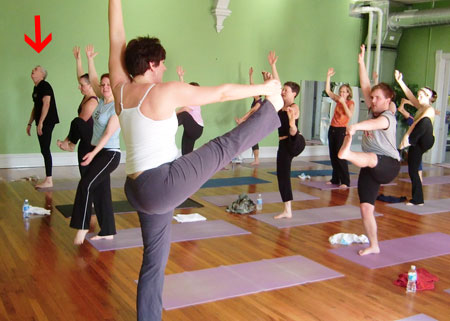
Greg Perry did a nice job manning the cameras (still and video) at this morning’s Show-Me Yoga Center event. You can learn more about 108 Sun Salutations from this earlier post. This shot captures my first 108SS perfectly. A picture worth 1,000 breaths. In case you’re wondering. I did about 104 of the 108 sequences (assuming you don’t count really shitty form). I got a blister on my big toe at about 30 and it broke around 40. I missed a couple when I made a band-aid pit stop. We go again in 6 months.

108 Sun Salutations

Surya Namaskar, the Sun Salutation, is a series of 12 (yoga) postures performed in a single, graceful flow. Each movement is coordinated with the breath. Inhale as you extend or stretch, and exhale as you fold or contract. The Sun Salutation builds strength and increases flexibility.

On Saturday, the Mid-Missouri Show-Me Yoga Center holds a semi-annual event during which we attempt to complete this series of postures 108 times. I’ve never done more than 5 or 10 so this should be interesting.

One of the instructors has asked me to bring a video camera to capture some of this so, between working the camera and doing the postures, it’s likely I won’t get my 108 this time but I’ll be ready in 6 months.

UPDATE: Thanks to Matt for point us to this info on the significance of “108”:

Renowned mathematicians of Vedic culture viewed 108 as a number of the wholeness of existence. This number also connects the Sun, Moon, and Earth: The average distance of the Sun and the Moon to Earth is 108 times their respective diameters. Such phenomena have given rise to many examples of ritual significance.

Google searches to track spread of flu.

“Google Flu Trends is based on the simple idea that people who are feeling sick will probably turn to the Web for information, typing things like “flu symptoms” or “muscle aches” into Google. The service tracks such queries and charts their ebb and flow, broken down by regions and states.

Early tests suggest that the service may be able to detect regional outbreaks of the flu a week to 10 days before they are reported by the Centers for Disease Control and Prevention. Some public health experts say that could help accelerate the response of doctors, hospitals and public health officials to a nasty flu season, reducing the spread of the disease and, potentially, saving lives.”
[New York Times via K]