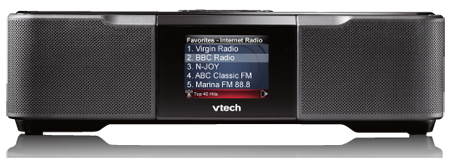
11,000 channel “radio”


“The VTech IS9181 is a Wi-Fi music streaming device, designed to make accessing the near-infinte variety of Internet radio as easy as traditional radio.”

“The IS9181 connects to any wireless network (802.11 b & g) and lets you access more than 11,000 free Internet radio stations worldwide. It also lets you access audio files (MP3, WMA, AAC, WAV, Real) stored on you Wi-Fi-enabled computer (PC or Mac). The IS9181 also offers localized weather (based on zip code).” (via Podcasting News)

My first thought was, “If I’m running a radio station, it better be one of the 11,000.” My next thought was, “It better be one of the ‘best’ of the 11,000.”

Scott Adams: Calendar as Filter

Scott Adams thinks the calendar will be the organizing filter for most of the information flowing into our lives:

“You think you are bombarded with too much information every day, but in reality it is just the timing of the information that is wrong. Once the calendar becomes the organizing paradigm and filter, it won’t seem as if there is so much.”

News: “When I read the news, I’m generally most interested in how stories have unfolded across time. I want to know the “new news,” as in the topics that have never been reported until today, but I also want ongoing charts and graphs about the “old news” such as wars and the economy. My understanding of the war in Iraq, for example, has little to do with what blew up today and a lot to do with the trend lines over the entire war. In other words, I see the news in terms of time.”

Advertisements: “Some time ago I blogged that advertising belongs in your electronic calendar, for your benefit more than for the advertiser. That’s because my interest and desire in certain products and services is linked to timing. If my calendar has a certain birthday coming up in a week, and I’ve checked the boxes saying the person is a certain age and gender, or has certain hobbies, my calendar can start giving me gift suggestions and recommending online flowers and e-cards and the like. In other words, advertisements can move from nuisance to valuable service just by adjusting when you see them.”

I know a lot of folks who use their Outlook email in-box as their primary organizing tool. (shudder) The calendar makes a lot more sense to me, too. Especially working out of iCal that’s sync’d between my desktop, laptop and iPhone.

Tweetie

Since installing Tweetie, I keep it running on the left side of my desktop. The clever folks who designed Tweetie must have anticipated this is how folks would use it. I can see at a glance when someone tweets; mentions @smaysdotcom or sends me a direct message.

Earlier tonight, William Gibson tweeted about a new movie coming out this summer, describing it as “must see” and included a link to the trailer. Well, when my favorite author says he “must see” the movie, you can bet I’ll see it, too.

When I saw his tweet, I thought: “Cool. William Gibson is online, at this moment, doing basically the same thing I’m doing.”

Now, I can’t direct message Mr. Gibson because he doesn’t follow me and I’d like to think I would not intrude if he did. But, with what other form of communication might I have such a real-time experience with one of my heros? Not email. Probably not a blog post. I’m not sure I can describe the feeling. Not quite personal, but almost.

Little Snapper worth a thousand words

I take a lot screen shots. Every day. In the bad old PC days, it involved hitting the prnscrn key, pasting into Word or Photoshop, etc etc. When I moved to the Mac it got easier, with some short-cut keys. But I still had to do the Photoshop thing if I wanted to annotate or add arrows or such.

Yesterday Bradley pointed me to Little Snapper, a new (?) app for the Mac. I won't event try to list or describe the features in LittleSnapper, there are just too many. But if you're a designer, developer, researcher or writer, you'll want this on your utility belt.

At $39, this is probably not a tool that everyone needs. But if you use screen grabs as much as I do, it's a must.

iPhone: “The world in my pocket”

That’s how Mindy McAdams describes her iPhone:

“If someone has all the videos and quality radio news she could ever find time to listen to (or watch) right in her pocket, how can anything even remotely like the newspaper compete with that? The newspaper as it was, in the heyday of the 30 percent profit margins, had something for everyone. Now the Internet-enabled phone provides that.”

I’ve had that “iPhone = world in my pocket” thought while sitting at the counter of the Towne Grill, waiting form my biscuits and gravy. First the email, then the Twitter, then Google Reader.

Once upon a time, I bought a copy of USA Today to read with my grub. But eventually 75 cents for the few stories of interest seemed pricey. Then I started printing out stories the night before and making my own little newspaper. And then I got an iPhone.

I think Ms. McAdams really asks the good question:

“Will traditional print news organization come up with programming, instead of random and disconnected stories? I don’t mean it has to be audio and video, but it would be something with an identity, like a show or a series. The closest thing I can think of that’s not radio is David Pogue — a brand unto himself.”

“Random and disconnected stories.” Hmm. I need to think about this. More in the morning.

Next morning: I’m now wondering if our news networks have been too focused on “random and disconnected stories?” We’ve worked hard to put our news stories online with less thought and energy given to building identity. Well, that’s not entirely true. We’ve put a lot of our existing radio programs and features on our websites. But would we be better served to focus more podcasts?