The annual doctor visit

The following excerpts are from a Wall Street Journal piece titled: Tech Advances Put the Annual Doctor Visit on the Critical List. The gist of the article is the yearly check-up with your doctor is in for some big changes.

Mayo Clinic, in Rochester, Minn., has started sending laboratory kits to patients in advance of their physicals. Patients, especially those who live far away, can get blood drawn at a local clinic and send it back for standard lab and genetic analyses and discuss results with their doctors virtually. The future, says Carl Andersen, medical director of the clinic’s executive health program, is “bringing healthcare to patients where they are as opposed to asking them to come in.”

Mayo eventually expects to gather additional patient information remotely via smartphone and smartwatch apps, wearable sensors and blood pressure cuffs that enable monitoring of such health indicators as blood pressure, blood oxygen levels, physical activity, heart rate, heart rhythm, blood sugar and sleep quality. Doctors elsewhere have begun adopting this strategy; some experts believe it is poised to fundamentally change how the physical is done and could prompt patients to engage more proactively in their health.
“When people start using a smartphone to monitor their blood pressure, they become experts at managing it,” says Eric Topol, director of Scripps Research Translational Institute in La Jolla, Calif. Maybe “it’s only a problem on Monday morning when they go back to work.” That finding wouldn’t emerge in a once-a-year visit, but it opens options for a patient other than a prescription for blood pressure pills.

Digital stethoscopes are available that allow doctors to check heart and lung sounds remotely. Dr. Tison and his colleagues at UCSF have developed a technique using a smartphone camera and flashlight that can detect a biomarker of diabetes in patients without a blood draw. Mayo doctors have tested an algorithm that can reveal heart weakness from data obtained in an electrocardiogram long before symptoms of heart failure, heart rhythm irregularities or cardiovascular disease arise.

DNA is poised to become part of the routine physical too. As part of its blood analysis, Mayo will soon offer liquid biopsy tests, which look for evidence of cancer in DNA fragments that even early-stage tumors shed into the bloodstream. The test will search for many more tumor types beyond the screens performed for breast, lung, prostate and colorectal cancers as recommended in current health checkups.

UCSF’s Dr. Tison suggests a more dynamic approach to the physical lies ahead: Doctors will provide, say, monthly electronic reports to patients on metrics such as blood pressure, heart function, blood oxygen levels and weight, based on the data stream from digital devices. Unless an abnormal signal turns up, in-person exams—with the hands-on touch doctors and patients value—could be set for every two or three years.
Hyperlinks

In the early days of HTML (“WWW“) I looked for every opportunity to embed an in-line link on the websites I was responsible for. The more links, the better. It was all about the “user experience” back then and links added value.

Seems like I don’t see that many links these days and I only had to wonder for about three seconds. Why would they send me off to another page/site? Maybe we were always just “eyeballs.” I miss those links and the places they took me.

“New App Lets Banner Ads Listen, Remember, Respond”

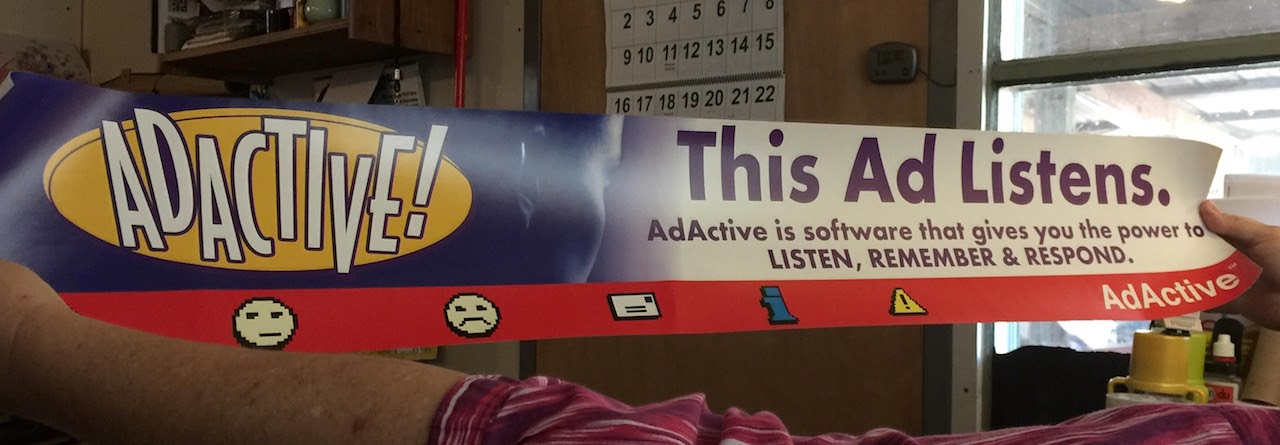
In the late 90’s I played a small part in our company’s early efforts to get on “the information highway.” We went all-in on an idea called AdActive. Proving, once again, that nothing ever dies on the Internet, I found the following on ClickZ. (1998)
Straylight in Seattle launched AdActive, a software product that allows existing banner ads to provide advertisers information on end-user brand perceptions, letting marketers target future messages based on individual responses.

Designed to support one-to-one relationships between customers and companies, AdActive works with a Web site’s existing ad delivery system or network to extend the traditional banner ad, the privately held company said.

Users are offered a number of options to tell advertisers what they think of the product or brand being presented without being taken away from the content they are viewing. AdActive then records the response so that it can be aggregated to provide detailed brand/product perception reports and used to more effectively target future ads.

“AdActive allows Web sites to realize new revenue by giving advertisers the ability to interact directly with consumers,” said Allen Hammock, technical director for Straylight’s AdActive Product Group. “Advertisers will also be able to look at what people think about their brand and products while giving Web surfers the ability to actively shape their online ad experience without registering or giving up their online anonymity.”

AdActive features a response bar, a small footprint Java applet, allows an individual to pass along positive or negative responses to an ad, contact an advertiser directly or even cancel an ad from being shown again.

The app gives advertisers the ability to respond to individual consumer brand perceptions with new advertisements or to refocus their efforts on consumers who chose not to respond at all.

AdActive is designed to work with NetGravity’s industry-standard ad delivery system, AdServer. The software is priced in a tiered structure based on a site’s traffic and computing resources.

Time Capsule

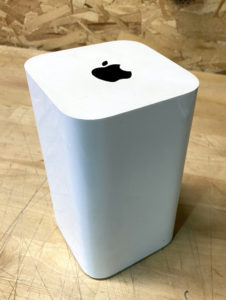
In early 2008 Apple introduced the Time Capsule, a wireless router that automatically backs up data for any computer connected to your wifi network. In approximately 2016, Apple disbanded the wireless router team that developed the AirPort Time Capsule and AirPort Extreme router. In 2018, Apple formally discontinued both products, exiting the router market.

Don’t recall when I got mine but it was a long time ago. Since Apple no longer supports the device, I retired mine and replaced it with an external hard drive, using Time Machine to back up my MacBook.

Was planning to take the old Time Capsule to the recycle place but remembered it still has my data on it. A lot of data. I could plug it back in and erase but I’m told it would take a long time so I decided to destroy the thing. But it’s impenetrable! No way (that I can see) to get it open and get to the hard drive. I could probably beat it with an axe or a sledgehammer but that sounds like a lot of work. So I’ve decided to take it down into the woods (we live on six acres) and bury it. I know, probably not good for ground water but I’ll do my best to seal it up.

I kind of like the idea some alien archeologist discovering the thing and being frustrated she can’t find a power cord or cable for it.

“AirPods!”

During the early days of the pandemic, as more and more people began showing up on TV via Zoom et al, I would shout out to Barb, “AIRPODS!” That quickly became annoying so I would whisper, “AirPods.” Now I just mouth the words.


I have mine in so frequently I’ve stopped noticing them (they fit my ears perfectly). Arguments about audio quality aside, they have changed my perception of music. It seems to be coming from inside my head, rather than through my ears.

Apple Music playlists (piano solos and cello solos) have become the the background for my awareness, making me noticeably more relaxed and peaceful.

Not much has changed

The first photo was taken in January of 2020. One of the last times I was in the Coffee Zone. The second photo was taken about a week ago. My life hasn’t really changed all that much. I have discovered a nice strong filter can takes a few years off. And once it was difficult to find a photo of me without a beer in my hand, these days it tends to be a phone.