
Humans out at advertising agency

Marketing communications firm (plans) “to utilize technology-based resources such as software, virtual robots, and media algorithms to create and implement advertising and marketing programs for its clients.” Excerpts below from The Ad Contrarian:

”We will need to keep a few tech people on staff to insure that our systems are functioning well and are properly integrated. But that’s it. Last-century resources like account managers, copywriters, art directors, and media planners — in other words, people — will be replaced by digital resources.”

”We have developed what we call ‘virtual robotics’ that can actually understand a client brief when it is converted into code via a proprietary algorithm we have developed. The robot program then goes online and hunts down previously created advertising and marketing campaigns in similar categories which it ‘borrows’ from — much like a traditional creative team does,” he explained.

I wrote a lot of radio commercials (we called them “spots”) over the years and while I wrote a few good ones, many were of grind-it-out-get-it-on-the-air variety. Yeah, I can imagine software doing those as well as I did.
Why the UPS driver runs

“An American Management Association survey found that 66 percent of US-based employers monitor the Internet use of their employees, 45 percent track employee keystrokes, and 43 percent monitor employee e-mail. UPS uses a system, Kronos, under which each of its delivery trucks is equipped with 200 sensors, which feed information back to headquarters about driving speed, seatbelt use, and delivery efficiency. Even trying to cheat the system can hurt the worker. Drivers commonly evade the seatbelt sensor by keeping the seatbelt locked but not strapping themselves in. UPS can claim higher safety compliance even though workers are actually more endangered.”

The people formerly known as advertisers

Media researcher Gordon Borrell says “we’ve reached the end of the Golden Age of Advertising.”

  • 82% of SMBs have established their own media channel in the form of a website or social media page.
  • Since 2007, spending has skyrocketed to the point at which businesses last year spent 72% more on marketing services and promotions than they had spent 10 years earlier. Meanwhile, the annual expenditure on local advertising was 22% less than it was a decade ago.
  • “Over the next 12 months, the gap will almost certainly widen to the point that all traditional advertising channels — print, broadcast, outdoor and mail — begin to look like niche support mechanisms to a local businesses’ digital marketing plan.”

Chase Apple Pay ad with Bleachers


“The ad — in which Apple was heavily involved according to AdAge — follows members of an indie band as they prepare for a show by making purchases with their Chase Freedom card through Apple Pay. One gets a haircut, for instance, while another has his guitar tuned.”

My first thought on watching this ad was, “Pretty cool for a bank.” Upon closer look I saw that Apple was “heavily involved” so… Wonder if someone at Chase went to Apple and said help us make this cool, or if Apple reached out to Chase and said why don’t you let us make this cool for you.

Been using Apple Pay here at The Coffee Zone for a week now and it reminds me a bit of using my key fob to unlock the MINI. When I approach my car I just automatically click the unlock button. When I approach cash registers, will I reach for my phone without thinking?

Online banking

For years (I’m embarrassed to admit how many) I’ve kept a wad of cash in a money market account at my local bank. For a long time I thought of this as my “savings” account, as opposed to my day-to-day checking account where I kept a few thousand bucks.

In the last couple of years I’ve moved most of those funds to my investment portfolio but kept some (too much) in the money market account. Last week I got curious about exactly how much the money market was earning. A whopping .15%. The lady at the bank apologized when she told me.

When I asked my financial advisor for ideas he recommended a savings account with an online bank. He pointed out that the good ones are FDIC insured, just like my local bank and because they aren’t supporting all that brick-and-mortar infrastructure, they can afford to pay better interest rates. I went with Ally where I’ll get .90%.

My initial experiences have all been positive. Security seems very tight. I can talk/chat with someone 24/7. And their iOS app is very good. By that I mean, simple.

Once it sunk in that my money is not really in the vault of the bank across the street, I got comfortable with the idea of an online bank. I’ll keep a checking account with my local bank but as tools like Apple Pay gain wider acceptance, that might not always be the case.

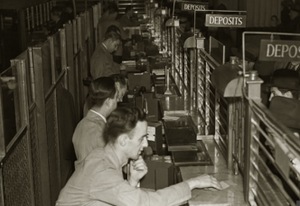
Your grandpa’s bank

oldbankI’ve enjoyed my VISA Amazon rewards card (from Chase) and I’ve used the points to make purchases. But rewards cards (at least this one) is not part of the Apple Pay system. No problem. Took about 5 minutes to get approved for a card that will work with Apple Pay. Haven’t decided on whether to keep the Amazon card.

My “back-up” card is a MasterCard issued by my local bank. So I stopped by to ask if they had any information on when/if they would support Apple Pay. The first guy I spoke with had never heard of Apple Pay.

“Have you heard about Ebola?” I asked him. It was a joke!

While he was calling different departments to see if anyone knew about this new “Apple Pay thing,” the lady at the next desk gave me a little lecture on how their bank (Central Bank, Jefferson City, MO) didn’t jump on every new thing that came along.

“We were one of the last banks in this area to offer online banking,” she proudly announced. “We’re very conservative.”

“So, this is Your Grandpa’s Bank,” I teased.

Stony silence.

Like the music business and television and newspapers, the banking industry is due for some major disruption. I really don’t need them for much these days and have started looking for ways to use them less.

Why Asians save and earn so much

The article starts with a little research: “A 2010 Pew Research study pegged Asian households earning a median $66,000 a year vs. $49,800 for the average US household, a 32% difference. A 2013 Nielsen Research Report found that Asian American households have a median net worth of $89,300 compared to $68,800 for overall US households, a 30% difference. Meanwhile, roughly 49% of Asian Americans have Bachelor’s degrees vs. 28% of the general US population, a 75% difference.”

The author identifies several contributing factors. I like these two: 1) Asians are allergic to debt. Debt is slavery. 2) There is nothing more important to the Asian American population than academics.

Six figure salary? You’re not rich

I’m old enough to remember when earning a six figure salary meant you had made it. You were rich. This post on the Personal Capitol blog explains why that is no longer the case. Here are a few nuggets to get you started:

  • the median household income stuck at around $53,093 in 2014
  • the average price of living the American dream has now risen to $130,000 per year
  • today’s family would need to earn $288,713.59 to achieve the same kind of lifestyle as someone making $100,000 in 1980.
  • the median price of a home was around $282,000 nationally in May 0f 2014.
  • the cost of raising one child for a middle class couple has grown to a staggering $241,080.


We Were Never Born

WE WERE NEVER BORN from Dosnoventa on Vimeo.

I’m not a big fan of the 30 second commercial (I’m referring to TV spots here since I don’t remember the last time I heard a radio spot). I find most advertising mindless and insulting. Not all, but most. But I love it when a company finds a way to touch me that leaves me feeling good about myself (and the company/product).

The video above (4 minutes) –produced for Dosnoventa Bikes– includes “a haunting, Johnny-Cashlike voiceover by James Phillips and beautifully curated music by Pink Floyd and Cash himself.”