
Who’s reading (and who’s not)

The Harry Potter buzz reminded me of an earlier post (exactly one year ago today) on American reading habits. That post linked to a bunch of stats on reading habits at ParaPublishing.com, including:

  • One-third of high school graduates never read another book for the rest of their lives.
  • 58% of the US adult population never reads another book after high school.
  • 42% of college graduates never read another book.
  • 80% of US families did not buy or read a book last year.
  • 70% of US adults have not been in a bookstore in the last five years.
  • 57% of new books are not read to completion.
  • Most readers do not get past page 18 in a book they have purchased.
  • Customers 55 and older account for more than one-third of all books bought.

If you can point us to more recent data, leave a comment. I want to believe these stats are wrong but have no reason to doubt them.
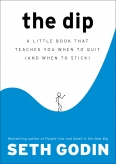
Seth Godin: The Dip: Knowing when to quit, and when to stick

The Dip

“Every new project (or job, or hobby, or company) starts out exciting and fun. Then it gets harder and less fun, until it hits a low point-really hard, and not much fun at all. And then you find yourself asking if the goal is even worth the hassle. Maybe you’re in a Dip — a temporary setback that will get better if you keep pushing. But maybe it’s really a Cul-de-Sac, which will never get better, no matter how hard you try.

What really sets superstars apart from everyone else is the ability to escape dead ends quickly, while staying focused and motivated when it really counts.

Winners quit fast, quit often, and quit without guilt — until they commit to beating the right Dip for the right reasons.

Losers, on the other hand, fall into two basic traps. Either they fail to stick out the Dip-they get to the moment of truth and then give up — or they never even find the right Dip to conquer.” [Squidoo]

I don’t blame Mr. Godin for wanting to make a buck, but this little “book” (about 70 tiny pages) should have been an eBook. Which I probably would not have bought, so… there you go.

But it brought back some memories.

It only took me about 3 months (in 1970) to decide I did not want to be a lawyer. I quit and I quit early. I then spent about a year as a Postal Inspector before calling it quits. I remember my boss urging me to stick it out.

I’m a Seth fan and found The Dip worth the hour it took to read. A few quotes after the jump.

Continue reading →

Everything Is Miscellaneous

David Weinberger’s latest book —Everything Is Miscellaneous— is a philosophical look at “the power of the new digital disorder.” A few nuggets:

“Individuals thinking out loud now have weight, and authority and expertise are losing some of their gravity. It’s not whom you report to and who reports to you or how  you filter someone else’s experience. It’s how messily you are connected and how thick with meaning are the links.

It’s not what you know, and it’s not even who you know. It’s how much knowledge you give away. Hoarding knowledge diminishes your power because it diminishes your presence. (p.230)

“A playlist is an important means of self-expression. The motivation is to say, ‘This is who I am, and you can find out who i am by knowing what I love.'” Attributed to Rebecca Tushnet, a professor at Georgetown University Law Center. (p.159)

“Physical limitations on how we have organized information have not only limited our vision, they have also given the people who control the organization of information more power than than those who create the information. Editors are more powerful than reporters, and communication syndicates are  more powerful than editors because they get to decide what to bring to the surface and what to ignore.(p.89)

“Facts are that about which we no longer argue.” (p.214)

“A span of expertise is about as long as a shelf in a library.” (p.205)

Republicans and Democrats

I do love a Lucas Davenport novel. Nothing heavy, fun read. The latest —Invisible Prey— includes a brief exchange between Lucas and his boss, Rose Marie, on the difference between Republicans and Democrats:

“Wonder why with Republicans, it’s usually fucking somebody that get them in trouble. And with the Democrats, it’s usually stealing?”

“Republicans have money. Most of them don’t need more. But they come from uptight, sexually repressed backgrounds, and sometimes, they just go off. Democrats are looser about sex, but half the time, they used to be teachers or government workers, and they’re desperate for cash. They see all that money up close, around the government, the lobbyists and the corporate guys, they can smell it, they can taste it, they see the rich guys flying to Paris for the weekend, and eating all the good restaurants, and buying three thousand-dollar suits. They just want to reach out and take some.”

— Invisible Prey, John Sandford (page 141)