
November 21, 1994: $49.95 for software; $19.95/mo (7 hours free; $3.00 per hour after that). 9600 baud/14400. And I was thrilled to get it.
Author Archives: Steve Mays
Online banking
For years (I’m embarrassed to admit how many) I’ve kept a wad of cash in a money market account at my local bank. For a long time I thought of this as my “savings” account, as opposed to my day-to-day checking account where I kept a few thousand bucks.
In the last couple of years I’ve moved most of those funds to my investment portfolio but kept some (too much) in the money market account. Last week I got curious about exactly how much the money market was earning. A whopping .15%. The lady at the bank apologized when she told me.
When I asked my financial advisor for ideas he recommended a savings account with an online bank. He pointed out that the good ones are FDIC insured, just like my local bank and because they aren’t supporting all that brick-and-mortar infrastructure, they can afford to pay better interest rates. I went with Ally where I’ll get .90%.
My initial experiences have all been positive. Security seems very tight. I can talk/chat with someone 24/7. And their iOS app is very good. By that I mean, simple.
Once it sunk in that my money is not really in the vault of the bank across the street, I got comfortable with the idea of an online bank. I’ll keep a checking account with my local bank but as tools like Apple Pay gain wider acceptance, that might not always be the case.
Autumn 2014
The transistor radio
From Walter Isaacson’s The Innovators:
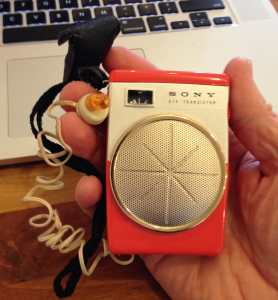 “Transistors were being sold in 1954 to the military for about $16 apiece. But in order to break into the consumer marker. Haggerty insisted that his engineers find a way to make them so that they could be sold for less than $3. They did. He also developed a Jobs-like knack, which would serve him then and in the future, for conjuring up devices that consumers did not yet know they needed but would soon find indispensable. In the case of the transistor, Haggerty came up with the idea of a small pocket radio. When he tried to convince RCA and other big firms that made tabletop radios to become a partner in the venture, they pointed out (rightly) that consumers were not demanding a pocket radio. But Haggerty understood the importance of spawning new markets rather than merely chasing old ones. He convinced a small Indianapolis company that built TV antenna boosters to join forces on what would be called the Regency TR-1 radio. Haggerty made the deal in June 1954 and, typically, insisted that the device be on the market by that November. It was. The Regency radio, the size of a pack of index cards, used four transistors and sold for $49.95. It was initially marketed partly as a security item, now that the Russians had the atom bomb. “In event of an enemy attack, your Regency TR-1 wiU become one of your most valued possessions,” the first owner s manual declared. But it quickly became an object of consumer desire and teenage obsession. Its plastic case came, iPod-like, in four colors: black, ivory, Mandarin Red, and Cloud Gray. Within a year, 100,000 had been sold, making it one of the most popular new products in history.”
“More fundamentally, the transistor radio became the first major example of a defining theme of the digital age: technology making devices personal. The radio was no longer a living-room appliance to be shared; it was a personal device that allowed you to listen to your own music where and when you wanted—even if it was music that your parents wanted to ban.”
Apple Pay
George Kopp and I went to Panera today for lunch and to try out Apple Pay. [The video is vertical because George thought it might get more of the transaction] This took a few extra seconds because I forgot to put my thumb on the Touch ID button. Had I done so it would have automatically used the first credit card in my Passbook app. As it was, I had to tap on my VISA card and then do Touch ID. I’m just not sure how paying for something is going to get easier/faster than this.
UPDATE: I stopped by Walgreen’s for a flu shot and on the way out picked up a bag of cookies to see if I could pay with Apple Pay. And, because nutrition is important to me, I swung by McDonald’s and got some fries. What I found most interesting is at both places, the person behind the counter had obviously never heard of Apple Pay. But when I passed my phone over the scanner, the registers made a happy beep and the transaction just happened. All the counter people did was enter the amount.
I see two possible futures for Apple Pay. (And I think we’ll know in six months) It will either be an unqualified success or it will go the way of the Amazon Phone, Microsoft’s Zune or Google’s Wallet. If it flops it will be because there was insufficient demand; retailers decided they didn’t want it (for reasons good and bad) and refused to make it an option; or some other combination of factors I’m not smart enough to see.
But it won’t be because people started getting their thumbs hacked off to fool TouchID or any other Mission Impossible bullshit.