
The first Web President

I’m working my way through a stack stories and columns examining how the Obama campaign used the web, social networks, email and other online tools. They went so far beyond just “click here to send us some money.” Somebody on the team (some bodies) really understands this space where so many of us choose to live and work.

Here’s a couple of snippets to get started and I’ll update as we go under the category: Obama Online

Washington Post: “The nucleus of that (campaign) effort is an e-mail database of more than 10 million supporters. The list is considered so valuable that the Obama camp briefly offered it as collateral during a cash-flow crunch late in the campaign, though it wound up never needing the loan, senior aides said. At least 3.1 million people on the list donated money to Obama.”

New York Times: “The juxtaposition of a networked, open-source campaign and a historically imperial office will have profound implications and raise significant questions. Special-interest groups and lobbyists will now contend with an environment of transparency and a president who owes them nothing. The news media will now contend with an administration that can take its case directly to its base without even booking time on the networks.

More profoundly, while many people think that President-elect Obama is a gift to the Democratic Party, he could actually hasten its demise. Political parties supply brand, ground troops, money and relationships, all things that Mr. Obama already owns.”

I’ve felt since I first got hooked on Obama’s campaign that my affinity is to this particular man (and his ideas), not the Democratic Party.

An excellent source for this kind of info is techPresident.

NYT/Bits: “Mr. Obama’s campaign took advantage of YouTube for free advertising. (Joe) Trippi argued that those videos were more effective than television ads because viewers chose to watch them or received them from a friend instead of having their television shows interrupted.

“The campaign’s official stuff they created for YouTube was watched for 14.5 million hours,” Mr. Trippi said. “To buy 14.5 million hours on broadcast TV is $47 million.”

There has also been a sea change in fact-checking, with citizens using the Internet to find past speeches that prove a politician wrong and then using the Web to alert their fellow citizens.”
Google searches to track spread of flu.

“Google Flu Trends is based on the simple idea that people who are feeling sick will probably turn to the Web for information, typing things like “flu symptoms” or “muscle aches” into Google. The service tracks such queries and charts their ebb and flow, broken down by regions and states.

Early tests suggest that the service may be able to detect regional outbreaks of the flu a week to 10 days before they are reported by the Centers for Disease Control and Prevention. Some public health experts say that could help accelerate the response of doctors, hospitals and public health officials to a nasty flu season, reducing the spread of the disease and, potentially, saving lives.”
[New York Times via K]

Recession: Not necessarily a bad thing

Michael S. Hyatt has compiled a list of ten benefits of the current recession:

   1. It causes you to get more creative.
   2. It forces you to make the tough decisions.
   3. It thins out the competition.
   4. It makes you realize you can’t take anything for granted.
   5. It reminds you that real wealth isn’t about the stuff you own.
   6. It fosters out-of-the-box thinking.
   7. It makes it easier to abandon business-as-usual.
   8. It brings you back to the basics.
   9. It accelerates change.
  10. It causes you to be less wasteful.

"While you may not be able to control what happens with the economy, you can control your own mental focus. Usually, this determines whether you feel anxiety and fear or peace and hope."

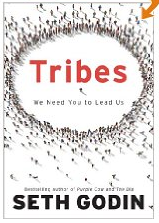
Tribes by Seth Godin

Picture_1I’ve read most of Seth Godin’s books and I’m a daily reader of his blog. But his latest book, Tribes, really spoke to me. When I read, I highlight or underline, make notes in the margins and, in recent years, post my favorite parts here.

I struggled to find one pull that captures the idea behind Tribes and decided on this one. Lots more after the jump. Continue reading →

Learning “New Media” tools

I’ll be in our Dallas office for a few days next week. The agenda is kind of loose and open-ended. Our sports division (HQ in Dallas) is exploring ways to use more “new media” tools and I’ll try to help them find ways to do this. I think. My point is, what a great job.

And here’s what I’ve learned. Just about every online tool you need is out there. Cheap or free and easy to use. The hard part is finding people who… I wish I could come up with a better word… people who “get” this whole Internet thing. Sure, everybody uses email and Google and all that, but for most the net is where you go to find something rather than create something.

Posting photos to flickr, writing a blog, even something as simple as Twitter involves sharing something of your self. Expressing who you are. It’s walking out on that high school stage and singing Killing Me Softly. A lot of people just can’t do it.

But when I meet (discover?) such a kindred spirit, someone who has something to say and a passion for saying it, it’s great fun showing them things I’ve discovered on my endless surfing safaris.