Better Than Human

In this Wired article, Kevin Kelly challenges us to ask and think about, “What are humans for?” A few excerpts:

“Two hundred years ago, 70 percent of American workers lived on the farm. Today automation has eliminated all but 1 percent of their jobs, replacing them (and their work animals) with machines. Before the end of this century, 70 percent of today’s occupations will likewise be replaced by automation.” 

“The highest-earning professions in the year 2050 will depend on automations and machines that have not been invented yet. That is, we can’t see these jobs from here, because we can’t yet see the machines and technologies that will make them possible. Robots create jobs that we did not even know we wanted done.” 

“This is not a race against the machines. If we race against them, we lose. This is a race with the machines. You’ll be paid in the future based on how well you work with robots. Ninety percent of your coworkers will be unseen machines. Most of what you do will not be possible without them. And there will be a blurry line between what you do and what they do. You might no longer think of it as a job, at least at first, because anything that seems like drudgery will be done by robots.”
Reading habits

“78% of Americans ages 16 and older say they read a book in the past 12 months. Urban (80%) and suburban (80%) residents are especially likely to have read at least one book in the past year. While rural residents are somewhat less likely to have read a book in the past year (71%), the book readers in rural areas read as many books as their counterparts in cities and suburbs.” (Pew Research)

Meditation strengthens the brain

“New research from the UCLA Laboratory of Neuro Imaging suggests that people who meditate show more gray matter in certain regions of the brain, show stronger connections between brain regions and show less age-related brain atrophy. In other words, meditation might make your brain bigger, faster and “younger”. As lead researcher Eileen Luders explains, “it appears to be a powerful mental exercise with the potential to change the physical structure of the brain.”

If you’re serious about ideas, blog

“Blogging’s ability to impact mainstream discourse has never been greater. When I worked as a reporter a decade ago, I knew that when my editor decided to put something on the web — but not in the actual paper — it was a brushoff. Fewer people would see the web content, and (pre-Google) it would evaporate into the ether; it wasn’t solid like an actual paper on someone’s doorstep. Now the hierarchy has been reversed; an article lives forever on the web and will be seen around the world. Nick Bilton’s blog on the New York Times website has just as much credibility as what’s in the print edition; and Mashable, in the tech world, has as much or more credibility than the Times. Nowadays, we’re measured by the quality of information — not its brand name. If you create high-quality content, you legitimately may become a source as powerful and trusted as the “legacy media.”

Harvard Business Review

My offices

office

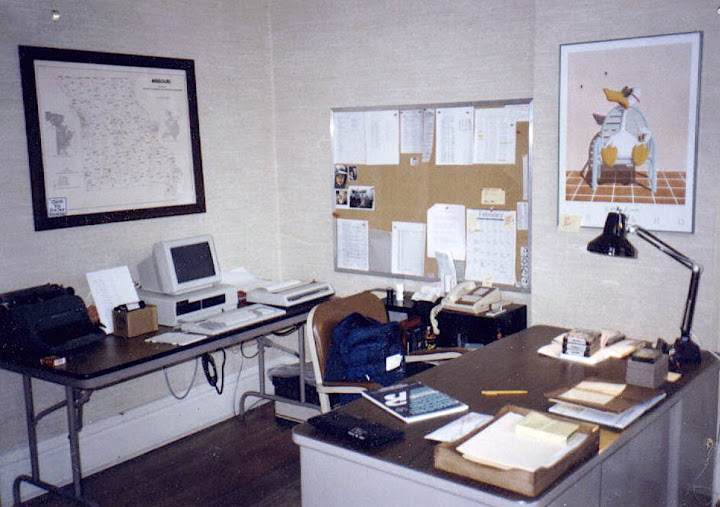
While cleaning out my office yesterday, I reflected on the spaces in which I’ve worked over the past 40 years. During my radio days I spent most of my hours in a studio (on-air or production). When I came to Learfield they didn’t have a real office but provided a tiny desk on a tiny sun porch attached to the old house.

sunporch

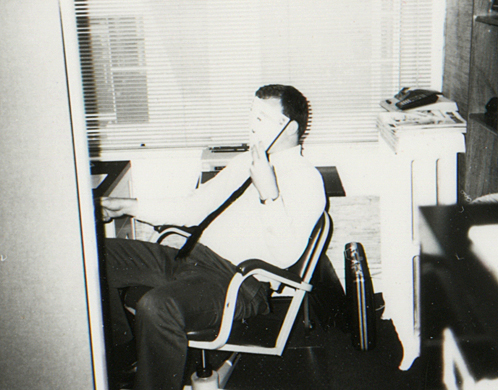
I don’t have a photo of my desk but it looked just like this one (in which Roger Gardner is hiding his face for some reason). I got a nicer space when Jim Lipsey and I each had a corner of a big old room in that same house.

mccarty_office

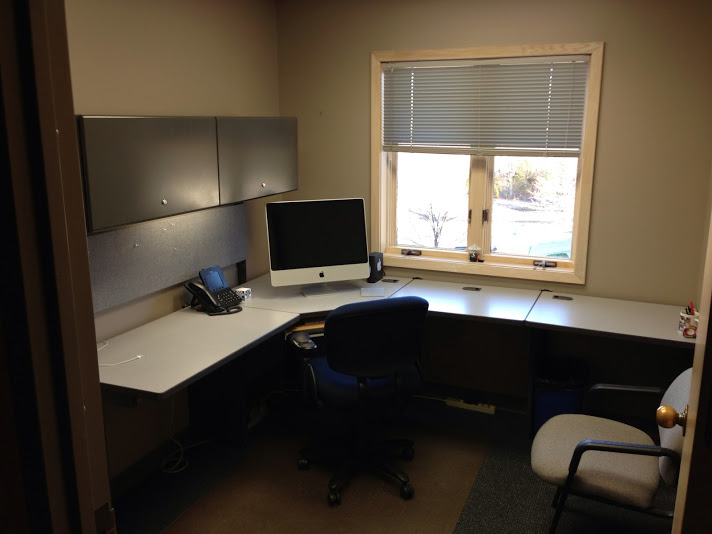
We eventually built the nice building we’re in now and I had a nice office just a couple of down from our CEO. That proximity mattered in those days (perhaps it still does). The carpet was a different color in these offices to visually make the point we were special.

I suppose we once needed offices to put things like filing cabinets and typewriters and chairs for visitors. And we needed a private space to talk about things that others weren’t authorized to hear. My little office started feeling like a small prison cell (albeit with a big window).

In an era of smart phones and MacBooks, a building filled with little square rooms lining hallways seems… quaint. Hardly the best use of space. But then, where would I keep my stapler.