
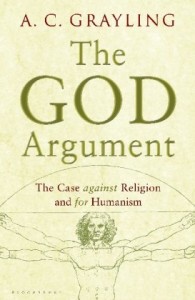
The God Argument

the-god-argumentThe God Argument (The Case Against Religion and for Humanism) by A. C. Grayling was a bit of a slow read for me, compared to a few other books I’ve read on this topic. This was, I believe, my first brush with secular humanism and it’s nice to have a basic definition of the concepts.

“Secularism is the principle of maintaining a separation between religious interests and bodies, on the one hand, and the state, on the other hand, on the premise that religion has no greater claim than any other self-interest outlook in debates about matters of government and public policy.”

“The basis of humanism is that we are to answer the most fundamental of all questions, the question of how to live, by reflection on the facts of human experience in the real world, and not on the basis of religion. […] As a broad ethical outlook, humanism involves no sectarian divisions or strife, no supernaturalism, no taboos, no food and dress codes, no restrictive sexual morality other than what is implicit in the demand to treat others with respect, consideration and kindness.”

Humanism’s two fundamental premises: 1) “there are no supernatural agencies in the universe,” 2) “our ethics must be drawn from, and responsive to, the nature and circumstances of human experience.”

“A key requirement (of humanism) is that individuals should think for themselves about what they are and how they should live. […] It imposes no obligations on people other than to think for themselves.”

Same for stoicism which, at first glances, seems to share some ideas with Buddhism.

“Stoicism’s main doctrine was that one should cultivate two capacities: ‘indifference’, and self-control. They used the term ‘indifference’ in the strict sense of this term to men neutrality, detachment, as in not taking sides on a question, or being disengaged from a quarrel.”

A few more ideas that got some highlighter »
Continue reading →
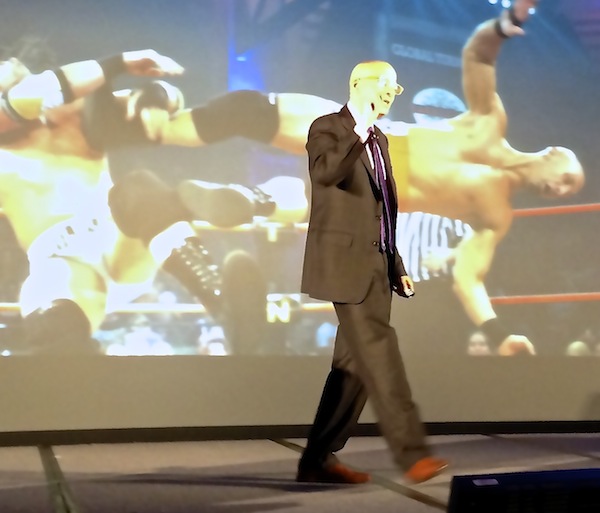
Seth Godin on Blogging, Radio and Stuff

seth600

The company I worked for for 29 years, Learfield, brought four or five hundred employees and friends to Dallas last week to celebrate the company’s 40th anniversary. We had two speakers: Ken Blanchard and Seth Godin. Following Mr. Godin’s excellent talk, he took questions.

How important is your blog?

“There’s two kinds of important. There’s the important of ‘can I make a living doing this,’ and the important of ‘this is who I am.’ My blog has nothing to do with me making a living. I don’t run any ads on it and I don’t sell many things on it, almost nothing, and that’s not why I do it and why I’ve been doing it for ten years. I do it because this is my chance to speak the thing I want to say, to talk about what I notice. If I had to pay money to write my blog, I would. The people who have blogs you don’t want to read are doing that blog because it’s their job. So I spend more time on my blog than almost anything I do because it’s my chance to do my art, as I see my art. […] The people who say ‘how am I going to get paid for this tomorrow?’ never make good stuff.”

“My blog is read by more people than all but ten magazines in the United States. And I write the whole thing by myself, every day. I don’t expect to stop blogging any time in the next 40 years.”

What do you see as the future of radio?

“Radio means two things. Radio means audio delivered to masses of people who want to hear it, and it means FCC coveted spectrum. Spectrum is over. For sure. We’re only two years away from cars having radio in them that has wifi. Once that happens, my radio, in my car isn’t going to have ten channels or a hundred channels, it’s going to have ten thousand channels, a hundred thousand channels. When there’s a hundred thousand radio stations to choose from, I’m not going to pick the local jock who’s yelling at me because he needsw his Arbitron ratings to go up a tenth of a point, I’m going to pick someone who cares. Radio connects us if it chooses to.”

And here are some of my notes from Mr. Godin’s remarks: Continue reading →

William Gibson, NY Public Library

William Gibson is the author of ten books, including, most recently, the New York Times-bestselling trilogy Zero History, Spook Country and Pattern Recognition. Gibson’s 1984 debut novel, Neuromancer, was the first novel to win the three top science fiction prizes—the Hugo Award, the Nebula Award, and the Philip K. Dick Memorial Award. Gibson is credited with coining the term “cyberspace” in his short story “Burning Chrome,” and with popularizing the concept of the Internet while it was still largely unknown. He is also a co-author of the novel The Difference Engine, written with Bruce Sterling.

Me with two really smart guys

Steve-Seth-Pepper

Pepper Bullock calls himself a “Change-Agent.” He has been advising senior management at Learfield (where I once worked) for years and I’ve gotten to know him a little. A really smart guy who happens to be really nice. That’s him on the right.

I was a little shy about getting my photo made with Seth Godin so Pepper dragged me up for this photo. (Thanks to Alan Blake for sending this along so promptly. He was one of the photographers at this event. A really nice guy, in addition to be a very good photographer.)