
Struggling and Hungry

I’ve really never been either so I’m talking about something here with which I have no first-hand experience. No points to make here, just thinking out loud.

In the last week I have seen three men, standing at intersections, holding cardboard signs that read: Struggling and Hungry. Two of these were in Columbia, MO (within a quarter mile of each other) and the third here in Jefferson City, MO. I’ll come back to the signs in a minute.

First, what do we call what these men were doing? “Begging” seems demeaning but “panhandling” seems euphemistic. “Homeless” seems to be the accepted term but we don’t know if the person has a home or not. But let’s go with homeless.

Second question: On what basis does someone decide to give/not give money to a homeless person? Physical appearance? Do they look hungry? Something in their expression or dress? Their body language? Do they have a dog? The answer is different for everyone of course and can change from encounter to encounter.

Is a homeless person aware of such considerations? Do they smile and make eye contact with motorists or have they found that to be a turn-off? Or a positive? Did they consciously bring their dog because they know dog lovers will be moved by the sight of the pooch? Have they learned that walking down the line of cars at a stop light can appear “pushy?”

Or perhaps by the time someone finds themselves on the side of highway holding a sign such calculations have given way to desperation. The answer is probably “all of the above.” Some are undoubtedly lazy and could get a job and some are at the end of their rope.

Back to the signs.

Do some signs work better than others? Would clean, printed sign say this person is just looking for a hand-out, while a ragged piece of cardboard with a scrawled plea touch a heart? And what about the “Struggling and Hungry” wording? Just coincidence? Or did someone discover (trial and error?) that phrase worked better than “Please help?” And is there any communication between sign-makers? Standing in line at McD’s perhaps? Do the homeless have smartphones and would that automatically kill a generous impulse? Should it?

I usually give if I can do so without endangering the person by making them dash between cars to get to my lane. And, yes, I usually give if there’s a dog (“Buy some food for the pup”). And I’m turned off when I see two people working an intersection. Do they see this a boring job and it’s better to have a pal to pass the time?
Undoing the monster TV created

“I wonder if TV will now help us undo the damage they unwittingly begat. Perhaps by having a Trump-like character get what’s coming to him. Put him in Archie Bunker’s chair, and see what happens.” — Dave Winer

Hard for me to imagine Aaron Sorkin isn’t hammering away on his MacBook at this moment. I’ve been thinking in terms of a tell-all book or movie (Primary Colors, Game Change, etc) but a TV series would have a longer life span. Gotta be HBO or Netflix or Amazon to properly portray the monster. Stay tuned.

Homo Deus: A Brief History of Tomorrow

The new book by Yuval Noah Harari (Homo Deus -A Brief History of Tomorrow (Yuval Noah Harari-PDF) sounds like just what I need.

“For the first time ever, more people die from eating too much than from eating too little; more people die from old age than from infectious diseases; and more people commit suicide than are killed by soldiers, terrorists and criminals put together. The average American is a thousand times more likely to die from binging at McDonalds than from being blown up by Al Qaeda.” Amazon

Mr. (Doctor?) Harari wrote the bestseller Sapiens: A Brief History of Humankind


From a brief interview (WIRED) interview with the author:

Dataism is a new ethical system that says, yes, humans were special and important because up until now they were the most sophisticated data processing system in the universe, but this is no longer the case. The tipping point is when you have an external algorithm that understands you—your feelings, emotions, choices, desires—better than you understand them yourself. That’s the point when there is the switch from amplifying humans to making them redundant.

Will tech companies become our new rulers, even gods?

When you talk about God and religion, in the end it’s all a question of authority. What is the highest source of authority that you turn to when you have a problem in your life? A thousand years ago you’d turn to the church. Today, we expect algorithms to provide us with the answer—who to date, where to live, how to deal with an economic problem. So more and more authority is shifting to these (technology) corporations.

Chris Stevens KBHR 570 AM (Northern Exposure)

Northern Exposure is an American comedy-drama television series that ran on CBS from 1990 to 1995. My favorite character was Chris Stevens (played by John Corbett). “A philosophical ex-convict who works as the disc jockey at KBHR 570 AM. Between songs, Chris offers comments on events in Cicely and on more intellectual and controversial subjects.”

The Chris character was the DJ we all wanted to be. Okay, “I” wanted to be. Fortunately, I was smart enough to know I couldn’t pull off those long, zen monologues without John Corbett’s wonderful voice and delivery, and a room full of writers. There are a few “Chris Stevens tribute videos” on YouTube that painfully illustrate the folly of those who tried.


My buddy Bob Hague (also a radio guy) told me of an acquaintance that “went bonkers” because Chris never wore headphones in the series.

My father was a Radio Operator (?) in the Navy during WWII. Based on the little he told me of that experience, it was Morse Code rather than than voice transmission. After the war he went to watchmaker school until he figured out he could get paid (GI Bill) to go to the Pathfinder School of Broadcasting (Kansas City).

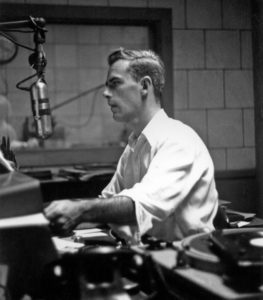
I recall him saying the the “announcers” didn’t wear headphones because they were in one studio and the engineers (who did wear ‘phones, suppose) were in another. I believe this was common and the reason you’d see announcers from that era cupping a hand behind one hear (holding copy in the other) in order to better hear the golden sound of their voice.

When pop got hired at the little station in Kennett, MO, he was shocked to learned he’d have to “run his own board” and that necessitated wear phones. But I remember (as a child) seeing him or one of the other announcers being on the air without headphones.